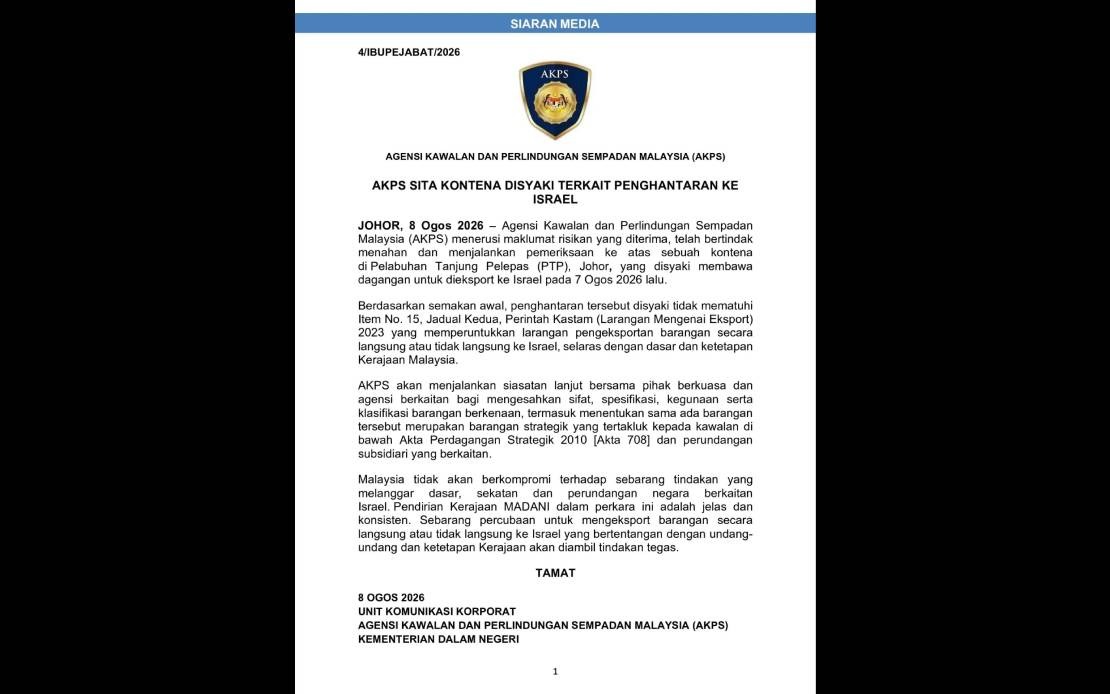
Malaysia's customs authorities have seized a container at the Port of Tanjung Pelepas in Johor suspected of carrying strategic goods destined for Israel, a move that Prime Minister Datuk Seri Anwar Ibrahim has characterised as demonstrating the nation's unwavering commitment to preventing its territory from facilitating trade that could bolster Israeli interests. The interdiction came through swift action by the Malaysian Border Control and Protection Agency (AKPS), which detained and inspected the shipment after identifying it as a potential violation of Malaysia's trade prohibitions with the Jewish state.
Anwar's public commendation of the agency underscores how Malaysia's government continues to leverage trade enforcement as a tangible expression of its foreign policy principles. Rather than treating the seizure as a routine customs matter, the Prime Minister elevated it to a statement of national values, positioning Malaysia among nations actively using economic mechanisms to signal disapproval of Israeli policies. This approach reflects a broader regional dynamic where Southeast Asian governments increasingly weaponise trade restrictions as a form of soft power, demonstrating responsiveness to domestic and regional sentiment regarding the Palestinian cause without overt military or diplomatic escalation.
The interdicted shipment violated Item No. 15 of the Second Schedule of the Customs (Prohibition of Exports) Order 2023, which explicitly forbids direct or indirect export of goods to Israel. This regulatory framework, grounded in Malaysian government policy directives, provides customs authorities with the legal machinery to enforce what amounts to a selective embargo. The inclusion of language prohibiting indirect exports is particularly significant, as it demonstrates Malaysia's intention to close loopholes whereby goods might transit through third parties or transshipment hubs to ultimately reach Israeli destinations.
Anwar situated this enforcement action within Malaysia's alignment with The Hague Group, a coalition of nations advocating stricter international protocols regarding Israeli practices. This reference connects Malaysia's unilateral trade restrictions to a broader multilateral framework, lending legitimacy to restrictions that some trading partners might otherwise challenge as discriminatory or protectionist. By invoking international legal solidarity, Malaysia positions itself not as pursuing isolated nationalism but as participating in a coordinated global response to alleged violations of humanitarian law.
The Prime Minister also reiterated Malaysia's pre-existing ban on Israeli vessels and cargo-carrying ships from utilising Malaysian ports, a prohibition that entered force in December 2023. This maritime restriction operates in parallel with the goods export prohibition, creating a multi-layered regime that simultaneously blocks both direct trade relationships and indirect logistical support. The dual-track approach demonstrates how Malaysia has constructed what amounts to comprehensive economic isolation of Israeli interests, affecting both goods and transportation modes.
For Malaysian policymakers, maintaining these restrictions requires navigating complex international trade relationships. Malaysia participates in multiple regional and bilateral trade frameworks that theoretically bind it to non-discriminatory commercial practices. Yet the government has determined that its commitment to Palestinian solidarity supersedes conventional trade liberalisation commitments, suggesting that Malaysia views the Israeli-Palestinian conflict as a matter of sufficient importance to justify departing from standard commercial norms.
The seizure also reflects Malaysia's domestic political economy, where Palestinian rights command broad public support across different demographic and religious communities. By publicly celebrating the AKPS action, Anwar reinforces the perception that his administration maintains consistency between rhetoric and enforcement on this issue. Such alignment between stated principles and administrative action reinforces government legitimacy on issues commanding significant grassroots attention, particularly among Muslim-majority populations.
From a Southeast Asian perspective, Malaysia's enforcement of these restrictions contrasts with the approach of some neighbouring nations that maintain more pragmatic trade relationships with Israel while avoiding public endorsement of Israeli policies. Malaysia's approach reflects a particular political culture and historical narrative regarding imperialism, colonial legacies, and current geopolitical struggles. Whether other regional governments might adopt similar measures depends on domestic political pressures and calculations regarding the relationship between principle and economic interest.
The effectiveness of Malaysia's trade restrictions in influencing Israeli behaviour remains analytically uncertain. As a relatively modest trading partner compared to China, India, or the European Union, Malaysia's unilateral measures produce limited economic leverage. However, the symbolic significance may exceed material impact, particularly if Malaysia's actions encourage other developing nations to adopt comparable restrictions, potentially creating a cumulative effect that eventually constrains Israeli commerce more substantially.
Looking forward, the frequency of such seizures will likely indicate whether customs enforcement remains episodic or becomes routine practice. If AKPS develops systematic monitoring capabilities to detect Israel-bound shipments masquerading under false declarations or third-country registrations, Malaysia could substantially raise the compliance costs for traders attempting to circumvent the restrictions. This would require investment in intelligence-sharing with port authorities and maritime agencies, suggesting that Malaysia's commitment to enforcement extends beyond public statements.
The seizure also invites scrutiny regarding how Malaysia's restrictions interact with its own trade interests and export industries. Sectors dependent on complex international supply chains may face complications if counterparts view Malaysia's selective enforcement as establishing a problematic precedent. Malaysian exporters of electronics, petrochemicals, and other advanced products might encounter reciprocal restrictions or increased regulatory scrutiny in markets uncomfortable with Malaysia's trade practices.
Anwar's framing of the seizure as consistent with principles of humanity and justice rather than narrow political calculation attempts to elevate Malaysia's position beyond parochial interest. This rhetorical strategy resonates with audiences who view support for Palestinian rights as a fundamental humanitarian obligation transcending conventional strategic calculations. However, it also invites questions about whether Malaysia applies comparable intensity to other international humanitarian concerns receiving less domestic political salience.

