Higher education institutions across Malaysia are now equipped with structured frameworks to govern generative artificial intelligence use following the Ministry of Higher Education's introduction of comprehensive guidelines in 2024. The policy framework, developed centrally by MOHE, has enabled individual universities to fashion their own institutional protocols and standard operating procedures tailored to local contexts while maintaining consistency with national expectations. According to MOHE Deputy Minister Adam Adli Abdul Halim, this decentralised approach has created the necessary guardrails to prevent misuse without stifling innovation or the legitimate pedagogical applications of AI technology.
The guidelines represent a significant step in addressing the tension between embracing transformative technology and maintaining academic rigour. Since their implementation, universities have established transparent procedures for managing incidents where AI is misused, including designated response mechanisms and disciplinary frameworks that clearly specify consequences for violations. What distinguishes this approach from reactive policymaking is its emphasis on prevention through clarity rather than punishment through ambiguity. Students and academic staff now operate within defined parameters, understanding precisely where legitimate use ends and misconduct begins.
A cornerstone of the framework requires students to declare their use of generative AI in academic work, creating transparency that enables educators to assess the appropriateness and extent of AI integration. This declaration requirement functions as both an accountability mechanism and a teaching moment, compelling students to reflect on their methodological choices and the intellectual contributions they themselves must demonstrate. The policy carefully preserves the traditional scaffolding of academic integrity by mandating that students continue employing rigorous research practices and proper citation standards, treating AI as a tool within established scholarly conventions rather than as a shortcut to replace fundamental academic disciplines.
Deputy Minister Adam Adli emphasised that institutional consequences for breaching academic ethics standards remain substantial, extending to potential revocation of academic qualifications in serious cases. This escalating penalty structure signals institutional seriousness and underscores that the university's reputation and graduates' credentials depend on maintaining integrity standards. The threat of qualification revocation addresses the root concern that students might otherwise view academic misconduct as a low-risk proposition, particularly when AI generation of entire assignments becomes technically seamless.
While infractions continue to occur despite the guidelines, Malaysian universities now possess standardised, institution-wide approaches rather than ad hoc or inconsistent responses. This consistency matters particularly in a regional education market where qualifications travel across borders and employers rely on the certification's integrity. A student from Universiti Malaya should face equivalent standards as one from Universiti Kebangsaan Malaysia, ensuring that degree value remains uniform and trustworthy. The guidelines' effectiveness lies partly in their deterrent function but equally in establishing shared expectations that shape student behaviour proactively.
The ministry's position that technology should augment rather than replace academic discipline represents a philosophical stance with practical implications. In fields ranging from engineering to humanities, AI can assist with literature reviews, draft generation, code development, and problem-solving approaches. However, the core intellectual work—synthesising sources, making original arguments, demonstrating subject mastery, and developing critical thinking—must remain the student's responsibility. This distinction acknowledges that AI is neither inherently good nor bad within education; its value depends entirely on pedagogical purpose and implementation.
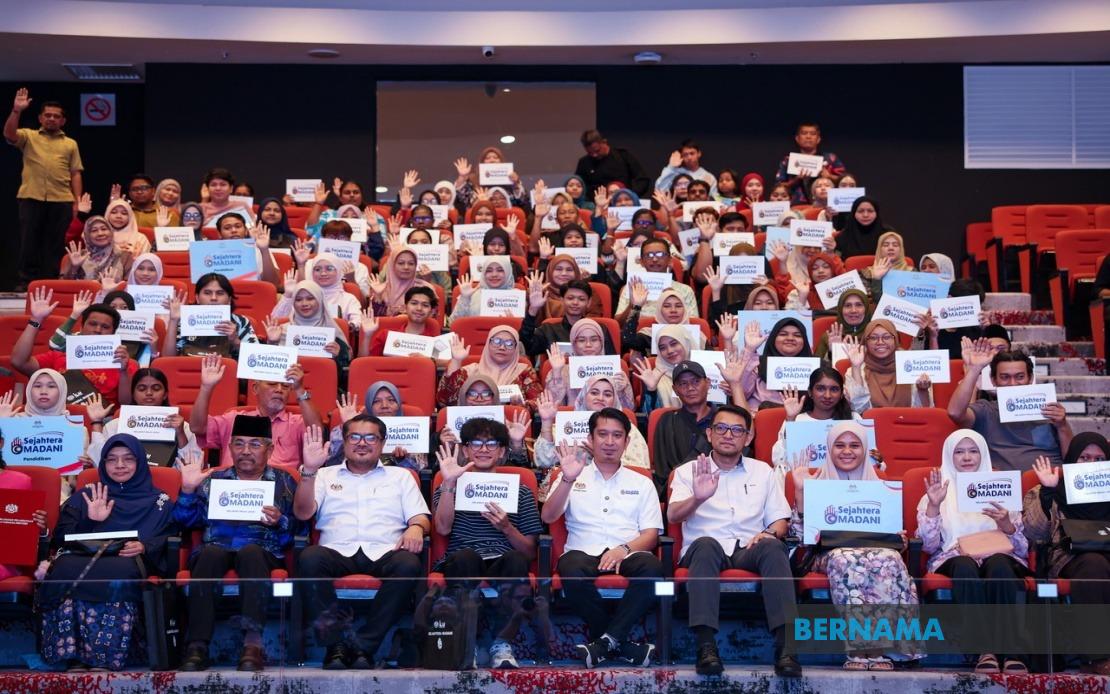
Beyond governance frameworks, MOHE simultaneously demonstrated commitment to student welfare through the Sejahtera MADANI initiative launched during the SPM Excellence Awards ceremony at Melaka International Trade Centre. Four standout SPM achievers received laptops, while one hundred university students from disadvantaged backgrounds in Melaka received Kasih SISWA tablets. This dual approach—establishing intellectual standards while ensuring equitable access to technology—reflects recognition that responsible AI governance must address not just misconduct prevention but also the digital divide that threatens to widen educational disparities.
The tablet distribution programme specifically targeted students from eKasih households who demonstrated academic excellence, effectively channelling technological resources toward those most likely to leverage them productively. Such targeted support matters in Southeast Asia's context, where internet connectivity and device ownership remain unevenly distributed across socioeconomic strata. By equipping promising students with tools, MOHE simultaneously demonstrates that technology access remains a development priority while establishing the institutional guardrails necessary to prevent technology from undermining educational quality.
For Malaysian employers and regional labour markets, these guidelines carry practical significance. As universities enforce clearer AI use standards, degree holders can credibly demonstrate foundational competencies despite graduating in the AI era. Engineering graduates have genuinely solved design problems, business graduates have conducted actual market analysis, and humanities graduates have formulated original arguments—not merely prompted machines to generate plausible-sounding responses. This credential integrity protects both individual graduates and Malaysian institutions' regional standing as educational hubs.
The rollout also positions Malaysia within broader global conversations about AI governance in higher education. While other nations grapple with whether to restrict, regulate, or embrace generative AI in universities, Malaysia has adopted a pragmatic middle path: enabling technology use while establishing clear ethical and procedural boundaries. This approach acknowledges that AI literacy and familiarity will characterise the workforce of 2030, making exposure to these tools educationally essential, yet recognises that learning itself requires intellectual struggle that machines cannot substitute.
Looking forward, the effectiveness of these guidelines depends partly on consistent enforcement and partly on ongoing refinement as AI capabilities evolve. The framework established in 2024 will require periodic reassessment as technologies advance and new misuse patterns emerge. Universities must maintain institutional capacity for both enforcement and innovation, ensuring that guidelines remain neither so restrictive that they prevent beneficial AI applications nor so permissive that they enable widespread misconduct. The next phase of implementation will reveal whether Malaysian higher education can maintain this equilibrium.
Furthermore, the guidelines' success rests on academic staff capability and willingness to adapt assessment methods. Educators must redesign assignments and examinations to evaluate learning outcomes that AI cannot trivially replicate—critical analysis, original synthesis, contextual judgment, and disciplinary reasoning. This shift requires faculty development, resource investment, and time. Universities implementing surface-level compliance without fundamental pedagogical adaptation risk creating guidelines that exist on paper while misconduct flourishes through undetected circumvention. The true test of Malaysia's approach lies in whether institutions embrace the philosophical challenge of education in the AI age rather than merely administering compliance mechanics.

