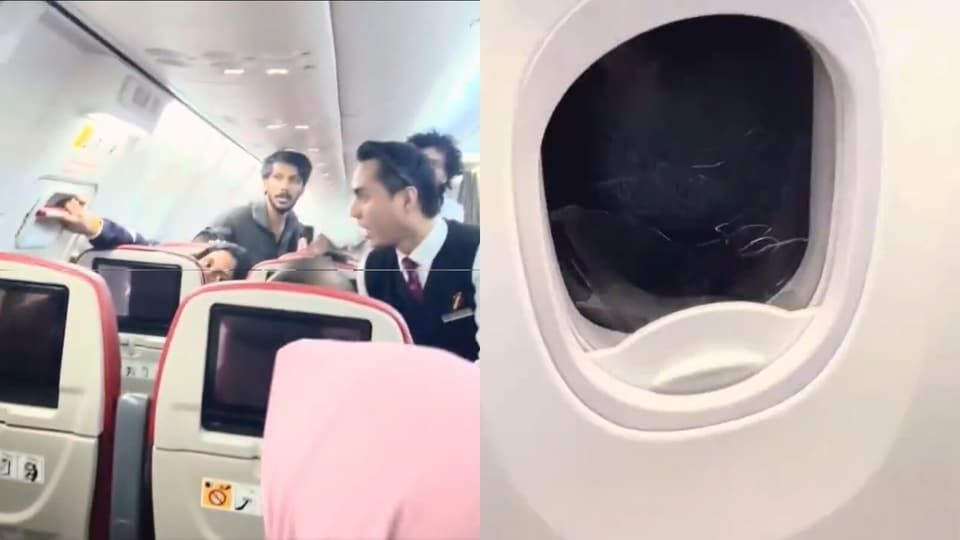
A 36-year-old man identified as Jamsheer Athanikkal was arrested following an alarming mid-air incident aboard a Batik Air flight travelling from Kuala Lumpur to Kochi late Wednesday night. The passenger, originally from Palakkad and currently residing in Sreemoolanagaram, attempted to open the emergency exit on the Boeing 737 aircraft, setting off panic throughout the cabin before quick intervention by fellow travellers and crew members prevented what could have been a catastrophic outcome. Kerala Police took him into custody upon the flight's arrival early Thursday morning, initiating what authorities say is a detailed investigation into the bizarre and dangerous occurrence.
According to the First Information Report filed by Batik Air's security personnel at Kochi airport, the disturbing sequence of events unfolded between 9:30 pm and 11:05 pm while the aircraft was cruising at altitude. Jamsheer allegedly used his foot to damage the emergency exit's inner window panel and subsequently attempted to force the door itself open. His actions extended beyond the physical assault on aircraft systems; authorities report that he also threatened and intimidated fellow passengers as well as members of the cabin crew, creating an atmosphere of genuine fear and confusion among those on board.
The gravity of the situation was considerably mitigated by the swift response of other passengers seated nearby and trained cabin crew members, who managed to restrain Jamsheer before the situation could spiral further out of control. One witness, fellow passenger Matty Mathew, documented the harrowing experience and later shared details on social media accompanied by video footage. According to Mathew's account, most travellers were sleeping on the overnight service when they were suddenly jolted awake by the sound of air rushing forcefully through the cabin as the passenger in the emergency row broke through the window and interfered with the door mechanism.
The aircraft's engineering proved to be a critical safety factor in averting tragedy. The door remained sealed throughout the ordeal because of the fundamental design principles governing modern aircraft and the pressurised cabin environment maintained at cruise altitude. Jamsheer's actions, while reckless and dangerous, were ultimately unable to compromise the structural integrity or safety systems of the aircraft. Nevertheless, Mathew's subsequent social media reflection captured the psychological toll of the incident: "It was an extremely frightening experience, but thankfully, all of us are safe," he wrote, expressing relief that no physical harm came to any passenger or crew member.
The legal consequences facing Jamsheer are substantial. Police have registered multiple charges against him under Indian aviation and criminal law frameworks. He faces charges under Section 351(3) of the Bharatiya Nyaya Sanhita for criminal intimidation, a serious provision addressing threatening behaviour towards others. Additionally, authorities invoked Section 11A of the Aircraft Act, which specifically addresses violations of safety and security directives aboard aircraft—a provision designed to protect the flying public and maintain order in commercial aviation environments. A third charge was added under Section 118(e) of the Kerala Police Act for acts deemed to endanger public safety, reflecting the serious nature of his conduct.
This incident occurs within a broader context of aviation safety concerns in South Asian skies. Just two days prior, an Air India flight operating from Phuket, Thailand to Delhi experienced a separate and unrelated crisis when the aircraft suddenly lost altitude during cruise operations on Tuesday. Air India flight AI2379 was carrying 137 passengers and eight crew members when the incident occurred, but the flight successfully landed in Delhi despite the harrowing experience. The unexpected altitude loss prompted immediate medical intervention for those aboard, with 13 passengers and four crew members requiring hospital admission for treatment following arrival.
The Air India incident raised questions about aircraft maintenance and operational oversight. Flight tracking service Flightradar24 identified the aircraft involved as a seven-year-old Airbus, suggesting the aircraft itself was not of extreme age or novelty. Air India subsequently informed all relevant aviation regulators about the occurrence and stated it was cooperating fully with ongoing investigations while also notifying the aircraft manufacturer, Airbus, of the incident. The airline's response protocol demonstrated standard industry practice for serious incidents, though the exact cause of the altitude loss remained under investigation.
The back-to-back incidents highlight the multi-faceted challenges facing aviation safety in the region. While the Kuala Lumpur-Kochi incident involved human behaviour and breach of security protocols, the Air India occurrence points to potential mechanical or operational issues. Both scenarios, despite their different origins, underscore the critical importance of well-trained crew members, robust aircraft engineering, and passenger compliance with safety regulations. The swift crew response in the Batik Air case and the successful emergency landing of the Air India flight both demonstrate that contemporary aviation safety systems, when functioning properly, can effectively manage crises.
For Malaysian readers and regional travellers, these consecutive incidents serve as important reminders about the unpredictability of air travel and the essential role of aviation safety protocols. The Batik Air incident demonstrates that even seemingly secure systems like emergency exits are protected by multiple layers of engineering redundancy, offering reassurance that aircraft are designed with catastrophic failure scenarios in mind. Nevertheless, the incidents underscore the necessity of maintaining vigilance regarding passenger behaviour and crew training, particularly on regional routes that connect Southeast Asia with the Indian subcontinent.
Air India reiterated that passenger and crew safety remains its "foremost priority" following the Tuesday incident, committing to continued support for affected passengers and crew members as investigations progressed. The airline's statement reflected industry-standard crisis management protocols, though the specific causes of both incidents remained subjects of ongoing official inquiry. These occurrences, while statistically rare relative to the millions of flights conducted annually across Asia, nonetheless captured public attention and raised awareness about aviation safety considerations among regular air travellers in the region.

