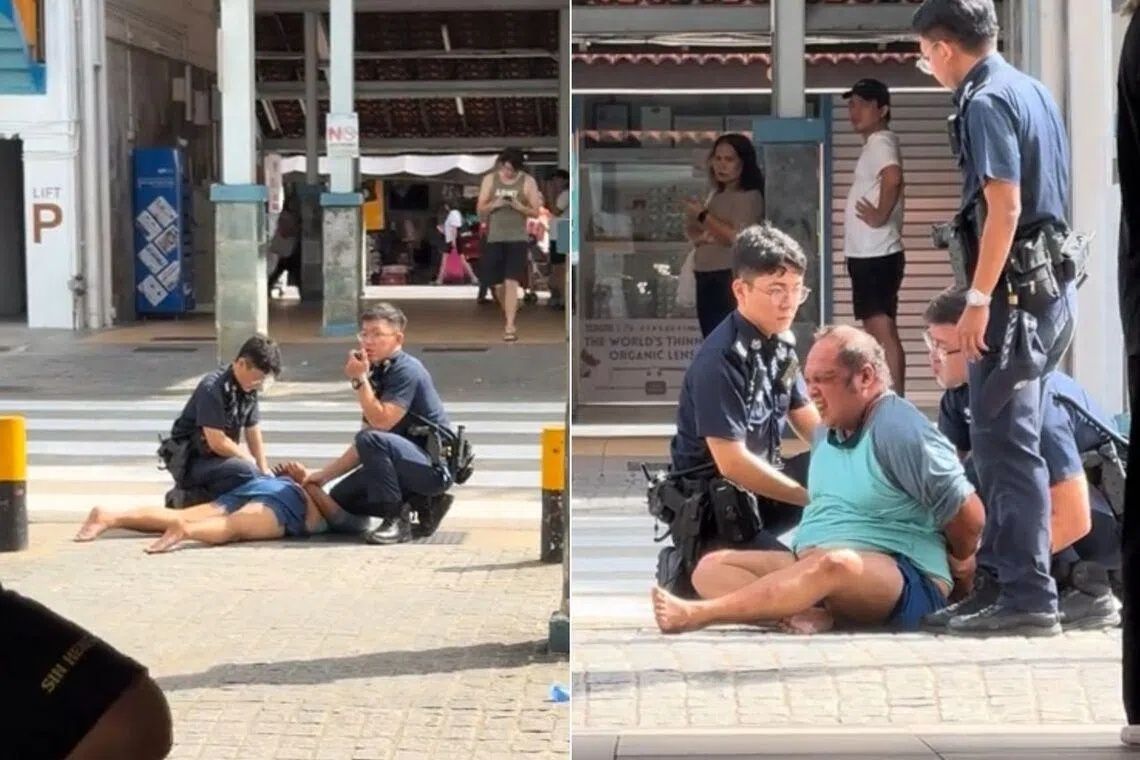
A 36-year-old man has been taken into custody by Singapore police following an incident in the Toa Payoh district where he engaged in indecent behaviour and physically attacked an officer responding to reports of disruptive conduct. The arrest occurred on Sunday morning at Block 184 Toa Payoh Central after authorities received a disturbance call at approximately 9.45am from a coffee shop in the area.
The incident unfolded when police responded to complaints about the man's behaviour at the establishment. During the process of apprehending the suspect, the situation escalated when he struck a police officer directly in the face. The assault on the uniformed officer represented a significant escalation from the initial reports of public misconduct, transforming what began as a response to disruptive behaviour into a case involving violence against law enforcement personnel.
Social media footage documenting the scene has circulated widely online, with videos uploaded by TikTok user Kee Wee Shang providing eyewitness perspectives of the police response. The recordings show multiple officers engaged in the apprehension, with two constables visible restraining the barefooted suspect on the ground during the initial phases of the arrest. Additional footage captures a third officer present at the scene as the handcuffed detainee is subsequently escorted away by the responding team.
The formal charges levelled against the 36-year-old encompass two distinct offences. The man faces allegations of committing an obscene act in public, which relates to the initial disturbance reported at the coffee shop. Additionally, he has been charged with voluntarily causing hurt to a public servant with intent to deter that officer from performing official duties. These charges reflect both the nature of the original complaint and the subsequent assault on police personnel.
A 19-year-old police officer suffered physical injuries during the confrontation, though medical assessment determined the harm to be minor in nature. The injured officer was transported to hospital for treatment while remaining conscious, indicating the assault, while significant enough to warrant hospitalisation, did not result in severe trauma. The officer's relatively young age highlights the exposure that junior police personnel face when responding to public disturbances and uncooperative individuals.
The incident underscores ongoing challenges faced by law enforcement agencies in managing public order situations, particularly in densely populated urban precincts like Toa Payoh. Such encounters, where individuals resist arrest and physically confront police, place responding officers in positions of considerable personal risk. For Malaysian observers, the incident illustrates the common nature of such conflicts across the region, where mental health crises, substance abuse, or personal disturbance can escalate rapidly when law enforcement intervention becomes necessary.
Singapore's police force has maintained a policy of transparent communication regarding incidents involving officers and the public. The formal media statement issued by the Singapore Police Force demonstrates adherence to public accountability protocols, ensuring that details of both the alleged misconduct and the police response are disclosed to the media and public. This transparency contrasts with varying approaches to such incidents across different Southeast Asian jurisdictions.
The investigation into the matter remains active, with police authorities continuing to gather evidence and assess the circumstances surrounding both the initial obscene conduct and the assault. Investigators will likely examine the social media footage as corroborating evidence and conduct interviews with witnesses present at the coffee shop. The thoroughness of the investigative process will inform subsequent prosecution decisions and potential court proceedings.
For the broader Southeast Asian region, including Malaysia, such incidents carry implications regarding police training, de-escalation techniques, and the management of individuals experiencing mental health crises or behavioural disturbances. The response demonstrated by the Singapore force reflects established protocols for managing resistant individuals, though the successful restraint and apprehension without more severe injury suggests training and coordination among responding officers functioned effectively despite the physical confrontation. These operational aspects are relevant for regional law enforcement agencies developing or refining their own protocols for similar situations.
The case also reflects growing documentation of police incidents through personal mobile devices and social media platforms, which has become increasingly prevalent across Asia. Citizen recordings now serve as contemporaneous evidence in many cases, providing alternative perspectives to official accounts and contributing to public discourse regarding law enforcement conduct and appropriateness of police response measures. This democratisation of incident documentation influences how agencies must approach transparency and public relations in the modern media environment.

