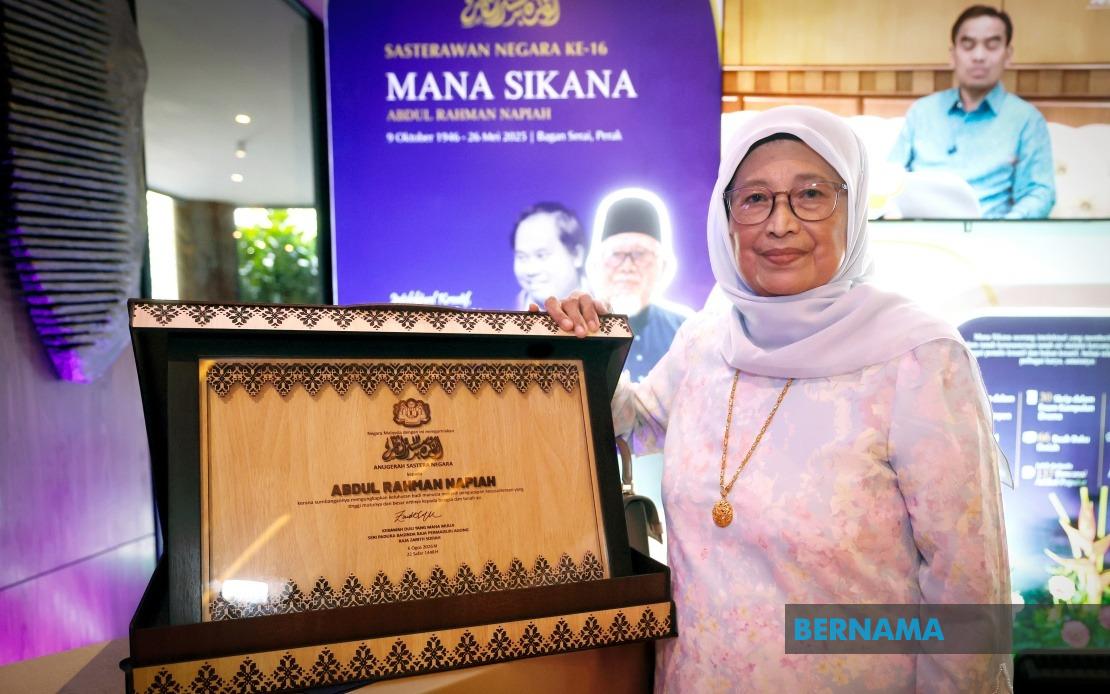
Malaysia has bestowed its highest literary honour on the late Dr Abdul Rahman Napiah, known professionally as Mana Sikana, naming him the 16th National Laureate in recognition of his profound impact on the nation's literary landscape. The award, presented by Her Majesty Raja Zarith Sofia, Queen of Malaysia, was received by his widow Salmah Ali at a ceremony in Kuala Lumpur, underscoring the enduring significance of a body of work that spanned more than five decades. Education Minister Fadhlina Sidek attended the proceedings, emphasising how Mana Sikana's selection reflected the depth of his contributions through creative writing, literary theory, criticism and academic engagement across multiple institutions and borders.
Salmah Ali, now 82, accepted the award with a mixture of emotions, proud of the recognition yet visibly moved by her husband's absence. She revealed that Mana Sikana had harboured hopes of receiving this particular honour before his death in May at the age of 80 from heart complications. In a poignant detail, she recounted that he had been informed of the possibility of the award before his passing, and that on the very day he fell ill, he had been actively engaged in presenting scholarly work at Dewan Bahasa dan Pustaka, an institution central to Malaysia's literary and linguistic development. This detail underscores how fully integrated literary work remained in his daily existence until the final moments.
The trajectory of Mana Sikana's career reflects the breadth of influence he wielded across multiple platforms and formats. Born in Bagan Serai, Perak, on 9 October 1946, he initially worked as a schoolteacher before transitioning into higher education. His versatility became evident through his simultaneous pursuits in different media—while based in Johor Bahru, he produced dramatic works for both Singaporean and Malaysian radio and television, demonstrating how literary creativity could extend beyond the printed page. This multimedia approach was unusual for his generation, showing an understanding that literary influence could permeate popular entertainment while maintaining artistic integrity. His teaching commitments never wavered even as these creative projects flourished, indicating a deliberate choice to educate while creating.
Mana Sikana's academic credentials became increasingly prominent as his career evolved. He pursued advanced studies at Universiti Kebangsaan Malaysia (UKM), eventually attaining the rank of professor—a distinction that reflected both his scholarly depth and institutional recognition of his contributions to Malaysian letters. Beyond Malaysia, his influence extended across Southeast Asia through visiting lectureships at Indonesian universities, positioning him as a regional intellectual figure rather than merely a domestic one. This transnational dimension of his work has particular resonance for Malaysia, a country with deep cultural and linguistic ties throughout the region. His ability to maintain scholarly rigour while producing works accessible to general audiences through television and radio distinguished him from academics who operate solely within institutional silos.
The awards and recognition began accumulating from Mana Sikana's school days, suggesting an early trajectory toward literary distinction that never substantially deviated. Throughout his life, he remained a consistent recipient of literary accolades, each one marking incremental recognition of his contributions. Yet for someone of his stature, the National Laureate designation—Malaysia's premier literary honour—had remained elusive until now, making its posthumous conferment particularly significant. Salmah's testimony that her husband had genuinely wanted this recognition suggests that despite his numerous achievements, this specific honour held particular meaning for him, perhaps as validation from the highest institutional level of his nation.
What emerges from Salmah's account is a portrait of an intellectual life fully integrated with family life. Mana Sikana shared his knowledge and passion for writing and literature not only with students and academic colleagues, but deliberately with his four children and twelve grandchildren throughout his life. This transmission of literary values within a family context created an extended intellectual lineage, suggesting that his influence extends beyond published works and academic papers into the formation of subsequent generations who witnessed and absorbed his commitment to language, storytelling and critical thinking. In Malaysian society, where family structures remain central, this intergenerational transmission of cultural values carries particular weight.
Fadhlina Sidek's official remarks positioned Mana Sikana's selection as recognition of his role in strengthening national literature through multiple dimensions of engagement—creative writing, literary theory, criticism and academic discourse. This formulation acknowledges that his significance lay not simply in producing literary works, but in the intellectual frameworks through which literature could be understood and critiqued. By honouring someone who engaged in literary theory and criticism alongside creative production, the National Laureate award recognises a more complex vision of literary contribution than mere authorship. This emphasis on theoretical rigour reflects Malaysia's need to develop critical literary traditions that can sustain local writing traditions intellectually.
The timing of this recognition, coming after Mana Sikana's death, raises broader questions about how societies acknowledge their intellectual figures. Posthumous honours inevitably carry a bittersweet dimension—validation arrived too late for the honoured individual to fully experience it. Yet they serve important functions in anchoring national memory and establishing canonical significance for future generations. By naming Mana Sikana the 16th National Laureate, Malaysia formally positions him among the nation's most essential literary voices, a designation that will shape how his work is taught, studied and remembered in schools and universities. For readers and scholars, the designation provides an official stamp of significance that may drive renewed engagement with texts that might otherwise remain overlooked.
For Malaysian literature more broadly, the Mana Sikana laureate honour signals commitment to recognising figures who worked across multiple registers—as teachers, as critical theorists, as creative practitioners and as regional contributors. His refusal to choose a single pathway, instead pursuing excellence simultaneously in academia, creative writing, broadcasting and family intellectual life, represents a model of intellectual engagement increasingly rare in contemporary specialised environments. The recognition of such a multifaceted career suggests that Malaysian literary institutions value breadth of contribution and cross-pollination of ideas across different platforms and audiences.
Salmah Ali's presence at the ceremony, accepting on behalf of her absent husband, embodied the bittersweet nature of the honour. Her testimony that Mana Sikana had been planning to present scholarly work on the day he fell fatally ill captured something essential about his character—a person for whom literary and intellectual engagement constituted not a career but a way of life. The National Laureate designation now stands as Malaysia's formal recognition of that commitment, even as it arrives in a form the honoured individual cannot personally receive.

