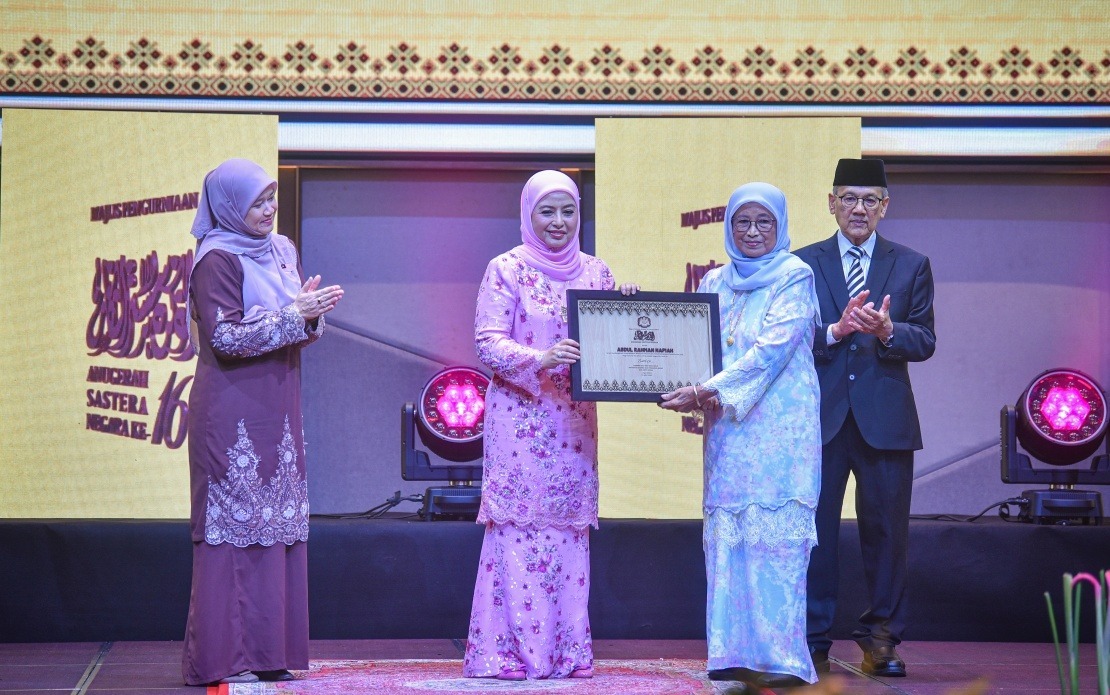
The Malaysian government has conferred its most prestigious literary honour upon Dr Abdul Rahman Napiah, better known to readers and scholars by his pen name Mana Sikana, recognising his profound and enduring contributions to the nation's literary landscape. The posthumous conferment took place at the 16th National Literary Award ceremony in Kuala Lumpur on August 6, with Her Majesty Raja Zarith Sofia, Queen of Malaysia, presenting the accolade to Mana Sikana's widow, Salmah Ali. The National Laureate designation represents the government's highest recognition for writers whose body of work has demonstrated exceptional sustained achievement and meaningful influence on Malaysian letters.
Mana Sikana's extensive catalogue of more than 100 publications across diverse genres established him as one of the country's most prolific and intellectually rigorous literary figures. Education Minister Fadhlina Sidek, who chaired the award selection panel, emphasised that his creative output transcended mere entertainment or artistic expression—his work functioned as a vehicle for cultivating awareness among readers, deepening empathy across different communities, and facilitating genuine cultural dialogue. Through his novels, essays, criticism and other written forms, Mana Sikana offered Malaysian audiences sophisticated analytical frameworks for understanding the country's complex multicultural society, mining the nation's social fabric for universal human truths that resonated across ethnic and religious boundaries.
The late author's intellectual reach extended well beyond the page itself. His influence proved particularly transformative in three interconnected dimensions of literary development: he expanded the technical and stylistic possibilities available to Malaysian creative writers, challenging conventions and introducing new methodologies that encouraged innovation; he promoted rigorous critical and theoretical thinking within literary works themselves, elevating discourse beyond surface-level narrative to encompass deeper philosophical inquiry; and through decades of university teaching, academic publishing, and mentorship, he cultivated successive generations of writers, literary scholars, researchers and cultural critics who would themselves shape Malaysian intellectual life. This three-pronged contribution—creative achievement, critical innovation, and institutional influence—distinguishes him among his contemporaries.
Born in Bagan Serai, Perak, on October 9, 1946, Mana Sikana's career trajectory reflected the interconnected nature of literary creation and academic knowledge production. He initially worked as a classroom teacher before transitioning into higher education, where he held positions at several prestigious institutions including Universiti Kebangsaan Malaysia (UKM), Singapore's Nanyang Technological University, and Universiti Pendidikan Sultan Idris (UPSI). He completed his doctoral research at UKM, anchoring his scholarly credentials in rigorous training. This dual commitment to both creative writing and academic rigour distinguished his approach, allowing him to move fluidly between imaginative composition and theoretical analysis in ways that enriched both domains.
Throughout his professional lifetime, Mana Sikana accumulated numerous accolades acknowledging his literary standing. He received the Malaysian Literary Prize, recognition as recipient of the Malaysian Perdana Literary Prize, designation as Perak Laureate, and ultimately the Darul Ridzuan Lifetime Literary Achievement Award. These successive honours documented the steady accumulation of respect across the literary establishment, from peer recognition through critical assessment to formal state acknowledgement. Yet the National Laureate appointment represents the ultimate institutional validation, placing him within an elite circle spanning Malaysia's contemporary literary history.
The National Laureate designation carries substantial material recognition alongside its symbolic prestige. Mana Sikana's estate receives a national letter of honour, a monetary award of RM60,000, and a publishing allocation enabling the production and distribution of up to 50,000 books or an equivalent value of RM500,000. This provision proves particularly significant: the Malaysian government will systematically acquire and distribute selected works throughout the nation's educational and institutional infrastructure—schools, public libraries, government departments and agencies—ensuring that Mana Sikana's literary legacy reaches readers across the country in coming years. Such distribution mechanisms represent a tangible state commitment to preserving and promoting his intellectual contributions beyond academic circles.
Mana Sikana passed away in May 2025 at the age of 80, with his death resulting from cardiovascular complications. The timing of the National Laureate conferment, arriving as a posthumous recognition, speaks to both the careful deliberative process characterising such selections and the Malaysian literary establishment's determination to ensure that extraordinary contributions receive appropriate formal acknowledgement even after an author's passing. For families and scholars, such posthumous honours validate the career-long dedication of writers whose full significance may only become evident with temporal distance.
For Malaysian literary culture, Mana Sikana's elevation to National Laureate status carries broader implications extending beyond individual biography. His recognition affirms the government's investment in supporting and celebrating serious literature as a cultural priority, particularly works that engage with Malaysia's social complexity and multicultural identity. In an era when reading habits shift and commercial publishing pressures intensify, the state's explicit endorsement of authors whose work prioritises artistic integrity and intellectual substance sends a powerful signal about cultural values. Mana Sikana's career—spanning creative innovation, scholarly rigour, and educational mentorship—represents a model of integrated intellectual contribution that transcends narrow specialisation.
The posthumous honour also invites reflection on how literary legacies develop and become consolidated within national memory. Mana Sikana's more than 100 published works, distributed through schools and libraries by government initiative, will introduce his writing to student readers encountering his texts for the first time. His theoretical contributions and critical interventions will remain available for academic researchers and literary scholars examining the development of Malaysian literary thought. The combination of creative and scholarly dimensions ensures multifaceted accessibility—younger readers may encounter his novels while literature students study his critical writings, and educators can utilise him as a case study in how individual writers shape national cultural discourse. This layered engagement across different audiences and intellectual contexts exemplifies how National Laureate designation transcends ceremonial recognition to become an active mechanism for cultural transmission and institutional memory-building across generations.

