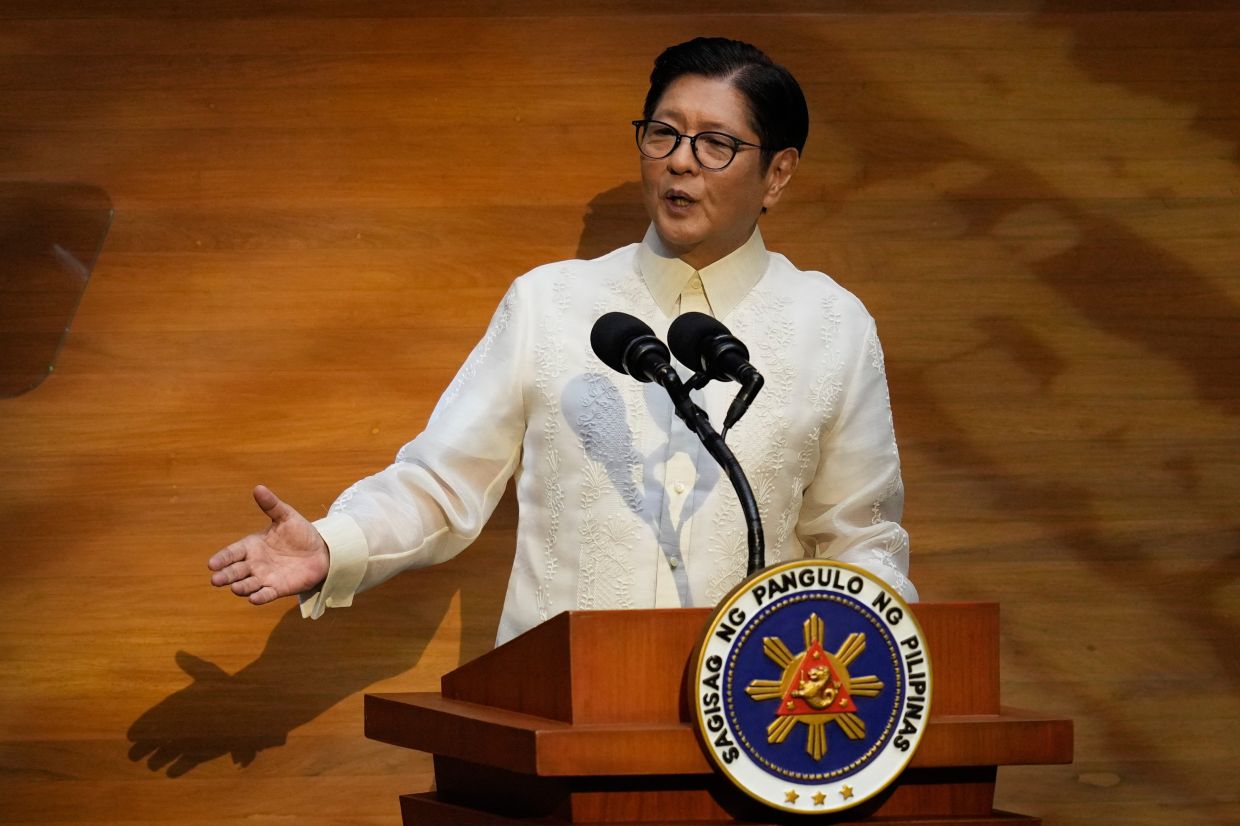
Philippine President Ferdinand Marcos Jr. used his annual state of the nation address to mount a forceful defence of his country's legal victory against China's expansive maritime claims, delivering what amounted to a carefully calibrated diplomatic rebuke that drew loud applause from lawmakers but stopped short of direct confrontation. Speaking before Congress on Monday, Marcos reaffirmed the Philippines' commitment to upholding a 2016 international arbitration ruling that invalidated Beijing's sweeping territorial assertions across the disputed South China Sea, declaring that his government would employ every available peaceful and legal mechanism to preserve this achievement against any attempt—foreign or domestic—to erode it.
The presidential address came against the backdrop of heightened regional tensions and mounting frustration with Chinese conduct in shared waters. Just days earlier, Marcos had summoned Chinese Ambassador Jing Quan to his office following the release of controversial content by China Daily, a state-owned media publication, which featured AI-generated imagery portraying Filipinos as primates. The animations were ostensibly created to mock the Philippines' position on the arbitration ruling, but the racist nature of the content sparked immediate condemnation from Manila's government, which branded the depictions "dehumanizing" and demanded their removal. The incident underscored growing friction between the two countries and provided the immediate context for Marcos's carefully worded but unmistakable criticism.
While Marcos conspicuously avoided naming China directly during his parliamentary speech, the target of his displeasure was unmistakable to all observers. In language suffused with national pride and dignity, he declared that "of late, our very humanity has been called into question" before delivering a pointed affirmation of Filipino character. He insisted that Filipinos represent "a noble and a great race" that is neither greedy nor racist, neither dishonest nor prone to capitulation. These remarks functioned as both a response to the dehumanizing imagery and a broader assertion of Philippine sovereignty and self-determination in the face of external pressure—a message that resonated powerfully within the chamber and reflected deepening nationalist sentiment across Southeast Asia regarding Beijing's conduct in the region.
The 2016 arbitration ruling itself carries particular significance for the Philippines and the broader international legal order governing maritime disputes. The landmark decision, rendered by a tribunal established under the 1982 United Nations Convention on the Law of the Sea, determined that China's historical claims to vast stretches of the South China Sea lacked legal foundation under international law. Marcos characterized the ruling as a "definitive benchmark" for interpreting and applying the maritime convention, emphasizing its finality and binding nature. The Philippines had initiated the arbitration process in 2013 following a tense naval standoff between Philippine and Chinese vessels near Scarborough Shoal, an area contested by multiple claimants. Beijing, however, steadfastly refused to participate in the proceedings and has consistently dismissed the tribunal's findings as a "political farce disguised as a legal proceeding," maintaining that the award is "illegal, null and void."
Beijing's official response to Marcos's speech and the broader diplomatic tensions remained characteristically measured in tone while unyielding in substance. Chinese Foreign Ministry spokesperson Lin Jian addressed the China Daily controversy by distancing the government from the offensive content, stating that the publication's output "does not represent the official position." Yet Lin reiterated China's fundamental rejection of the arbitration process itself, reaffirming Beijing's position that the South China Sea ruling possesses no binding legal force. This bifurcated approach—appearing to disavow inflammatory rhetoric while maintaining uncompromising positions on the substantive territorial questions—reflects Beijing's strategy of managing international criticism while avoiding escalation that might trigger coordinated regional pushback.
The maritime disputes in the South China Sea have intensified notably in recent years, with increasingly frequent confrontations among Chinese, Philippine, and Vietnamese forces and commercial fishing fleets operating in contested waters. The strategic waterway remains one of the world's most critical trade corridors, carrying trillions of dollars in annual commerce and connecting major Asian economies. Beyond the three nations regularly engaged in direct friction, Malaysia, Brunei, and Taiwan also maintain territorial claims or strategic interests in the region. The persistent tensions create significant risks for regional stability and complicate efforts to establish clearer rules of engagement. Marcos's emphatic reaffirmation of the arbitration ruling signalled that Manila will not quietly abandon its legal position despite Chinese pressure, a stance that carries implications for the broader regional balance of power and the credibility of international maritime law.
Beyond foreign policy, Marcos used his address to address a significant domestic governance challenge that has dominated political headlines and generated considerable public controversy. Without explicitly naming his cousin and longtime political ally Martin Romualdez, the president disclosed that a special anti-graft prosecutor would imminently file corruption charges against the former House Speaker. Romualdez had previously resigned from his position leading the lower chamber but retained his congressional seat. The charges relate to a sprawling corruption scandal that Marcos himself had exposed during his state of the nation address the preceding year, demonstrating his willingness to pursue accountability even within his own political inner circle.
Romualdez and several other legislators stand accused of securing substantial kickbacks from government flood control projects through mechanisms that involved both legislative and executive channels. The allegations form part of a much broader investigation into large-scale corruption spanning multiple government agencies and construction contractors. Authorities have already charged and detained an incumbent senator, a former senator, a former secretary of public works who served under the Marcos administration, numerous government engineers, and several construction executives. The investigation has proven sufficiently comprehensive that authorities recovered or froze approximately 25 billion pesos—equivalent to roughly $410 million—in cash and property belonging to various suspects, with portions subsequently returned to the national treasury.
Marcos's declaration that he would pursue charges against Romualdez, despite their familial relationship and political alliance, was framed as a matter of principle and legal obligation rather than personal choice. "This is painful to me, but we have to do the right thing," the president stated publicly, adding that his role encompassed national leadership rather than family or factional advancement. "I'm not a president for my family. I'm not a president for my friend." These remarks carried particular weight given the historical perception in Philippine politics that family ties and patronage networks frequently supersede institutional accountability. Romualdez responded through a statement reiterating his assertion that he had committed no legal violations and expressing confidence in his ability to demonstrate his innocence through the judicial process.
The dual thrust of Marcos's address—reasserting national dignity against external pressure while simultaneously pursuing accountability within the political establishment—reflected his attempt to position himself as a president concerned with both sovereignty and institutional integrity. The strategy carries risks, however, as pursuing prominent political figures can generate perceptions of selective justice depending on the apparent vigor with which other alleged offenders are pursued. The broader anti-corruption campaign has already demonstrated substantial results in terms of recoveries and prosecutions, but sustaining momentum while navigating elite political sensitivities remains a significant governance challenge.
For regional observers in Malaysia and other Southeast Asian nations navigating their own relationships with Beijing, the Philippine president's stance carried broader implications. Marcos's firm defence of the arbitration ruling and his refusal to yield to Chinese pressure—both in words and increasingly in actions—provided an illustration of how smaller regional powers might balance accommodation with principled assertion of legal rights. Malaysia, like the Philippines, has contested maritime claims and has demonstrated varying degrees of willingness to contest Chinese assertions. Vietnam has pursued a more assertive approach to defending its territorial positions. How these states collectively manage their relationships with Beijing while maintaining commitment to international legal frameworks represents one of the defining questions for Southeast Asian geopolitics in coming years.

