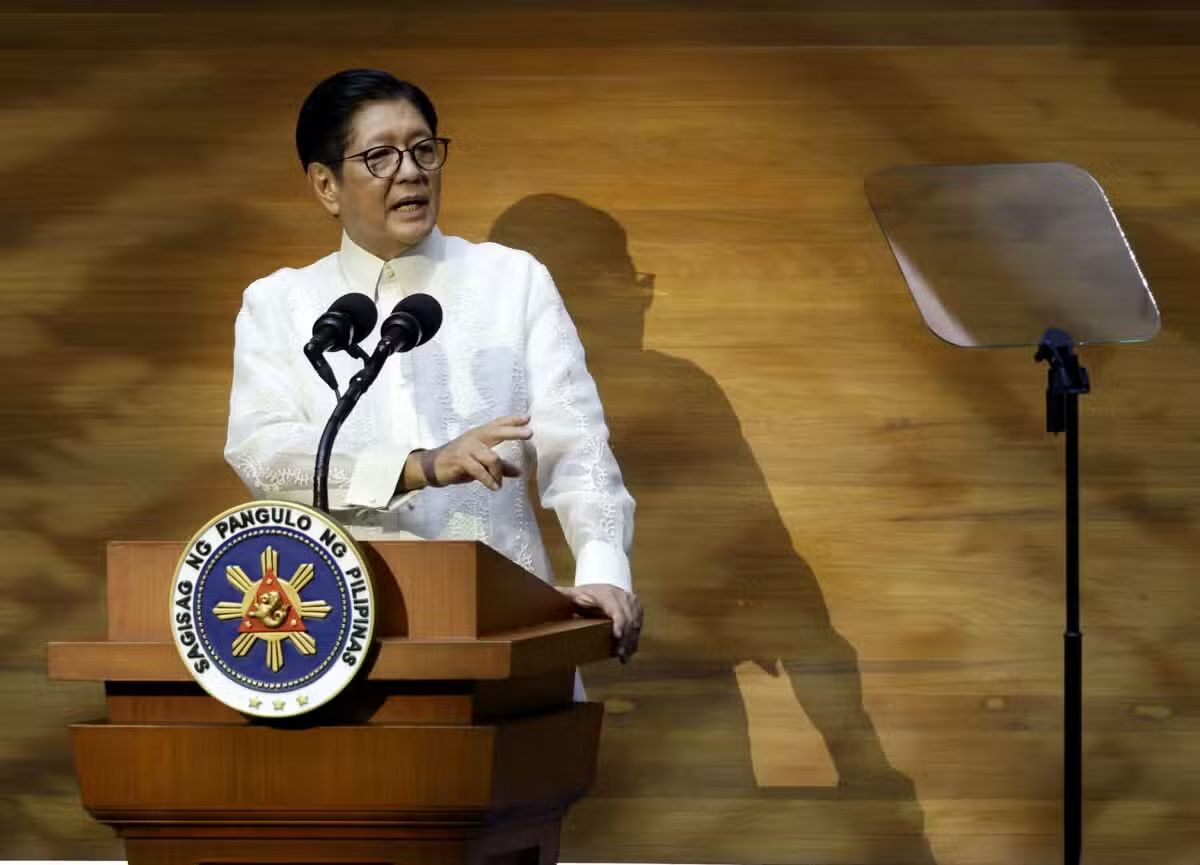
Philippine President Ferdinand Marcos has unveiled an ambitious tax relief package aimed at buttressing the purchasing power of salaried workers and small entrepreneurs, acknowledging that geopolitical turmoil in the Middle East continues to create economic headwinds for ordinary Filipinos. In his 2026 State of the Nation Address, Marcos positioned the measures as essential safeguards for the nation's middle class and entrepreneurial backbone, signalling that policymakers recognise the vulnerability of these segments to external shocks and cost-of-living pressures.
The centrepiece of the proposed tax overhaul involves broadening income tax exemptions to encompass all wage earners taking home up to ₱350,000 annually—a threshold designed to relieve financial strain on the growing professional workforce. Concurrent with this expansion, the administration intends to reduce marginal tax rates for other employees whose incomes exceed that ceiling, creating a progressive system that distributes relief across multiple income brackets. For small business proprietors, the government proposes eliminating the minimum corporate income tax obligation, a move intended to preserve capital that entrepreneurs might otherwise deploy toward payroll, inventory, or operational improvements.
The Middle East crisis has cast a long shadow over Philippine economic planning and consumer confidence. Extended regional instability dampens tourism revenue, disrupts remittance inflows from overseas Filipino workers stationed in Gulf states, and contributes to commodity price volatility that ripples through supply chains serving the archipelago. Marcos framed the tax relief initiative as a direct counter to these external pressures, arguing that enabling workers and small operators to retain larger portions of their income would sustain domestic demand, cushion household savings buffers, and provide businesses with breathing room to invest rather than merely survive.
Beyond income tax reforms, the administration is advancing a comprehensive tax amnesty scheme targeting individuals and entities with outstanding liabilities across multiple categories. The amnesty window would cover unpaid income tax obligations, estate duties, donor taxes, and value-added tax arrears, alongside forgiving related penalties and surcharges that often balloon the original debt burden. This dual approach—simultaneously offering prospective relief through lower rates and exemptions while extending a retrospective olive branch to delinquent taxpayers—reflects pragmatic recognition that fiscal compliance has fractured amid economic uncertainty, and that rebuilding the tax base requires both carrot and stick.
The timing of these proposals carries particular significance for regional economies watching the Philippine trajectory. As Southeast Asia's second-largest economy by nominal GDP, the Philippines' fiscal and monetary choices influence regional investor sentiment and capital flows. Tax relief measures that stimulate consumer spending could bolster demand for goods and services across the broader Association of Southeast Asian Nations bloc, while conversely, erosion of government revenue capacity might constrain public investment in infrastructure and social services—ultimately dampening medium-term growth prospects across the region.
Marcos explicitly framed the initiatives as instruments for achieving what policymakers term socio-economic sustainability—a concept encompassing not merely macroeconomic stability but also equitable distribution of prosperity and opportunity. By expanding exemptions upward toward ₱350,000, the administration acknowledges that the definition of disposable income has shifted in an era of elevated living costs, and that tax brackets calibrated to pre-pandemic price levels no longer reflect contemporary economic reality. The small business exemption from minimum corporate income tax similarly recognises that micro and small enterprises operate on razor-thin margins, and that statutory minimum levies can precipitate closure or force informal-economy migration.
The legislative pathway ahead remains uncertain. Congress must deliberate and ultimately pass enabling legislation for these measures to take effect, meaning political consensus across competing interests and ideological viewpoints will prove decisive. Business lobbies, labour unions, and fiscal conservatives will likely weigh in with divergent priorities, forcing lawmakers to negotiate trade-offs between revenue foregone and economic stimulus delivered. The government's framing emphasises that tax relief generates revenue by accelerating economic activity—a supply-side argument that assumes behavioural responses to lower tax burdens will outweigh mechanical revenue losses, though empirical validation of such multiplier effects remains contested among economists.
For Malaysian observers and policymakers, the Philippine experience offers instructive lessons regarding the political economy of tax reform during periods of external vulnerability. Malaysia has likewise grappled with managing fiscal sustainability while protecting household incomes amid commodity price fluctuations and geopolitical disruptions. The tension between cutting tax rates to stimulate growth versus maintaining revenue adequacy for social spending represents a perennial challenge across the region, and how the Philippines navigates these shoals could inform deliberations in Kuala Lumpur and other Southeast Asian capitals.
The amnesty programme component warrants particular attention, as it signals governmental willingness to prioritise inclusivity and compliance recovery over punitive enforcement. By reducing the penalty burden associated with past non-compliance, authorities create stronger incentives for tax delinquents to voluntarily regularise their status, thereby expanding the tax base without recourse to confrontational collection measures that risk driving economic activity underground. This carrot-heavy approach contrasts with jurisdictions emphasising audit intensity and penalties, and its success or failure will generate important evidence regarding optimal enforcement strategy in developing economies where informal sectors remain substantial.
The broader context suggests that Philippine policymakers view the Middle East crisis not as a temporary aberration but as a structural shift requiring sustained policy adaptation. Tax relief measures represent the demand-side complement to expected central bank monetary accommodation and ongoing infrastructure spending, forming a comprehensive fiscal-monetary-administrative approach to sustaining growth and employment amid uncertainty. Whether these measures prove sufficient to insulate the Philippine economy from deepening regional tensions, however, will depend partly on factors beyond Manila's control—including the duration and intensity of Middle East geopolitical friction and its cascading effects on global energy prices and supply chain stability.

