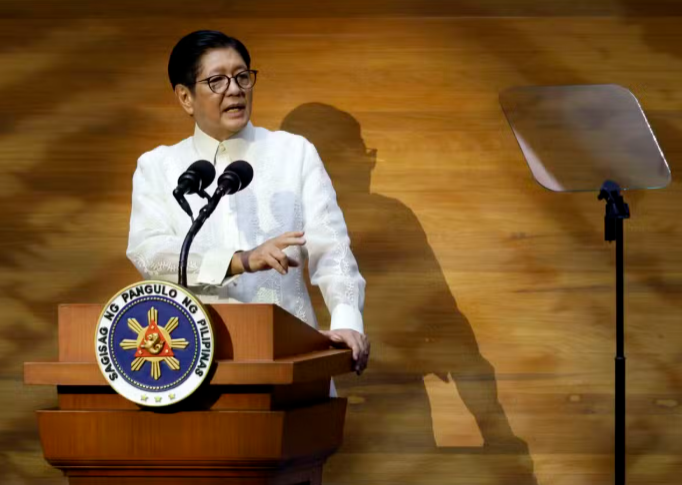
President Ferdinand Marcos of the Philippines made an emphatic declaration during his fifth State of the Nation Address on July 27, asserting that his administration's pursuit of corruption will extend to relatives and political allies without exception. The statement carried particular weight as it coincided with the Office of the Ombudsman launching a formal investigation into Martin Romualdez, the President's cousin and former House Speaker representing Leyte, regarding his alleged involvement in a multibillion-peso flood control scandal.
In addressing a joint session of Congress, Marcos articulated a clear delineation between his personal relationships and his constitutional obligations. He emphasised that the government's anticorruption programme had operated "without favor or bias," resulting in the filing of plunder, graft, bribery and money laundering charges against dozens of politicians, former officials and contractors. The President acknowledged that charges against Romualdez were likely forthcoming, yet stressed that familial connections would not shield anyone from accountability. His remarks, "I am not the President of my family. I am not the President of my friends. I am the President of the Philippines, and my duty is to you, my fellow Filipinos," crystallised the administration's stated position on impartiality in its anticorruption efforts.
Romualdez responded with a statement expressing respect for the President's position despite the personal anguish the situation caused. He explicitly denied requesting preferential treatment and maintained his innocence regarding the allegations. The first cousin and longstanding political ally of Marcos stated his willingness to navigate the judicial process, trusting that evidence would ultimately vindicate him. His measured response demonstrated an attempt to balance family loyalty with acknowledgment of the President's enforcement mandate, reflecting the sensitive political dynamics at play.
The flood control scandal investigation originated from Marcos' commitment made during his 2024 State of the Nation Address, when he first publicly exposed alleged irregularities in infrastructure projects and issued his now-famous rebuke, "Mahiya naman kayo (Have some shame)." This rhetorical flourish catalysed the creation of Executive Order No. 94, which established the Independent Commission for Infrastructure to scrutinise questionable flood control projects spanning the previous decade. The commission completed its fact-finding mission in February, producing nine comprehensive referrals that recommended both criminal and administrative charges against 65 individuals, including lawmakers, contractors, and personnel from the Department of Public Works and Highways and the Commission on Audit.
The scale of prosecutions initiated through this investigation demonstrates the administration's commitment to translating anticorruption rhetoric into concrete legal action. Currently, at least 45 individuals face criminal charges before the Sandiganbayan and regional trial courts. These defendants include two sitting lawmakers, two former representatives, 33 former DPWH officials and eight contractors. Among the detained are Senator Jinggoy Estrada and former Senator Ramon "Bong" Revilla Jr., along with contractors Curlee and Sarah Discaya and several former DPWH officials. Former House appropriations committee chair Zaldy Co remains at large in Europe after authorities could not apprehend him within the prescribed timeframe, leading to the archiving of his separate graft case. Former Public Works Secretary Manuel Bonoan was dropped as a respondent after being accepted as a state witness, indicating potential cooperation with prosecutors.
Financial recovery represents a tangible dimension of the anticorruption campaign that extends beyond prosecutions. The administration has recovered, frozen or preserved nearly 25 billion Philippine pesos in funds and assets associated with the accused, with more than 800 million pesos already returned to the National Treasury. By blocking payments for defective, fake or nonexistent projects, the government has prevented the diversion of public resources to corrupt officials and favoured contractors. This financial dimension underscores that the anticorruption drive produces measurable benefits for the state budget and public welfare, moving beyond symbolic gestures to material outcomes affecting national finances.
The Marcos administration has also undertaken institutional reforms designed to prevent future corruption within infrastructure agencies. Under the stewardship of newly appointed Public Works Secretary Vince Dizon, the DPWH has recruited new graduates and contract workers while implementing comprehensive reviews of infrastructure projects from initial planning and cost estimation through implementation phases. These structural measures aim to address systemic vulnerabilities that enabled the flood control scandal, suggesting a recognition that prosecutions alone cannot reform institutions without accompanying procedural and personnel changes.
Marcos articulated a measured optimism regarding the remaining prosecutions, now transferred to the Office of the Ombudsman and the Department of Justice's National Prosecution Service. He expressed confidence in the independence of the judiciary, stating, "You can be assured that the wheels of justice are turning." This delegation of ongoing cases to prosecutorial and judicial bodies reflects a strategic repositioning of responsibility, allowing the administration to claim credit for initiating investigations while distancing itself from prosecutorial decisions in a manner that theoretically enhances the appearance of institutional independence.
The anticorruption campaign's prominence in Marcos' State of the Nation Address—his longest since assuming office in 2022, lasting one hour and 26 minutes—indicates the political importance the administration assigns to this narrative. The emphasis on prosecuting relatives and allies represents a calculated attempt to establish credibility with a public frequently sceptical of government anticorruption claims in the Philippine context, where family-oriented politics and personalised networks have traditionally constrained accountability efforts.
For Malaysian observers, the Philippine case illustrates both the possibilities and complexities of anticorruption campaigns in Southeast Asian democracies. While the scale of prosecutions and financial recovery appears substantial, the involvement of high-profile political figures suggests that anticorruption initiatives often reflect shifts in factional dominance rather than institutionalised commitment to impartial justice. Marcos' willingness to prosecute a first cousin demonstrates either genuine institutional strength or calculated risk-taking regarding factional politics. Malaysia's own experience with corruption prosecution, particularly involving former Prime Minister Najib Razak and the 1Malaysia Development Berhad scandal, offers instructive parallels regarding how judicial processes intersect with political transitions and the challenges of sustaining anticorruption momentum across changing administrations.
The broader question animating the Philippine anticorruption campaign concerns whether institutional mechanisms can be established that survive political transitions and personal leadership changes. The independent commission that generated the referrals has completed its mandate, now dispersing responsibility among permanent institutions. Whether these bodies maintain investigative vigour and prosecutorial independence as political configurations evolve remains uncertain. For Southeast Asian democracies confronting corruption challenges, the sustainability of anticorruption efforts beyond their initial political impulse remains a fundamental test of institutional maturity and the depth of reform commitments.

