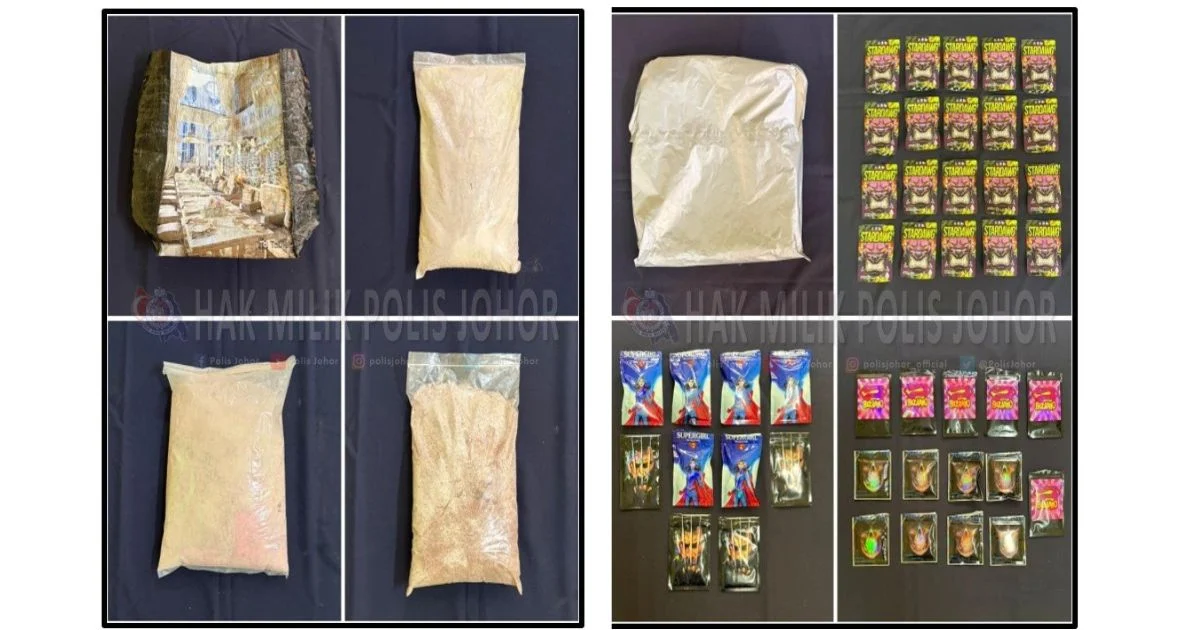
Police in Johor Baru have successfully dismantled what investigators describe as an active drug syndicate operating in Kulai, moving to arrest a married couple and confiscate a substantial cache of narcotics estimated at RM3.59 million. The operation represents a significant enforcement victory in the state's ongoing battle against organised drug trafficking, which continues to plague communities across northern Johor despite intensified policing efforts in recent years.
The arrests came following an extended surveillance operation that allowed police to identify the couple's central role in distributing controlled substances throughout the region. Officers conducted raids at multiple locations associated with the suspects, yielding the large quantity of drugs that investigators say would have serviced the local market for an extended period. The scale of the seizure underscores how sophisticated distribution networks have become in Malaysia, with family-operated enterprises increasingly serving as the backbone of mid-level trafficking organisations.
Johor has emerged as a critical transit point and consumption hub for narcotics flowing through the Malay Peninsula. Its proximity to Singapore, coupled with its extensive port facilities and road networks connecting to other Malaysian states, makes the region particularly vulnerable to transnational drug trafficking. The porous border areas and numerous illegal entry points have historically attracted organised criminal syndicates seeking to establish supply chains. Law enforcement agencies acknowledge that while major seizures grab headlines, the underlying supply problem remains formidable.
The involvement of a married couple in this operation reflects broader trends in Southeast Asian drug trafficking, where family networks provide both operational security and trusted logistics. Intimate partnerships create layers of deniability and reduce law enforcement's ability to penetrate syndicates through informant networks. Such arrangements also allow couples to manage inventory, finances, and customer relationships with minimal external recruitment, thereby limiting exposure and reducing vulnerability to infiltration by undercover officers.
Investigators have not yet disclosed the specific types of narcotics recovered, though the valuation suggests a mixture of high-potency substances such as methamphetamine and heroin, which command premium prices in Malaysian markets. The distinction matters significantly for understanding the syndicate's operational model and customer base. Methamphetamine-focused operations typically target urban professionals and young adults, while heroin distribution networks serve entrenched addiction populations in urban centres and smaller towns alike. The RM3.59 million figure implies a mixed portfolio serving diverse market segments.
The timing of this bust coincides with ongoing regional efforts to combat drug trafficking across Southeast Asia. Countries including Malaysia, Thailand, and Indonesia have ramped up enforcement in recent years, though observers note that supply disruptions are temporary without addressing fundamental demand and precursor chemical flows. The region remains a critical battleground in the global war on drugs, with transnational syndicates constantly adapting their methods to circumvent border controls and law enforcement interdiction.
For Johor residents, such operations provide temporary relief but highlight the persistent challenge of drug-related crime and its associated harms. Communities across the state have witnessed increased rates of addiction, drug-related violence, and property crime linked to narcotics distribution networks. While police celebrate major seizures, residents in affected neighbourhoods often express frustration that visible supply continues despite enforcement activities, pointing to systemic inadequacies in prevention and rehabilitation strategies.
The case also illustrates enforcement priorities within the Royal Malaysia Police, which has designated drug trafficking as a priority crime category alongside human trafficking and organised crime. However, resource constraints mean that only a fraction of suspected trafficking activity results in arrests and prosecutions. Intelligence-led policing approaches have improved hit rates for major operations, yet the sheer volume of suspected activity across the state means that many smaller distribution networks operate with relative impunity.
Moving forward, the arrested couple will face charges under the Dangerous Drugs Act, with sentences potentially reaching decades of imprisonment depending on the substance type and quantities involved. Malaysia maintains some of Southeast Asia's harshest drug penalties, reflecting the government's zero-tolerance stance. However, criminal justice experts argue that deterrence-based approaches have limited effectiveness without complementary investments in drug treatment, prevention education, and addressing root causes of addiction within communities.
The Kulai syndicate dismantling represents one successful outcome in what remains an ongoing and resource-intensive struggle against narcotics trafficking. For Malaysian authorities and regional neighbours, the priority now extends beyond securing convictions in individual cases toward developing sustainable strategies that address both supply-side enforcement and demand-side prevention. The collaboration between federal and state law enforcement agencies will likely intensify, recognising that transnational drug networks require coordinated responses transcending state boundaries and national jurisdictions.

