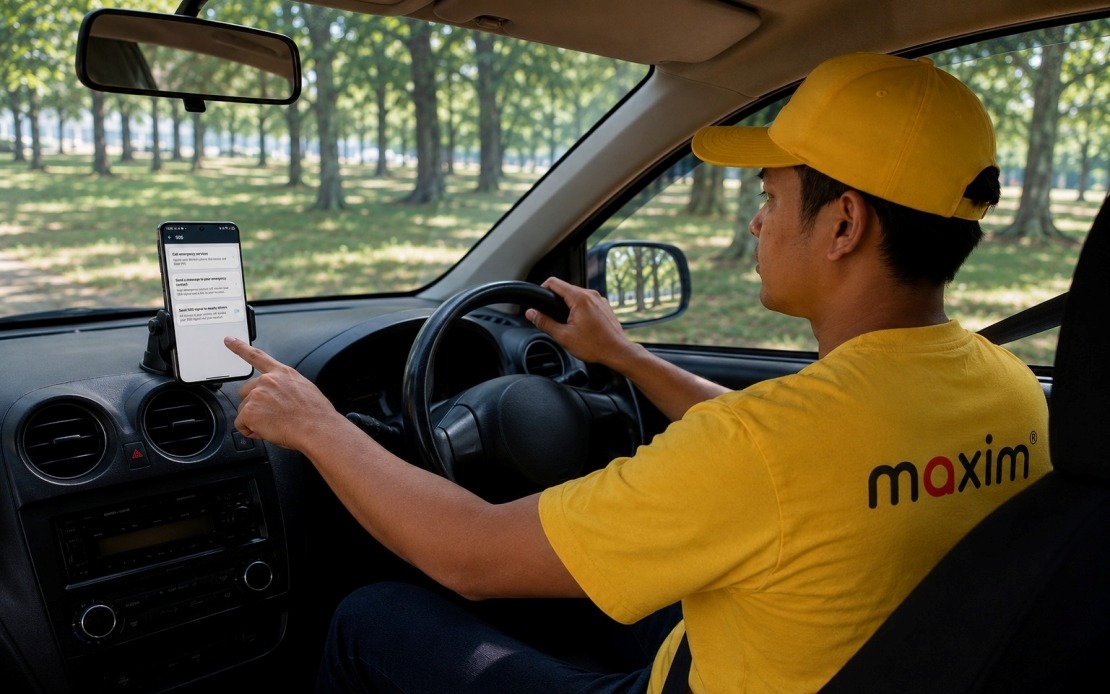
Maxim Malaysia has substantially strengthened its commitment to user safety by deploying a redesigned emergency response system that promises faster access to help during critical situations. The ride-hailing platform announced the enhancements in Kuala Lumpur this week, marking a significant shift in how both passengers and drivers can summon assistance when facing unexpected incidents on the road.
The core innovation centres on a revamped SOS button that operates with improved speed and reliability compared to its predecessor. What distinguishes this upgrade from comparable systems in the Southeast Asian mobility sector is the flexibility it provides users in determining their preferred response pathway. Rather than forcing all emergencies through a single channel, the system now permits individuals to route alerts to their chosen emergency contacts, professional rescue services, or nearby community resources, depending on the specific nature of the crisis they encounter.
Under the new architecture, users can transmit distress notifications to as many as three pre-registered emergency contacts simultaneously. Each recipient receives a text message containing the affected user's precise GPS coordinates and a hyperlink enabling real-time monitoring of the ongoing journey. Importantly, this functionality maintains operational integrity even when internet connectivity falters, relying on SMS technology as a backup delivery mechanism—a critical consideration for Malaysian users navigating areas with inconsistent network coverage.
The system offers distinct advantages for Maxim's partner driver community. A dedicated Driver Alert System broadcasts emergency notifications to other Maxim drivers operating within a three-kilometre radius of the incident location. This peer-assistance mechanism creates an informal safety net, allowing nearby drivers to render immediate help while professional emergency services mobilise toward the scene. The concept leverages the distributed nature of the ride-hailing network as an inherent safety resource, particularly valuable in districts where formal emergency response times may extend.
Mohd Hazwan Musli, Maxim Malaysia's director, articulated the strategic thinking underlying these modifications. He emphasised that modern safety infrastructure must accommodate diverse emergency scenarios, each demanding different response sequences. A medical emergency might necessitate immediate contact with hospitals and family members, while a vehicle malfunction could benefit from peer driver assistance before official towing services arrive. By collapsing multiple response options into a unified interface accessible within seconds, the platform acknowledges that time compression during crises directly correlates with outcome improvement.
The platform has standardised its SOS functionality across both passenger and driver populations, eliminating previous discrepancies in safety protocols between user categories. This harmonisation reflects industry best practices and recognises that emergencies affect both constituencies, requiring equivalent access to responsive systems. The decision to standardise carries implications for operational consistency and regulatory compliance across Malaysia's transportation sector, where ride-hailing services operate under increasingly stringent safety oversight.
Beyond the SOS framework, Maxim Malaysia maintains complementary safety infrastructure addressing fraud prevention and journey transparency. An encrypted in-app messaging system shields communications from compromised credentials or impersonation attacks. Continuous journey monitoring captures essential trip metrics alongside GPS positioning, creating detailed records of passenger and driver movements. The Trip Sharing feature permits passengers to broadcast real-time journey visibility to designated individuals, converting digital transparency into a protective mechanism that deters misconduct through accountability.
Data protection underpins all safety functionality. Information transmitted through the SOS system, Driver Alert framework, and Trip Sharing interface undergoes encryption conforming to international security standards. Access restrictions limit viewing rights to authenticated security personnel and government authorities, triggered only through formal legal procedures. This architecture addresses privacy concerns that frequently emerge when mobility platforms concentrate location data, ensuring that safety enhancements do not inadvertently compromise user confidentiality.
The upgrade reflects broader industry recognition that ride-hailing safety constitutes a competitive and operational imperative across Southeast Asia. Incidents involving passengers or drivers in Malaysia, Singapore, and neighbouring jurisdictions have generated public scrutiny regarding platform accountability and emergency responsiveness. By proactively enhancing its safety infrastructure, Maxim positions itself within the growing cohort of regional mobility services prioritising user protection as a primary business function rather than regulatory compliance afterthought.
For Malaysian commuters and drivers, these improvements carry tangible implications. Workers utilising ride-hailing services during late-night shifts now access faster emergency pathways. Passengers traversing unfamiliar districts benefit from expanded notification options reaching their social networks. Drivers facing mechanical failures or security concerns can simultaneously alert family members and nearby colleagues, multiplying available assistance vectors. The system's resilience under poor network conditions proves particularly relevant across Malaysia's diverse geographic and infrastructural landscape.
Regulatory authorities overseeing ride-hailing operations in Malaysia have increasingly demanded robust safety demonstrations from platforms seeking operational approval. Maxim's systematic approach to emergency response, particularly the formalised driver assistance network and multi-contact notification capability, aligns with regulatory expectations around user protection and incident management. The platform's transparency regarding encryption standards and access controls suggests alignment with emerging Southeast Asian data governance frameworks.
As ride-hailing competition intensifies throughout the region, safety differentiation increasingly influences consumer choice. Passengers and drivers evaluating platform selection now commonly prioritise emergency responsiveness and transparency features alongside pricing and convenience metrics. Maxim's upgraded system addresses this evaluative dimension directly, offering users tangible proof that the company has invested substantially in their protection rather than merely meeting minimum regulatory thresholds.
The deployment of these safety enhancements occurs within a broader context of Malaysian society's growing expectations regarding technology-enabled safety protections. Urban commuters increasingly demand that mobility platforms provide security features equivalent to those available through traditional transportation modes. By delivering faster response mechanisms, peer assistance networks, and multiple notification pathways, Maxim demonstrates responsiveness to user expectations while establishing benchmarks that may influence competitive responses from rival ride-hailing services operating throughout Malaysia and Southeast Asia.

