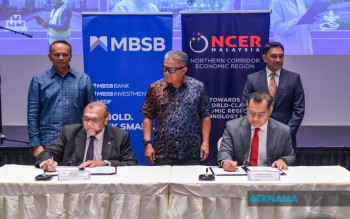
MBSB Bank has entered into a strategic financing partnership with the Northern Corridor Implementation Authority, unveiling a RM1 billion facility designed to unlock economic potential across four northern Malaysian states. The memorandum of understanding, formalised at a signing ceremony in Petaling Jaya on July 17, represents a concerted effort to channel capital toward small and medium enterprises seeking to establish or expand operations within the Northern Corridor Economic Region, which spans Perlis, Kedah, Penang, and Perak.
The collaboration addresses a persistent financing gap that has historically constrained SME growth in Malaysia's less densely populated northern states. By deploying dedicated capital specifically earmarked for this region, the partnership signals confidence in the NCER's development trajectory and seeks to redistribute economic opportunities beyond the Klang Valley and Selangor. For businesses operating in these jurisdictions, the initiative removes a critical barrier to expansion, providing structured access to banking facilities that might otherwise require relocation to more established financial centres.
MBSB Bank chairman Datuk Wan Kamaruzaman Wan Ahmad framed the arrangement as a vehicle for regional transformation, emphasising how the financing facility would enable enterprises to scale operations, integrate into complex supply chains, and contribute meaningfully to the NCER's economic diversification agenda. This positioning reflects recognition that sustainable regional growth depends not merely on attracting foreign direct investment or large multinational operations, but on nurturing indigenous business ecosystems capable of supporting sustained employment and value creation.
The bank's group chief executive officer, Rafe Haneef, extended the partnership's scope beyond domestic financing by highlighting MBSB's existing collaboration with the European Santander Group. This tri-party arrangement—involving Malaysian SMEs, a domestic bank, and an international financial institution—creates export pathways that traditionally have been difficult for smaller enterprises to navigate. By reducing information asymmetries and facilitating cross-border transactions, the platform addresses a longstanding constraint on Malaysian SME internationalisation.
NCIA chief executive Datuk Mohamad Haris Kader Sultan articulated how the financing mechanism aligns with Malaysia's 13th Malaysia Plan priorities, anchoring the initiative within the broader national development framework. The NCER has already established itself as a diversified industrial hub, with particular strength in electrical and electronics manufacturing, advanced automotive components, and food processing. The RM1 billion facility capitalises on this existing momentum by reducing capital constraints that often limit businesses from exploiting established supply chain networks within the region.
The targeted sectors identified—E&E, advanced manufacturing, agri-food, logistics, digital economy, and green technology—reflect deliberate concentration on industries offering higher value addition and export competitiveness. This sectoral focus prevents capital dispersion across low-productivity activities and instead directs financing toward enterprises capable of competing in global markets. For Malaysian policymakers, this specificity demonstrates how development finance can be strategically deployed to reshape regional comparative advantage.
The NCER's recent performance as one of Malaysia's fastest-growing economic zones validates the underlying premise of this financing partnership. Existing investments in infrastructure, logistics hubs, and industrial parks have created conditions favourable for business expansion, yet capital availability has remained a constraint relative to opportunity. The RM1 billion facility addresses this misalignment, potentially catalysing a second wave of growth by unlocking investments that have long been economically viable but financially inaccessible to SME owners.
For SMEs themselves, the arrangement offers practical advantages beyond mere fund availability. Partnership with MBSB Bank provides credibility signals that can strengthen relationships with international suppliers and customers, while access to Santander's platform opens avenues for trade finance and cross-border payment solutions that would be prohibitively expensive for isolated small enterprises. The ecosystem created through this MoU thus functions as both direct financing and enabling infrastructure for business internationalisation.
The timing reflects Malaysia's renewed emphasis on regional economic rebalancing. As the southern regions of the Peninsular have reached higher development plateaus, policy attention has shifted toward unleashing potential in northern states where land, labour, and infrastructure costs remain comparatively advantageous. For multinational enterprises considering relocation or diversification away from saturated southern markets, the availability of dedicated financing for local suppliers and partners makes the NCER increasingly compelling as an operational base.
Regional implications extend beyond Malaysia's borders. The NCER's geographic proximity to Thailand and its position within broader Southeast Asian supply chains mean that strengthened financing capacity here supports deeper integration across the region. Thai and other regional businesses seeking Malaysian suppliers or manufacturing partners will find the NCER's improved capital availability significant, potentially redirecting trade and investment flows within ASEAN.
The partnership also signals MBSB Bank's strategic positioning within Malaysia's development finance architecture. By securing a dedicated financing role within one of Malaysia's priority growth regions, the bank establishes itself as a development-oriented lender capable of mobilising capital for policy-aligned objectives. This positioning offers competitive advantages in securing government support and accessing concessional funding sources that reward institutions demonstrating commitment to equitable regional development.
Looking forward, the success of this initiative will depend on effective deployment mechanics—loan processing efficiency, technical support provision, and realistic credit assessments that recognise SME-specific risk profiles. If MBSB and NCIA establish streamlined processes that reduce application complexity while maintaining prudent underwriting standards, the RM1 billion facility could exceed expectations in catalysing regional growth. Conversely, if implementation becomes encumbered by bureaucratic requirements typical of development finance programmes, uptake may disappoint, leaving capital unutilised.

