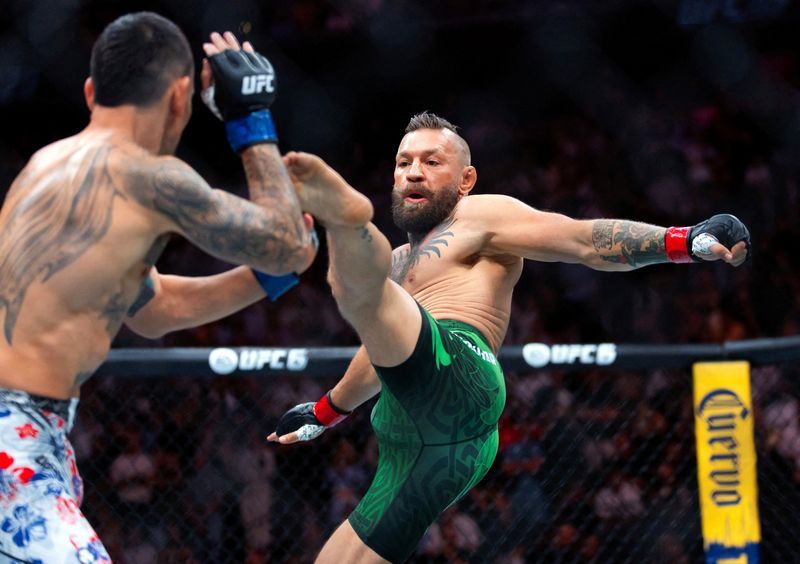
Conor McGregor's long-awaited return to the mixed martial arts octagon lasted barely more than a minute before a devastating knee injury forced the former dual-weight champion to abandon his comeback attempt. The Irish fighter suffered the damage during the opening moments of his Las Vegas bout against Max Holloway on Saturday when he attempted a jump kick and landed awkwardly, immediately signalling to the referee that he could not continue the fight. The abruptness of the injury—occurring just 69 seconds into the bout—will add to mounting frustration for one of combat sports' biggest draws, whose career trajectory has been consistently disrupted by both physical setbacks and personal controversies.
In a post shared across social media on Monday, McGregor expressed his resolve to pursue surgical intervention and rehabilitation. His message, peppered with references to faith and resilience, suggested optimism about fighting again despite the immediate setback. He referenced undergoing prehabiliation work, returning to martial arts training, and competing in a final fight under his existing contract. The statement represents his public commitment to a recovery pathway, though the specific nature of the knee injury and its severity remain to be confirmed through medical evaluation and imaging.
The 37-year-old's career has become a case study in how external circumstances can derail even the most prominent athlete's trajectory. Five years prior, McGregor had experienced a severe lower-leg injury during a fight with Dustin Poirier that required significant recovery time. More recently, a scheduled June 2024 clash with Michael Chandler fell apart when McGregor incurred a broken toe during training camp—a relatively minor injury that nonetheless prevented his participation. Such disruptions have become increasingly common in McGregor's latter years, raising questions about whether physical conditioning, training intensity, or simple misfortune is responsible for the recurring setbacks.
Beyond the training room, McGregor has encountered substantial obstacles outside competitive fighting. An Irish civil court jury determined in a significant legal proceeding that the fighter was liable for the rape of Nikita Hand in 2018. This ruling carried serious reputational consequences and reflected broader accountability discussions surrounding high-profile athletes. Additionally, Combat Sports Anti-Doping authorities charged McGregor with whereabouts failures after he missed three separate attempts to collect biological samples in 2024. He subsequently accepted an 18-month suspension for these violations, though the punishment was backdated and technically expired in March of this year, clearing the way for his recent Vegas appearance.
The timing of McGregor's latest injury coincides with a period of attempted professional reinvention. Having cleared anti-doping suspension barriers and working through the aftermath of adverse legal outcomes, his fight with Holloway appeared positioned as a genuine comeback vehicle—a chance to reclaim relevance in a heavyweight landscape that has evolved considerably during his extended absence from regular competition. The rapid conclusion of that bout now raises uncomfortable questions about whether McGregor, even if physically cleared to compete, can reliably deliver the performances his status and legacy demand.
For Malaysian and Southeast Asian combat sports enthusiasts, McGregor's situation underscores the vulnerability of even the most accomplished fighters to injury and circumstance. The region has produced numerous talented martial artists, many of whom have had their momentum disrupted by similar challenges. McGregor's public handling of adversity—through social media declarations of faith and determination—reflects a modern athlete's approach to maintaining fan engagement during difficult periods, a dynamic increasingly relevant to how regional fighters manage their own comeback narratives.
The financial and contractual implications of McGregor's current position warrant consideration. His statement referencing a final contracted fight suggests ongoing obligations to the Ultimate Fighting Championship, his long-time promotion home. Whether McGregor can fulfill those obligations through successful competition, given the recurring injury pattern, remains uncertain. The substantial drawing power he commands means organisations have strong incentives to facilitate his return, yet each abbreviated performance raises doubts about his ability to deliver marquee entertainment value.
McGregor's path forward will likely involve extended rehabilitation overseen by specialist medical teams, followed by gradual return-to-training protocols typical of knee injury recovery. The fact that he has already publicly committed to this process suggests confidence in eventual clearance, though the timeline for meaningful competition remains undefined. Given his age and the progressive nature of repeated injuries, the window for mounting a genuinely competitive comeback may be narrower than his public optimism suggests.
For the global combat sports industry, McGregor's situation exemplifies challenges facing ageing athletes in high-injury-risk disciplines. Unlike less contact-intensive sports, mixed martial arts recovery involves not merely healing damaged tissues but rebuilding confidence, timing, and competitive reflexes against evolving opponents. McGregor's previous dominance now seems increasingly distant, and whether surgical intervention combined with disciplined rehabilitation can restore genuine championship-level performance remains the central question underlying his comeback attempt.

