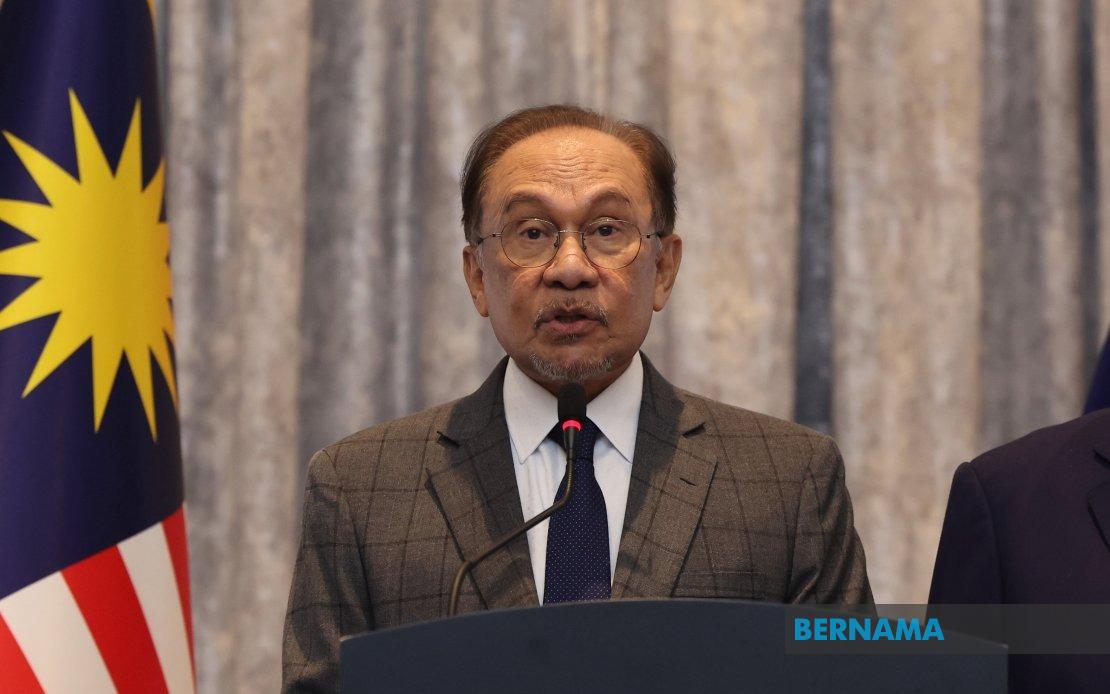
Malaysia's Prime Minister has sounded a cautionary note about the intersection of media, technology and national identity, telling journalists gathered at the Malaysian Press Night and Malaysian Press Institute awards ceremony that the country cannot afford to sacrifice its values in the rush toward digital transformation. Speaking at an event honouring journalism excellence, Datuk Seri Anwar Ibrahim framed technological progress not as an inherent threat but as a domain requiring careful stewardship, where freedom and innovation must coexist with ethical guardrails and cultural consciousness.
The prime minister's remarks underscore a growing tension across Southeast Asia between embracing the economic and informational benefits of digital platforms and protecting citizens from what he characterised as ideologically driven external influence. Anwar warned that Malaysia risked being left vulnerable if the country failed to remain alert to the challenges accompanying rapid technological change. His comments reflect broader regional concerns about technology's role in shaping public discourse, particularly as artificial intelligence, data analytics and algorithmic content distribution reshape how information flows through societies.
Central to Anwar's message was the concept of the "captive mind"—a framework traditionally associated with political control and colonial dominance but now reimagined for the digital age. He argued that while Western media historically shaped global narratives according to its own strategic interests, a new form of cognitive capture now operates through technological channels, with powerful actors seeking to advance ideological or cultural systems that may conflict with local values and sovereignty. This reframing positions technology not merely as a neutral tool but as a contested arena where nations must actively defend their own narrative authority and cultural integrity.
The prime minister specifically highlighted the responsibility of Malaysia's Communications Ministry under Datuk Seri Fahmi Fadzil and the Malaysian Communications and Multimedia Commission to support media institutions navigating these pressures. Rather than positioning government as a restrictive force, Anwar framed state engagement as collaborative and consultative, suggesting that officials and journalists must work together to chart a course that maximises the benefits of digital innovation while minimising vulnerability to external manipulation. His emphasis on dialogue and openness to criticism signals an attempt to build consensus around shared concerns rather than impose top-down directives.
For Malaysian media practitioners, the implications are nuanced. Anwar explicitly acknowledged the necessity of upholding press freedom, democratic principles and the media's watchdog function, including its capacity to offer constructive criticism of government. Simultaneously, he appealed to journalists to consider how technology itself shapes editorial choices and public understanding. The challenge extends beyond individual news organisations to encompass the broader media ecosystem—from traditional newsrooms to social media platforms, influencer networks and artificial intelligence systems that increasingly curate information consumption.
The government's framing also reflects Malaysia's strategic positioning within broader geopolitical competition for technological dominance. As major powers compete to establish global standards for artificial intelligence governance, digital infrastructure and content moderation, smaller nations face pressure to adopt external frameworks or develop indigenous alternatives. Anwar's emphasis on preserving national identity through media stewardship suggests Malaysia intends to avoid being relegated to a passive consumer of foreign technology and values, instead asserting agency in how these tools operate within Malaysian society.
The recognition given to the Malaysian Press Institute, with support from PETRONAS, and the Malaysian Media Council for driving innovation and reform indicates official confidence in industry-led solutions. Rather than relying solely on regulation, the government appears to be encouraging professional standards bodies and corporate partners to help develop frameworks that allow technological adoption while anchoring journalism in established ethical principles. This approach assumes that media organisations themselves have incentives to maintain public trust and credibility, which depend on sustained commitment to factual accuracy and editorial integrity regardless of how information is transmitted or discovered.
Columnists and opinion writers received particular mention in Anwar's address, suggesting that analysis and interpretation of technological change deserve as much attention as breaking news coverage. This recognition reflects an understanding that how society understands technology's implications—what it means for privacy, autonomy, inequality and national sovereignty—depends partly on thoughtful editorial commentary that helps citizens contextualise rapid change. The implicit challenge to columnists is to move beyond reactive commentary on individual technological developments toward sustained examination of systemic patterns and deeper implications.
For Southeast Asian countries watching Malaysia's approach, Anwar's framework offers both aspiration and caution. The region collectively faces pressures from major technological powers, economic incentives to rapidly digitise public and private sectors, and genuine opportunities to leapfrog outdated infrastructure. Yet each nation must also protect its capacity to define what development means culturally and politically. Malaysia's attempt to articulate principles—freedom with values, innovation with identity, openness with vigilance—provides a vocabulary for regional peers grappling with similar tensions, though implementation inevitably proves more complex than rhetorical framing.
The broader context matters too. Malaysia's media landscape has experienced periods of significant constraint alongside genuine competitive pluralism, and international press freedom indices have documented concerns about political interference and self-censorship. Against this backdrop, Anwar's appeal to government-media collaboration and his acknowledgment of journalism's critical role carry particular weight. Whether the stated commitment to listening to views and accepting criticism will translate into substantive protections for editorial independence and investigative journalism remains an open question that will likely define how effectively Malaysia navigates the technological transition.
Ultimately, Anwar's message represents a claim that technology is not destiny—that Malaysian media and society retain agency in determining how digital systems operate within their borders and influence their citizens. This optimistic view contrasts with technological determinism that portrays digital transformation as an inevitable force before which nations can only adapt passively. By framing values as essential rather than optional, and by suggesting that government has a stake in supporting rather than controlling media institutions, the prime minister has articulated an approach that, if implemented genuinely, could position Malaysia as a model for balancing innovation with cultural and democratic integrity in the digital age.

