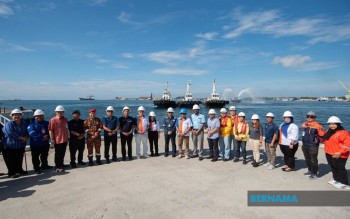
Megah Port Management Sdn Bhd marked a significant operational milestone at Labuan Port on July 29 by formally initiating its marine services division, backed by a RM23 million acquisition of four purpose-built tugboats. The investment underscores the port operator's determination to elevate service standards and operational resilience across one of Southeast Asia's strategic maritime hubs.
Managing director Datuk Seri Patrick Tiong positioned the tugboat procurement as a cornerstone investment reflecting MPM's broader commitment to the responsibilities outlined in the recently executed Operation, Facility and Management Continuation Agreement with the Labuan Port Authority. Under this accord, marine services provision represents a mandatory operational requirement that MPM has embraced as integral to its port management mandate. The decision to invest substantially in dedicated maritime assets demonstrates the company's intention to move beyond basic compliance toward proactive service enhancement across all terminal operations.
The four vessels will serve multiple critical functions within Labuan Port's confined waters. These tugboats will provide essential assistance during vessel entry and departure procedures, manage complex berthing and unberthing manoeuvres, and offer navigational support in conditions where weather or currents create operational challenges. Beyond routine towing and pushing operations, the vessels enable MPM to exercise greater control over vessel movements and provide direct assistance to ships experiencing mechanical distress or loss of propulsion—capabilities that fundamentally reshape the port's operational flexibility.
Labuan Port encompasses several major operational zones and specialized terminals that benefit from enhanced marine service capability. The DG Terminal, Petronas Chemicals Methanol Labuan Terminal, Asian Supply Base Fuel Terminal, and Shell Timur Terminal all fall within the port limits served by these new tugboats. This comprehensive coverage means that international shipping operators and petrochemical facilities relying on Labuan's infrastructure gain access to more reliable and responsive maritime support infrastructure than previously available.
Emergency preparedness has emerged as a central pillar of MPM's marine services strategy. The tugboat fleet significantly strengthens the port's capacity to respond to maritime incidents through coordinated rescue, evacuation, and firefighting operations. In critical situations, the vessels can be rapidly deployed to remove vessels from high-risk zones, support initial firefighting efforts, and provide crucial assistance to maritime enforcement and security agencies managing emergency situations. This capability becomes particularly valuable given Labuan's role as a regional hub handling hazardous materials and supporting complex marine operations.
The launch ceremony included a live emergency response demonstration that illustrated the tugboats' firefighting and incident response capabilities in realistic Labuan waters scenarios. This practical showcase provided enforcement agencies, industry stakeholders, and port users with tangible evidence of MPM's enhanced operational readiness. Such demonstrations also signal to the shipping community and cargo owners that Labuan Port has strengthened its safety infrastructure—a competitive advantage in attracting premium cargo operations and risk-conscious vessel operators.
Interagency coordination represents an essential dimension of effective marine services deployment. Tiong emphasized that close working relationships with the Malaysian Maritime Enforcement Agency, Marine Police Force, and other security authorities remain fundamental to ensuring that vessel movements, towage operations, and broader maritime activities remain compliant with Malaysian maritime law and international safety standards. This collaborative framework ensures that MPM's expanded capabilities integrate seamlessly with existing regulatory oversight structures rather than operating in isolation.
For Malaysian maritime stakeholders and regional shipping operators, the expansion carries meaningful implications. Enhanced tugboat services reduce port congestion by accelerating berthing procedures and improving vessel movement efficiency, translating directly into lower waiting times and reduced operational costs for shipping companies. The investment also addresses longstanding capacity constraints that occasionally limited Labuan's ability to simultaneously handle multiple vessel movements in confined anchorage areas.
From a competitive standpoint, Labuan Port strengthens its regional positioning through this infrastructure upgrade. As Southeast Asian ports intensify competition for transshipment cargo and specialized petrochemical logistics, demonstrated investment in safety systems and operational reliability serves as a differentiator. Malaysian maritime businesses and international operators considering Labuan for regional operations gain concrete assurance that the port continues modernizing its core infrastructure and emergency response capabilities.
The RM23 million commitment also reflects broader confidence in Labuan's long-term maritime relevance. Despite Malaysia's diversified port infrastructure across Peninsular Malaysia and East Malaysia, Labuan maintains specialized roles in offshore support services and petrochemical handling that justify continued capital investment. MPM's willingness to deploy substantial resources indicates management confidence that the port's operational future remains robust and that enhanced capabilities will attract sustained business volume.
Moving forward, MPM has signaled receptiveness to ongoing feedback from maritime authorities, industry participants, and cargo stakeholders regarding marine service improvements. This collaborative posture suggests that the four-tugboat fleet represents a foundation rather than a ceiling for future marine service expansion. As vessel traffic patterns evolve and port utilization intensifies, MPM may consider additional asset acquisition or service enhancements aligned with operational demands.
The formal commencement of marine services at Labuan Port demonstrates how Southeast Asian maritime operators are responding to competitive pressures by systematically upgrading infrastructure and safety capabilities. For Malaysian stakeholders depending on Labuan's specialized services, the investment signals institutional commitment to professional, law-compliant, and safety-conscious port operations that can sustain regional competitiveness across maritime industries.

