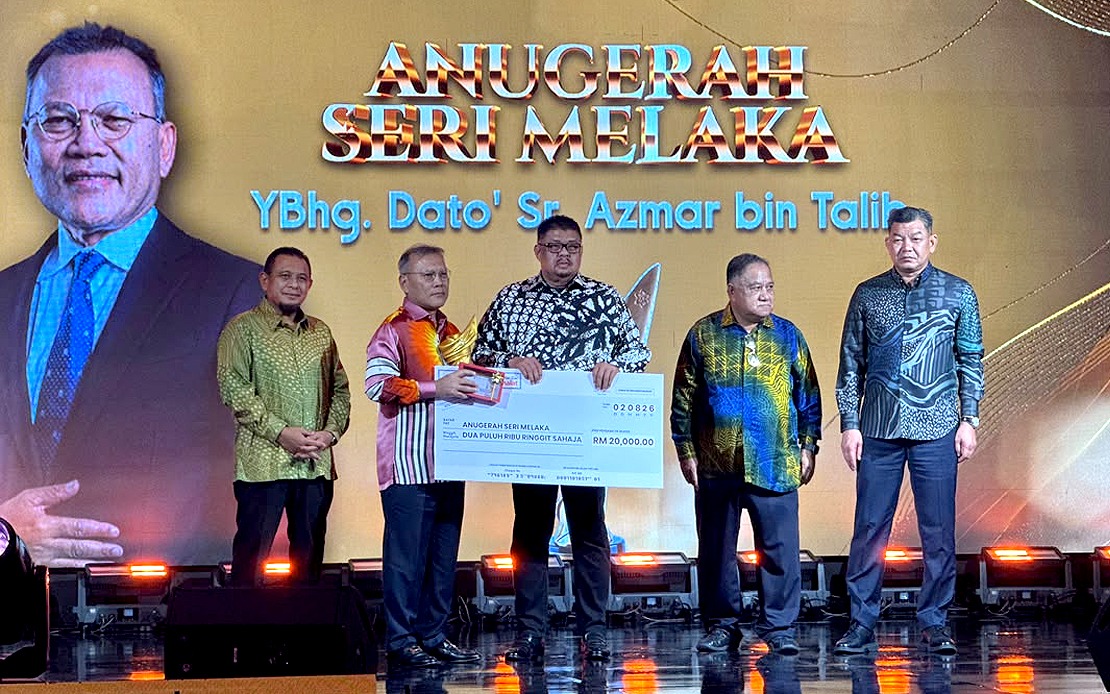
Melaka's Chief Minister Datuk Seri Ab Rauf Yusoh has made an impassioned appeal to the state's most accomplished citizens to leverage their professional standing and personal networks in service of broader development goals. Speaking at the inaugural Anugerah Seri Melaka (ASM) ceremony held at the Melaka International Trade Centre in Ayer Keroh, Ab Rauf articulated a vision where individuals who have achieved distinction in their respective fields become deliberate catalysts for opportunity creation within their home state, rather than confining their achievements to personal gain or external prestige.
The initiative, operating under the broader Melaka Sayang Rakyat (MeSRa) programme framework, represents an intentional effort by the state administration to systematise recognition of excellence while simultaneously extracting practical value from that recognition. The Chief Minister argued that documenting and publicising the accomplishments of Melaka-born talents serves a dual purpose: acknowledging individual merit whilst simultaneously creating a repository of inspirational narratives that can motivate younger generations to pursue their own ambitious paths. This approach reflects a deliberate philosophy that personal success stories, when properly shared, function as educational and motivational resources for entire communities.
The structural design of ASM encompasses four distinct categories reflecting the diverse sectors through which talent and excellence manifest themselves in Melaka's economy and society. The Public Service category recognises individuals who have distinguished themselves through government and institutional roles, whilst the Corporate category honours those who have achieved prominence in the private sector. The Sports and Arts and Culture categories acknowledge that societal contribution and excellence extend beyond purely economic measures, encompassing athletic achievement and creative cultural production that enhance state prestige and identity.
The inaugural awards ceremony revealed the breadth of accomplishment within Melaka's achiever networks. Datuk Azmar Talib, chief executive officer of TRX City Sdn Bhd, received the prestigious Corporate award, representing business and entrepreneurial excellence. Aaron Chia, a national badminton player, took the Sports category honour, demonstrating Melaka's capacity to produce internationally competitive athletes. In the Arts and Culture category, performing arts director Lokman Abd Ghani's recognition underscores the state government's acknowledgement of cultural production as a legitimate vector for regional differentiation and community identity.
The Public Service award went to Datuk Zamri Misman, director-general of the Legal Affairs Division at the Prime Minister's Department, signifying that Melaka-born talent has successfully penetrated the upper echelons of federal administration. Additionally, international medical science researcher Dr Saiful Anuar Singar received a Special Category award, highlighting the state's production of scholars and researchers contributing to global knowledge advancement in critical fields such as medical science.
The financial incentive structure reflects state commitment to recognising excellence meaningfully. The principal ASM award recipient received RM20,000 in cash alongside a trophy, whilst category winners each received RM10,000 and corresponding recognition. Whilst these sums are symbolic rather than transformative to accomplished individuals, they represent public validation and resource allocation toward recognising achievement, signalling state priority.
Ab Rauf's framing emphasised that documented success represents accumulated human capital that should circulate throughout the state ecosystem rather than remaining sequestered in individual biographies. The Chief Minister explicitly positioned success as inherently transmissible—that achievements by one Melaka-born individual create demonstrable pathways and possibilities for others pursuing similar trajectories. This reflects contemporary development thinking which emphasises that knowledge transfer, mentorship networks, and normative expectations shaped by visible role models constitute crucial infrastructure for sustained human capital development.
The initiative arrives within a Malaysian context where state governments increasingly compete for talent retention and attraction. The programme implicitly acknowledges a historical brain drain dynamic whereby Melaka's most accomplished citizens frequently establish themselves in Kuala Lumpur, Selangor, or international locations, diminishing the state's ability to retain human capital advantages. By creating structured recognition and requesting deliberate engagement from successful individuals, the state government attempts to maintain psychological and institutional connections with its diaspora of achievers.
The response to the inaugural awards suggests substantial reservoir of talent within Melaka's networks; the programme received more than 200 nominations across categories, indicating either significant achievement levels within the state population or alternatively strong willingness among Melaka-connected individuals to nominate peers. This nomination volume suggests that recognising excellence resonates within the community and that formal institutional recognition carries value beyond symbolic acknowledgement.
For younger Melakans navigating career decisions and professional development, the programme establishes visible demonstration that success originating from the state carries prestige and institutional recognition. The awards implicitly communicate that excelling in Melaka or elsewhere whilst maintaining state connections generates social capital and legacy opportunities. This messaging may prove particularly influential for secondary school and university-age individuals considering whether to invest efforts in state-based networks or to orient themselves exclusively toward Kuala Lumpur or international centres.
The Chief Minister's emphasis on experience and network sharing addresses a particular development challenge: that success often concentrates both economically and informationally. Accomplished individuals possess not merely financial resources but crucially hold knowledge about institutional pathways, professional networks, funding sources, and strategic relationships that younger individuals require to replicate success. By encouraging formalised mentorship through the awards framework, the state government attempts to democratise access to these informational and relational resources beyond what organic mentorship networks might provide.
Moving forward, the programme's effectiveness will depend substantially on translating recognition into actionable mentorship engagement. Awards ceremonies generate goodwill and validation, but sustained impact requires that honoured individuals actually dedicate time and intellectual resources to mentoring activities. The state government will need to develop supporting infrastructure—mentorship platforms, facilitation mechanisms, and potentially incentive structures—to convert the symbolic recognition of ASM into tangible knowledge transfer and opportunity creation for Melaka's emerging talent cohorts.

