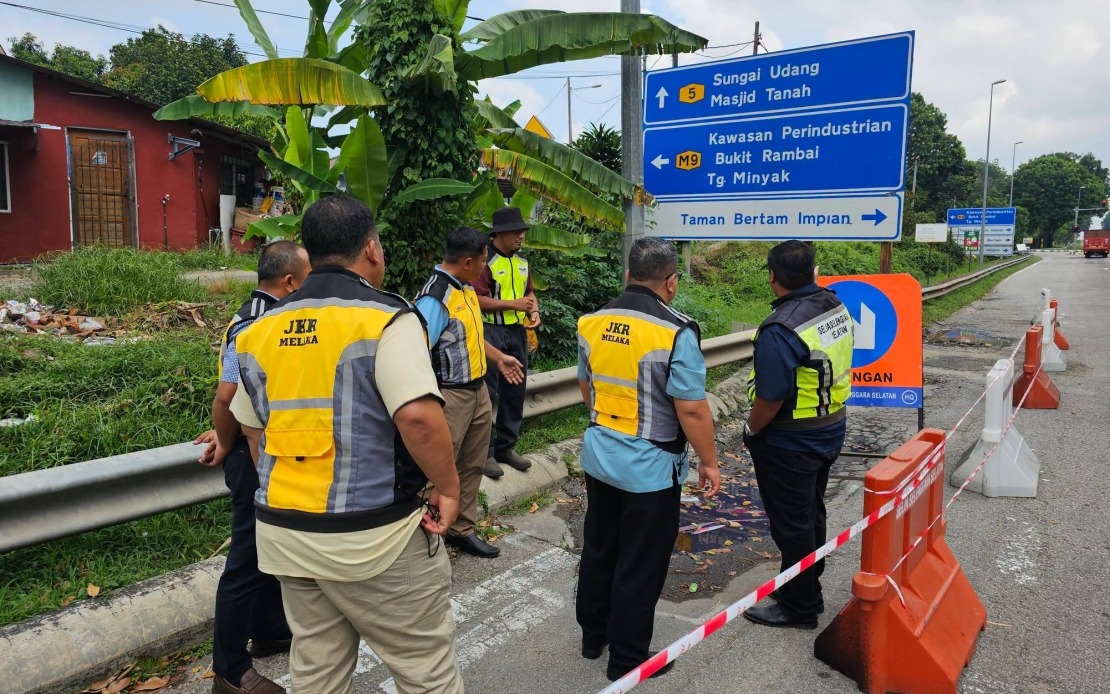
Melaka's state government is deploying RM25 million in emergency funding to restore critical infrastructure devastated by recent floods, signalling an aggressive response to the water management crisis that continues to plague the peninsula's southern region. The allocation represents a substantial commitment to immediate recovery efforts, targeting drainage systems and infrastructure across the state that suffered extensive damage during the severe weather events.
Datak Hameed Mytheen Kunju Basheer, chairman of the State Works, Infrastructure, Public Facilities and Transport Committee, revealed that authorities have pinpointed 100 separate locations requiring emergency intervention. These sites encompass a wide range of critical infrastructure, from compromised road networks and deteriorating river embankments to undersized drainage systems that proved inadequate during the recent inundation. The geographic spread of damage underscores the systemic nature of Melaka's flooding vulnerability, extending beyond isolated neighbourhoods to affect regional transportation corridors and essential drainage pathways.
To ensure coordinated and efficient deployment of resources, the state government has established a dedicated task force operating under the oversight of the state Department of Irrigation and Drainage. This supervisory structure aims to prevent the fragmentation often seen in large-scale recovery operations, where multiple agencies working independently can generate bottlenecks and inefficiencies. The centralised monitoring approach reflects lessons learned from previous disaster response cycles across Southeast Asia, where consolidated command structures typically accelerate project timelines and reduce wasteful duplication of effort.
The RM25 million has been distributed among four key implementing bodies: the District and Land Office, the Public Works Department, the Department of Irrigation and Drainage, and local authorities throughout the state. By channelling funds through existing administrative structures rather than creating new parallel organisations, Melaka's government is attempting to leverage established expertise and local knowledge. Each entity has been tasked with completing assigned remedial work in sequential phases, with all repair initiatives scheduled for completion by the end of August—a compressed timeline that reflects the urgency officials attach to preventing future episodes during the monsoon season.
The current intervention represents what Melaka's leadership explicitly characterises as a short-term stabilisation measure rather than a permanent solution to the state's persistent flooding challenge. Officials acknowledge that emergency repairs to existing infrastructure, while necessary to restore immediate functionality, do not address the underlying structural deficiencies that make Melaka disproportionately vulnerable to severe weather events. The distinction between immediate damage control and comprehensive system overhaul highlights a fundamental reality confronting many Malaysian states: limited budgets force difficult prioritisation between urgent response and long-term prevention.
For sustainable flood mitigation, Melaka's government is pursuing federal-level engagement to secure additional capital investment in expanded water retention infrastructure. The state is seeking funds to construct additional retention ponds that would capture and temporarily hold excess rainfall, reducing the volume of water flowing into existing drainage systems during peak events. Concurrently, authorities are planning to deepen and widen major drainage channels—a straightforward but expensive intervention that increases system capacity to accommodate the larger volumes of water anticipated during intense precipitation events.
These longer-term initiatives reflect an evolving understanding within Malaysian state administrations that climate patterns are shifting, with rainfall intensity increasing and traditional infrastructure designed for historical precipitation benchmarks proving inadequate for contemporary weather extremes. The drainage expansion programme contemplated by Melaka's planners aligns with similar adaptive infrastructure strategies being advanced across Southeast Asia, where rapid urbanisation and changing meteorological patterns have exposed the vulnerability of systems designed and constructed decades ago under different environmental conditions.
The funding announcement also carries implications for other flood-prone Malaysian states facing comparable infrastructure deficits. Melaka's allocation, while substantial in absolute terms, distributes to merely RM250,000 per identified priority location—a modest sum for comprehensive repairs in many instances. This limitation underscores the broader resource constraints facing state governments attempting to address infrastructure challenges that often require multi-year investment commitments exceeding annual budget capacities. States such as Selangor, Johor, and Terengganu, which experience comparable or more severe flooding episodes, confront similar funding pressures and competing budgetary demands.
The August deadline for completing repairs creates a race against the northeast monsoon season, which typically intensifies from October through March and generates the heaviest rainfall affecting Melaka and southern Peninsular Malaysia. If the timeline slips—a common occurrence in government infrastructure projects—the state risks entering the high-risk season with only partially remediated drainage systems and weakened embankments. This temporal constraint adds pressure to executing agencies and highlights the coordination challenges inherent in large-scale, time-bound infrastructure interventions.
Melaka's dual-track approach—combining immediate damage repair with longer-term preventive infrastructure development—reflects pragmatic governance realities. State administrations cannot realistically defer all response activities while awaiting federal funding approvals for major new projects. Simultaneously, investing exclusively in patchwork repairs without addressing systemic capacity limitations merely perpetuates the cycle of recurring damage and emergency response that has characterised Malaysian flood management for decades. The success of Melaka's strategy will depend on the speed and effectiveness of both the immediate repairs and the eventual construction of expanded retention and drainage capacity.

