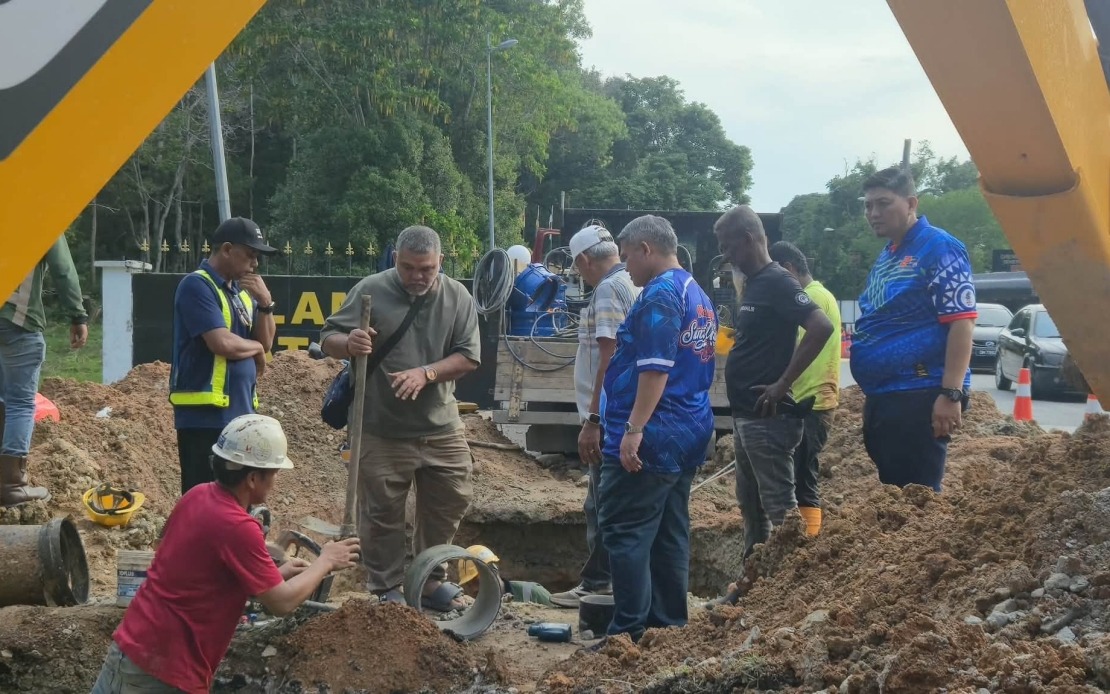
The Melaka state government is preparing to construct a temporary water storage facility at Kem Terendak in Sungai Udang to alleviate persistent water supply problems plaguing the military installation, according to Datuk Rais Yasin, the state senior executive councillor responsible for housing and local government matters. The proposal represents an interim solution designed to maintain water availability at the camp until a comprehensive overhaul of the water distribution infrastructure reaches completion, a timeline that extends to April 2028.
The initiative gained momentum following a severe pipe rupture along Jalan Kampung Payasum in Sungai Udang that left approximately 2,000 military personnel, their families, and five educational institutions—including a MARA Junior Science College—without adequate water supplies over a five-day period. Rais, who represents the Sungai Udang constituency, disclosed that the immediate emergency triggered a coordinated response involving Syarikat Air Melaka Berhad (SAMB), the state water utility company, which mobilised 25 tanker lorries to deliver 25,000 gallons daily beginning the day before his statement.
The temporary tank proposal nevertheless hinges on securing clearance from the Ministry of Defence, a prerequisite that underscores the complex jurisdictional landscape surrounding military installations. Rais acknowledged that responsibility for water infrastructure at Kem Terendak technically resides with the Public Works Department and Defence Ministry, yet he emphasised that Melaka's administration remains determined to support the affected military community and their dependents. The state government intends to submit formal plans to Defence Ministry, identifying an appropriate site for the temporary installation while concurrently maintaining emergency water distribution through mobile tanker deployments.
The immediate crisis stemmed from the major pipeline fracture, with repairs anticipated to conclude the same evening as Rais's announcement, though full restoration of normal supply capacity would require an additional one to two days. The scale of the emergency became apparent in the numbers: 2,000 military personnel and households suddenly confronted a water shortage, alongside administrative complications for the schools within the garrison. The daily delivery volume of 25,000 gallons, while substantial, proved insufficient given the scale of demand, prompting SAMB to also supply water containers directly to schools to sustain essential operations.
Rais's public apology to camp residents and affected families acknowledged the inconvenience and disruption, signalling political awareness of the broader implications for military morale and community welfare. The delivery of two 5,000-litre water tanks from SAMB to Kem Terendak, conducted during a formal handover ceremony, represented an immediate stopgap measure. Terendak Garrison Headquarters commanding officer Lt Col Annuar Kaliman and SAMB chief executive officer Datuk Mohd Saleh Jusman attended the ceremony, reflecting the multi-agency coordination required to address the crisis.
The longer-term Development and Upgrade of the Water Reticulation System project at Kem Terendak will fundamentally restructure how the camp receives and distributes water once operational in April 2028. This comprehensive infrastructure renewal suggests that current supply arrangements have proven inadequate to serve the camp's demands, necessitating not merely maintenance but systemic transformation. The multi-year timeline indicates the magnitude of work involved and the technical complexity of upgrading military installation utilities.
For Melaka's administration, the incident highlights vulnerabilities in coordinating infrastructure services across jurisdictional boundaries where federal military property meets state-level utility provision. The requirement to obtain Defence Ministry approval for even temporary measures demonstrates the procedural constraints that can delay responses to public emergencies. The state government's proactive approach through SAMB represents an attempt to exercise whatever authority it possesses to mitigate hardship, though the ultimate responsibility remains diffused among multiple federal agencies.
The water crisis at Kem Terendak carries implications extending beyond the immediate military community. It illustrates the broader infrastructure challenges affecting Melaka and the wider region, where ageing pipe networks remain susceptible to catastrophic failures capable of disrupting essential services across multiple institutions simultaneously. The decision to supply water containers to schools demonstrates awareness that educational continuity depends on basic utilities, a principle that resonates beyond the military context.
The temporary tank proposal, contingent on Defence Ministry approval, exemplifies the pragmatic problem-solving that characterises local government responses to infrastructure emergencies. Rather than simply managing acute shortages through tanker distribution indefinitely, the state administration seeks to implement a semi-permanent interim solution that provides reliability while the definitive infrastructure project progresses. This approach balances the fiscal constraints of emergency response against the need to restore normalcy for the affected population within a reasonable timeframe.

