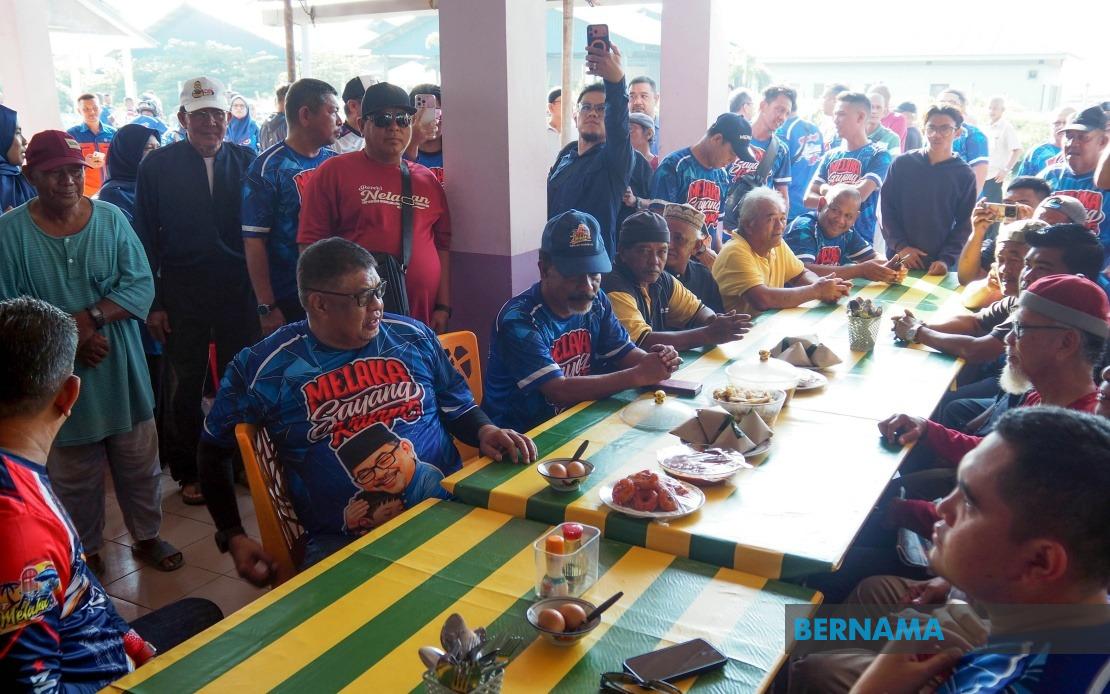
The Melaka state government has unveiled a comprehensive support package aimed at strengthening the livelihoods of its fishing communities, combining traditional social safety nets with modern fishing technology. Unveiled during the fifth leg of Chief Minister Datuk Seri Ab Rauf Yusoh's 'Jelajah Ketua Menteri Sayang Rakyat' tour at Kuala Sempang Jetty in Jasin, the dual-pronged approach signals a deliberate shift toward both protecting and modernising one of the state's traditional economic sectors. The initiatives represent an effort to address long-standing vulnerabilities facing maritime workers whilst equipping them with tools to enhance catch efficiency and income generation.
Datak Seri Ab Rauf Yusoh articulated the motivation behind these measures during the Merlimau state constituency engagement, emphasising the importance of direct interaction between government officials and fishing communities. Rather than relying on administrative channels, the Chief Minister stressed that policymakers must venture into fishing villages and coastal areas to observe conditions firsthand and respond to genuine, articulated needs. This ground-level approach has yielded two major commitments: universal PERKESO (Sockarangkan Keselamatan Sosial Organisasi) coverage for all registered fishermen and the provision of fish-finding technology. The philosophy underpinning these decisions reflects broader recognition that fishing communities have historically operated with minimal institutional support despite facing occupational hazards and income volatility.
The PERKESO coverage component addresses a significant gap in occupational protection for Malaysia's maritime workers. Fishermen face considerable workplace risks—from equipment-related injuries to unpredictable weather conditions and maritime accidents—yet many operate outside formal employment frameworks that would automatically grant them social security protection. By mandating PERKESO coverage, Melaka extends critical benefits including disability insurance, death benefits, and emergency medical support specifically designed for workers in hazardous environments. This move recognises that elderly fishermen and those without alternative income sources require institutional safeguards against income loss due to injury or incapacity. For fishing communities in Melaka, where many households depend entirely on maritime activities for sustenance, such coverage provides essential economic stability.
The second pillar—distribution of fish-finder technology—represents a modernisation initiative with tangible economic implications. Fish finders, electronic devices that use sonar to detect underwater fish concentrations, have become standard equipment in commercial fishing operations globally but remain prohibitively expensive for small-scale fishermen operating with limited capital. At between RM1,000 and RM2,000 per unit in retail markets, individual acquisition remains economically unfeasible for most traditional fishermen. By subsidising or providing these devices, Melaka reduces a major capital barrier whilst simultaneously increasing catch efficiency and reducing fuel costs associated with unsuccessful fishing expeditions. Fishermen can pinpoint high-concentration areas rather than relying on experience-based estimation, thereby improving success rates and sustainability of catches.
During the Kuala Sempang event, authorities distributed RM200 assistance to each of 107 registered fishermen under the 'Bantuan Jaring Nelayan' scheme, totalling RM21,400 in direct transfers. This immediate cash assistance supplements the longer-term benefits of PERKESO coverage and fish-finder provision, offering urgent relief for operational costs such as net repairs, fuel, and maintenance. Simultaneously, the government distributed 360 kilogrammes of fish valued at RM3,600 to the public at approximately 1.5 kilograms per person, demonstrating commitment to ensuring food security whilst supporting local fishermen through direct market absorption of catch. These concurrent distributions—cash assistance to fishermen and fish provision to residents—create a localised economic circuit that benefits both supply-side producers and demand-side consumers within Melaka.
Amirul Shah Fuad Shah, a 35-year-old fisherman with over two decades of maritime experience from Kuala Merlimau, articulated the practical value of fish-finder technology for traditional fishing operations. The technology transforms uncertainty into precision, allowing fishermen to transition from intuitive, experience-based location-scouting to data-driven positioning. Previously, decisions about where to cast nets relied on accumulated knowledge of seasonal patterns, water conditions, and historical catch sites—methods that remain vulnerable to environmental variability and provide no real-time feedback. Fish finders deliver immediate sonar feedback, dramatically reducing unsuccessful casting and associated resource waste. For Amirul, whose household economic security depends directly on fishing productivity, such technological enhancement represents a meaningful improvement in operational reliability and income predictability. His acknowledgment that the retail cost of RM1,000 to RM2,000 per unit places fish finders beyond individual financial reach underscores the importance of government provision for small-scale fishermen operating on constrained budgets.
Kampung Sempang Fishermen's Association chairman Md Khalil Md Jadi, aged 67, brought a community perspective to the initiatives, framing them as acknowledgment of fishing communities' historical marginalisation within broader economic development narratives. He emphasised that many fishermen are elderly workers lacking alternative income sources and entirely dependent on maritime activity for household survival. For this demographic, occupational risks assume heightened significance—injury or incapacity translates directly into destitution rather than temporary income disruption. PERKESO coverage thus represents not merely administrative protection but a commitment to sustaining elderly workers through inevitable physical decline and unexpected maritime incidents. Simultaneously, Md Khalil contextualised fish-finder technology within a longer modernisation trajectory, suggesting that fishermen have long sought tools to enhance traditional methods rather than abandon them. The provision of technology whilst maintaining cultural and occupational continuity reflects a development model that upgrades rather than displaces traditional economic activities.
These initiatives must be understood within Melaka's broader fishing sector context. As a coastal state, Melaka's fishing communities constitute a significant portion of the rural population, particularly in constituencies like Merlimau. Yet fishing remains economically vulnerable and institutionally neglected compared to urban commerce or modern manufacturing sectors. Government provision of PERKESO and fish-finder technology signals political commitment to rural coastal communities, traditionally under-resourced relative to urban constituencies. The 'Jelajah Ketua Menteri Sayang Rakyat' campaign structure, which explicitly routes leadership engagement through grassroots constituencies, reflects efforts to align rural development priorities with state-level policymaking. Such engagement mechanisms can identify sectoral needs that might otherwise remain invisible within conventional bureaucratic channels, enabling targeted support rather than generic rural development schemes.
For Malaysian fishing communities more broadly, Melaka's approach offers a potential model for state-level interventions addressing occupational vulnerability and technological capability gaps. Many maritime workers across Malaysia's coastal regions operate in comparable conditions—limited capital, high occupational risk, and dependence on traditional knowledge systems. The combination of social security extension and technology subsidisation addresses both immediate welfare concerns and productivity enhancement, creating complementary rather than competing policy objectives. However, successful replication requires adequate state revenue, institutional capacity for registration and distribution systems, and ongoing commitment to maintenance and training associated with technological provision. The fish-finder initiative particularly requires supporting infrastructure including technical support, equipment servicing, and perhaps user training to ensure devices deliver intended efficiency gains rather than accumulating as underutilised assets.

