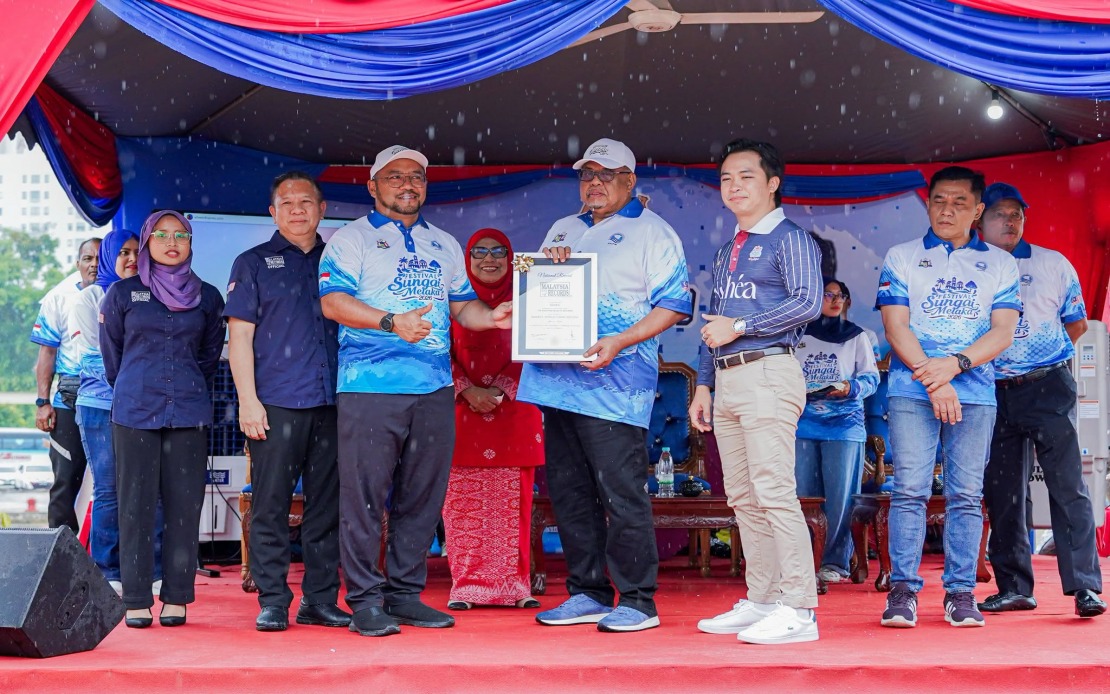
Melaka has accumulated four Malaysia Book of Records (MBOR) tourism recognitions within a compressed three-year timeframe, marking a significant acceleration in the state's efforts to position itself as a premier regional destination. The latest record caps a consistent pattern of achievement that state officials say reflects deliberate, innovation-driven strategies in the tourism portfolio. The ceremony presenting the newest certificate took place at Dataran Pengkalan Rama during festivities surrounding the Sungai Melaka Festival 2026, signalling how Melaka is weaving record-breaking initiatives into broader cultural and community programming.
Chief Minister Ab Rauf Yusoh framed these accolades not as endpoints but as catalysts. Speaking at the presentation ceremony, he articulated a philosophy that distinguishes his administration's approach: recognition certificates alone hold minimal value unless they generate tangible downstream effects. The chief minister explicitly rejected the notion of achievements becoming mere wall decorations, instead calling for these records to stimulate fresh ideas, novel tourism offerings, and programmes capable of extending visitor stays and multiplying economic returns for local residents. This framing reflects growing pressure across Southeast Asia for tourism success to be measured not in headlines but in distributed prosperity.
The Sungai Melaka Festival represents a flagship vehicle for this strategy. Now in its seventeenth iteration, the festival programming spans all three of Melaka's administrative districts and encompasses more than thirty discrete activities, demonstrating an intentional effort to distribute tourism activity geographically rather than concentrating it in heritage zones. The scale and diversity of programming suggest Melaka is moving beyond heritage tourism—the state's historical strength—toward experiential and recreational offerings that appeal to broader demographics and repeat visitation patterns.
A particularly instructive component involves the freshwater fishing competition, which drew 1,123 participants from both within and beyond Melaka's borders. With aggregate prize money totalling RM30,000 and a first-place purse of RM10,000, the competition achieved sufficient scale to attract serious competitors while establishing a differentiated leisure product. The chief minister's observation that such participation numbers indicate a dedicated and mobilizable fishing community suggests Melaka recognizes niche tourism segments often overlooked by mainstream destination marketing. This approach mirrors successful strategies in Thailand and Vietnam, where recreational fishing tourism has evolved into substantial economic generators.
The fishing competition warrants expansion into a standalone tourism product, according to state leadership, with plans for enhanced scale and augmented prize structures. This trajectory—from festival component to dedicated tourism offering—reflects incremental yet purposeful development strategy. Rather than attempting wholesale reinvention, Melaka is identifying successful pilots within existing festivals and methodically scaling those with proven appeal. The pattern suggests administrative confidence in ground-level market testing before major capital deployment.
Melaka River development has emerged as a thematic anchor for diversification efforts. The Melaka River and Beach Development Corporation (PPSPM), represented at the ceremony by chief executive officer Shaharul Azuar Idris, coordinates riverbank activation through community-centred programming. This institutional arrangement—establishing a dedicated development corporation—parallels approaches employed by Kuala Lumpur in Klang Valley revitalization and Singapore in Marina Bay enhancement. The river thus functions as both heritage asset and contemporary recreation hub, accommodating heritage tourism while incubating newer recreational experiences.
For Malaysian tourism stakeholders, Melaka's trajectory offers instructive lessons. The state is demonstrating that MBOR recognition, while valuable for marketing purposes, gains greatest utility when deployed as evidence of operational capability and market validation. The fishing competition example illustrates how record-breaking potential exists across tourism subsectors rather than exclusively in marquee heritage or infrastructure projects. This democratization of achievement-setting could encourage smaller tourism operators and community groups to pursue recognition, creating multiplier effects throughout the ecosystem.
Regionally, Melaka's approach addresses persistent Southeast Asian tourism challenges. Many destinations struggle to convert heritage attractions into sustainable economic models that benefit broader populations beyond central districts. By systematically developing complementary recreational and experiential offerings—from fishing to river festivals to culinary experiences—Melaka is constructing a more resilient tourism portfolio less vulnerable to temporary demand fluctuations or heritage fatigue. This diversification strategy proves particularly relevant as post-pandemic tourism patterns shift toward experiences and activities rather than passive sightseeing.
The four records achieved within three years also signal institutional capacity. Malaysian state governments typically face resource constraints limiting tourism innovation. The frequency of Melaka's recognition suggests either substantial investment, exceptional organizational efficiency, or most likely both. For competing Malaysian destinations and other ASEAN states, these results invite examination of Melaka's administrative processes, marketing strategies, and stakeholder engagement mechanisms. The state has effectively transformed record-seeking from vanity exercise into a structured innovation framework.
Looking forward, the chief minister's emphasis on converting recognition into extended visitor stays and community economic participation establishes performance metrics beyond the records themselves. This stance acknowledges a risk endemic to tourism development: spectacular projects and achievements that generate limited tangible benefit for residents can foster local resentment and undermine sustainability. Melaka's explicit commitment to ensuring recognition translates into distributed economic gain suggests awareness of this dynamic and intention to manage it proactively.
The Sungai Melaka Festival's expansion across all three districts represents spatial strategy that previous analyses of Malaysian tourism have often overlooked. Many destinations concentrate resources in heritage cores, leaving peripheral areas tourism-poor. Melaka's deliberate programming across Melaka Tengah, Melaka Utara, and Melaka Selatan distributes tourist activity and associated spending more equitably. Such spatial strategies, if sustained and coupled with infrastructure investment, can gradually reshape state tourism economies to benefit communities currently peripheral to visitor flows.

