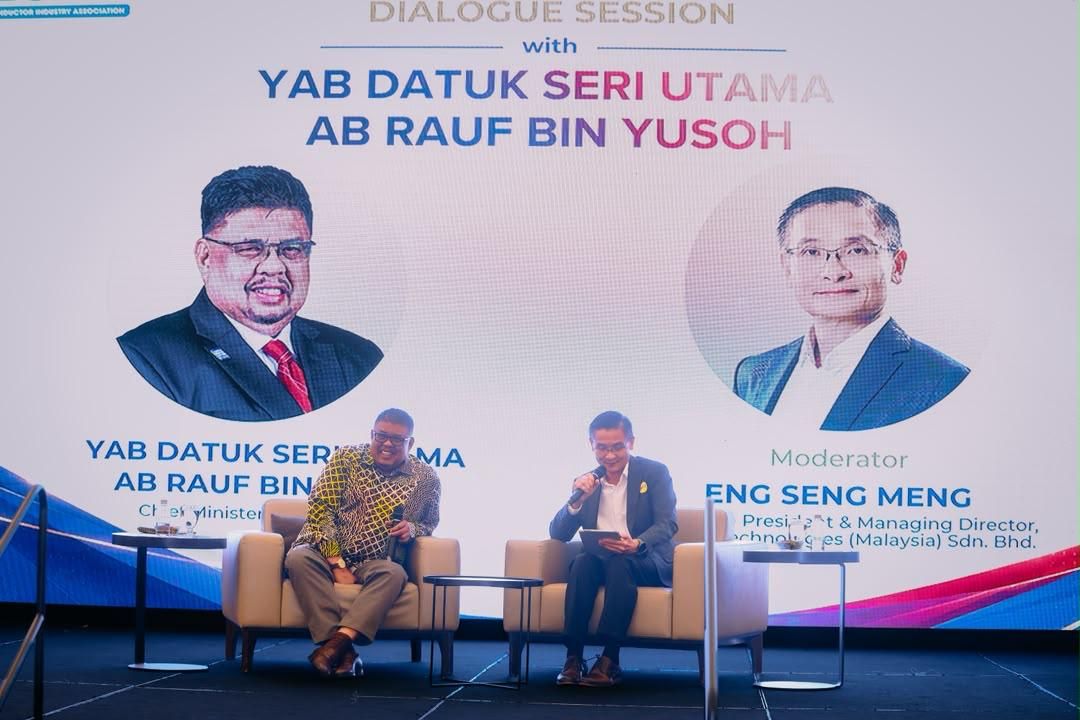
Melaka's semiconductor industry has matured into a RM17.6 billion economic pillar over half a century, according to Chief Minister Datuk Seri Ab Rauf Yusoh, who traced the sector's trajectory from humble beginnings to a world-class manufacturing destination. Speaking at an industry dialogue session in July, Ab Rauf chronicled how the state transformed from a modest operation with a skeleton workforce into a competitive global technology hub, reflecting decades of sustained growth and strategic development.
The sector's roots reach back to the early 1970s, when an international investor took a calculated risk by establishing semiconductor manufacturing in Melaka. Rather than occupying a sprawling industrial complex, the company began operations from an Umno building on Jalan Hang Tuah before expanding to Batu Berendam following the establishment of Melaka's first Free Industrial Zone in 1976. This foundational moment initiated a cascading series of industrial developments that positioned the state as a preferred location for advanced manufacturing across multiple decades.
What distinguishes Melaka's semiconductor success is not merely the scale of a single corporation but the systematic ecosystem development that emerged around early investments. The handful of dedicated workers from those pioneering years evolved into a complex industrial network supporting more than 400 manufacturing companies operating across 18 distinct industrial sectors. Manufacturing now contributes 36.1 percent to the state's overall economy, cementing the sector's centrality to Melaka's prosperity and regional competitiveness.
The economic ripple effects extend far beyond headline statistics. The semiconductor industry has created employment pathways for skilled workers while sustaining livelihoods across supply chains that encompass multinational manufacturers, local component suppliers, small and medium enterprises, and supporting service industries. Over five decades, this ecosystem has generated sustained high-value employment opportunities that distinguish Melaka from many peer regions competing for advanced manufacturing investment.
Ab Rauf identified three fundamental competitive advantages underpinning Melaka's appeal to global investors. The state's geographic position between Kuala Lumpur, Johor, and Singapore provides convenient access to major regional markets, while proximity to ports and airports facilitates international logistics. Simultaneously, Melaka maintains cost competitiveness in land acquisition, operational expenses, and living costs compared to more developed neighbouring jurisdictions—a combination rarely available in Southeast Asia's manufacturing landscape.
The state possesses over 2,600 hectares of available industrial land, providing companies with expansion flexibility as demand fluctuates. Critically, this land base offers breathing room for operations to scale without geographic constraints that plague more densely developed alternatives. The availability of undeveloped industrial zones represents a tangible advantage in attracting manufacturers seeking long-term growth trajectories rather than immediate-term establishment.
Skilled labour availability constitutes another pillar of competitive advantage. Melaka has developed 61 technical and vocational education institutions producing industry-ready graduates whose training increasingly aligns with semiconductor manufacturers' evolving requirements. This institutional focus on workforce development differentiates the state from regions lacking comparable TVET infrastructure, ensuring supply chains can access appropriately skilled workers without costly relocation or intensive retraining programmes.
Investor confidence in Melaka's stability and business environment remains robust despite intense global competition for semiconductor manufacturing. Multinational corporations from the United States, Germany, China, Japan, and other technology-leading nations have maintained continuous operations spanning multiple decades, their presence attesting to perceived reliability and political-economic stability. This demonstrated commitment reflects expectations that the regulatory environment and business fundamentals will remain conducive to long-term investment.
Recent investment performance reinforces optimistic positioning. Melaka recorded RM14.68 billion in investments across 312 projects during 2025, marking the highest investment value in 22 years. This achievement, however, arrives amid competitive pressures that demand immediate attention. Ab Rauf cautioned that semiconductor manufacturing decisions made in the present period will shape global technology supply chains for the next two decades, implying that Melaka faces time-sensitive competitive windows.
The Chief Minister warned that insufficient pace in responding to manufacturer requirements could result in relocation decisions favouring jurisdictions offering faster approvals, stronger technological capabilities, and greater operational certainty. Failure to maintain competitive positioning risks not only attracting new investments but also losing expansion opportunities for existing operations—consequences that would cascade through supporting industries and deprive thousands of high-skilled workers of employment opportunities. Local SMEs integrated into global semiconductor supply chains face particular vulnerability to competitive displacement.
Responding to these pressures, Melaka has launched the Semiconductor Strategy 2035, an initiative designed to secure high-value investments while strengthening local technological capabilities and reinforcing the state's desirability among global semiconductor players. The strategy represents acknowledgment that historical competitive advantages require continuous renewal and adaptation to maintain relevance in rapidly evolving global markets. Beyond infrastructure development and financial incentives, the state government has committed to operational support encompassing expedited approvals, issue resolution, and hands-on project facilitation from planning through implementation phases.
Ab Rauf emphasised that Melaka's value proposition now encompasses integrated advantages spanning geographic connectivity, operational cost competitiveness, technological talent availability, a demonstrated industrial ecosystem, and government commitment to supporting sustained investment. This multifaceted positioning reflects evolution from basic cost advantages toward comprehensive ecosystem development that addresses sophisticated manufacturer requirements across operational, logistical, and human capital dimensions.
The semiconductor sector's trajectory illustrates how initial investment decisions catalyse long-term economic transformation when supported by strategic infrastructure development, workforce preparation, and business environment stability. For Malaysia and Southeast Asia, Melaka's experience demonstrates that sustained competitiveness requires continuous investment in institutional capacity and responsiveness to evolving global market demands, particularly in technology-intensive sectors where competitive positioning shifts rapidly.

