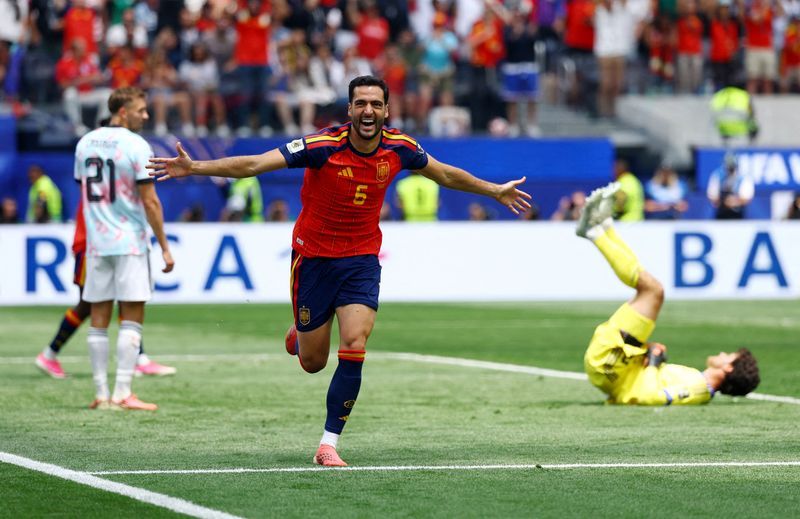
In a match shaped as much by misfortune as by football excellence, Spain advanced to the World Cup semifinals with a 2-1 victory over a depleted Belgium side at Los Angeles Stadium on Friday, positioning themselves for a tantalising encounter with tournament favourites France in Dallas. The decisive moment came when substitute goalkeeper Senne Lammens, pressed into action after Thibaut Courtois suffered an injury, failed to secure a routine save, allowing midfielder Mikel Merino to convert the rebound just four minutes after taking the field. The late drama at the sold-out venue, with a predominantly Spanish crowd, underscored how narrow margins often decide knockout competitions at the sport's highest level.
Spain's path to this semifinal has been marked by surgical precision and tactical discipline under Luis de la Fuente, qualities that were on display despite Belgium's determined resistance. The Spanish side controlled large portions of the contest and created multiple opportunities to extend their advantage, yet they required Merino's clinical finishing to ultimately break Belgian resistance. The performance demonstrated Spain's ability to find solutions even when opponents frustrate their natural rhythm, a hallmark of tournament-winning teams. Belgium, conversely, was operating with significant disadvantages, having lost key personnel before and during the competition.
The match unfolded predictably in its opening stages, with Spain dominating possession and territorial advantage. Fabian Ruiz provided the breakthrough in the thirtieth minute, capitalising on a fortunate rebound after Courtois had made an outstanding diving save to deny an earlier effort. Ruiz's finishing, threading his shot between defender Timothy Castagne's legs, reflected Spain's quality in attack and de la Fuente's tactical acumen in selecting the Paris Saint-Germain midfielder instead of Pedri. This decision to deploy a player closer to full fitness, ahead of one still building match sharpness, proved vindicated by the opening goal.
Belgium's response came swiftly, as Charles De Ketelaere levelled matters eleven minutes after falling behind. The Belgian forward's well-timed run and clean header from Castagne's cross represented the first goal Spain had conceded in the tournament, a statistic that suddenly became less impressive as the match progressed. The equaliser provided psychological momentum to Belgium's camp and suggested the contest might develop into a tightly contested affair, though the Spanish side's superior depth and fresh legs would eventually prove decisive.
The conditions in Los Angeles were oppressive, with intense heat affecting both teams' rhythms and physical capability. Spain adapted more successfully to these demands as the second half commenced, demonstrating the cardiovascular superiority that comes from careful rotation management and a larger pool of quality replacements. The introduction of teenage sensation Lamine Yamal, whose electric pace and dribbling repeatedly troubled Belgium's defensive structure, exemplified Spain's attacking depth. De la Fuente's substitution strategy proved crucial, with Merino replacing Ruiz and immediately making an impact that will be remembered as the defining moment of this quarterfinal encounter.
Merino's intervention speaks to a broader narrative about Spanish football's evolution in tournament football. The Athletic Bilbao midfielder's ability to find the back of the net in high-pressure moments, combined with his earlier substitute-appearance winner against Portugal in the round of sixteen, marks him as a clutch performer when matches remain finely balanced. His post-match observation that preparation breeds opportunity rather than mere chance underscores the mentality within Spain's squad, where even players entering matches late have been schooled in the team's tactical principles and are ready to contribute immediately.
Belgium's campaign was undermined by injury circumstances beyond their control. Captain Youri Tielemans was removed from the starting lineup mere minutes before kickoff following a warm-up injury, forcing Hans Vanaken into an unexpected role. More significantly, midfielder Amadou Onana had already been lost to a cruciate ligament tear sustained during Belgium's previous knockout-stage victory over the United States. These absences deprived Belgium of midfield control and dynamism precisely when they needed to compete with Spain's passing dominance. Veterans Kevin De Bruyne and Romelu Lukaku, despite their immense talent, could not compensate for the structural weaknesses created by these enforced absences.
Spain's achievement also represents a remarkable turnaround for a national team that has historically excelled at the continental level but faced questions about their World Cup pedigree before this tournament. The last time they reached the semifinals was in 2010, when they completed their journey by winning the trophy, defeating the Netherlands in the final. That distant memory provides both template and inspiration for this current squad, many of whom are inspired by the legacy of that golden generation. Now standing two matches from potential glory, Spanish football finds itself in familiar position of being among the tournament's elite contingents.
The semifinal against France will test Spain against perhaps the tournament's most formidable opponent. The reigning world champions possess the defensive organisation and offensive firepower to challenge anyone, yet Spain's technical superiority in midfield construction offers them a genuine pathway to victory. De la Fuente's comments that both teams approach the encounter with mutual concern suggest realistic assessment from the Spanish coaching staff, acknowledging France's quality whilst maintaining confidence in their own capabilities. The Dallas matchup on Tuesday promises to be one of the tournament's marquee encounters, pitting two European footballing traditions against each other when stakes have never been higher.

