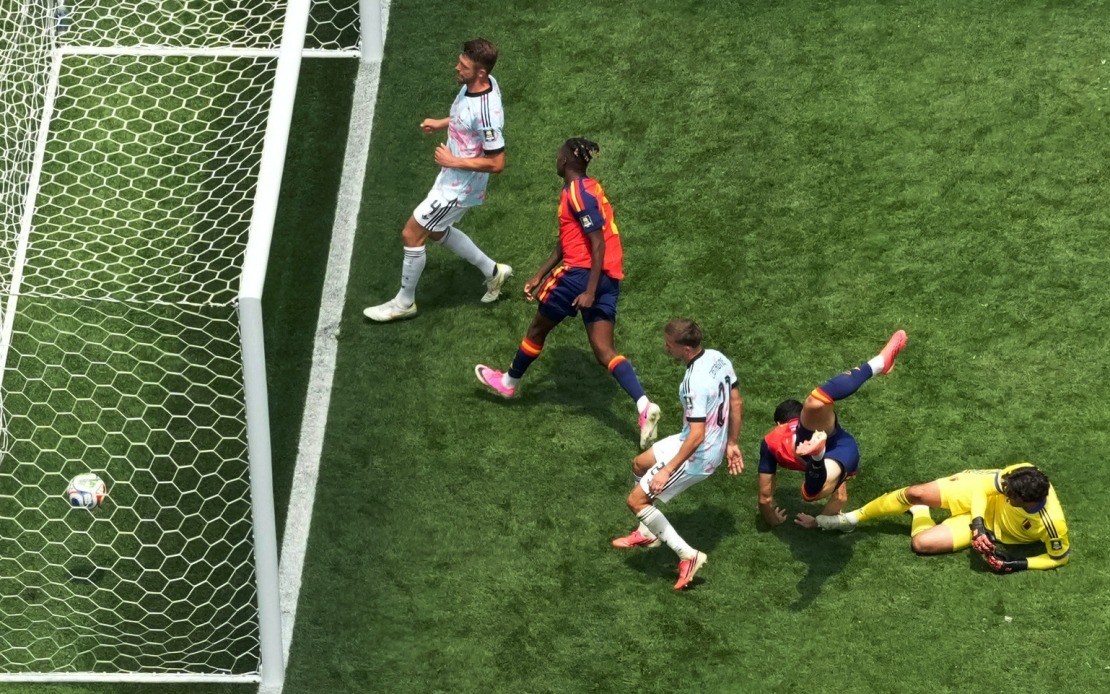
Spain has returned to the semi-finals of football's premier tournament for the first time in more than a decade, courtesy of substitute midfielder Mikel Merino's clinical finishing in the 88th minute against Belgium at Los Angeles Stadium on Friday. The victory, achieved with a 2-1 scoreline, marks a significant milestone for La Roja, who last reached this stage in 2010 when they claimed the tournament title. Merino's knack for delivering when it counts most has now been demonstrated twice in this competition, following his decisive contribution in the round-of-16 victory over Portugal, underlining his value as an impact substitute in high-pressure matches.
Spain's path to the semi-final began with dominant football in the opening exchanges, with the team controlling possession and dictating play against their Belgian opponents. The dominance nearly translated into early advantage when 18-year-old sensation Lamine Yamal unleashed a curling shot that narrowly missed the left post in the 21st minute, showcasing the emerging talent that has captured international attention throughout this tournament. However, the breakthrough came through midfielder Fabian Ruiz in the 30th minute, when he reacted fastest to a rebound following Belgian goalkeeper Thibaut Courtois's impressive save from winger Dani Olmo's initial effort.
Courtois, the 34-year-old custodian competing in what may be among his final World Cup appearances, proved to be Belgium's primary defensive pillar throughout the first half. Beyond his crucial saves, the experienced goalkeeper demonstrated exceptional positioning and reflexes in denying Yamal once more in the 35th minute, diving sharply to his right to parry a free-kick that had been heading for the bottom corner. His commanding presence between the sticks suggested Belgium might mount a credible resistance despite Spain's tactical superiority, yet the Red Devils would concede again before the interval through an entirely preventable lapse in defensive concentration.
Belgium's equaliser arrived in the 41st minute when the defensive line collapsed around full-back Timothy Castagne's delivery from the right flank. Forward Charles De Ketelaere, finding space in the penalty area, powered a downward header past goalkeeper Unai Simon to restore parity and inject dramatic tension into the encounter. The goal represented Belgium's first concession of the tournament, suggesting that the defending champions had tightened their rearguard considerably entering the knockout stages. This equaliser would prove pivotal in shaping the narrative of the second half, as Belgium sensed an opportunity to exploit what appeared to be a Spanish vulnerability under pressure.
Rudi Garcia's Belgian side emerged for the second half with renewed attacking intent, nearly capitalising on a spell of Spanish disorganisation when full-back Maxim De Cuyper's effort struck the side netting approximately 10 minutes after the restart. The moment epitomised Belgium's tactical approach in the latter stages: attempting to exploit spaces on the flanks while pressing higher up the pitch to disrupt Spain's intricate possession-based system. However, as the match progressed toward its conclusion, Spain's greater technical depth and superior fitness began to assert itself decisively.
Courtois continued to frustrate Spain's attacking intentions with a succession of reflexive saves, denying both Yamal and forward Mikel Oyarzabal within rapid succession before succumbing to what appeared to be a leg injury in the 71st minute. The Belgian goalkeeper's departure, necessitating the introduction of Manchester United's Senne Lammens, would ultimately prove catastrophic for Belgium's aspirations. Lammens, lacking Courtois's composure and reading of the game, immediately struggled to command his penalty area effectively, a deficiency that would prove decisive within minutes.
The turning point arrived in the 88th minute when centre-back Pau Cubarsi dispatched a long-range effort that the substitute goalkeeper could not securely gather. The resultant spill left the ball loose in the box, and Merino, demonstrating the predatory instinct that characterises top-class finishers, pounced with a poacher's finish to complete Spain's turnaround. The goal sent Los Angeles Stadium into bedlam among the Spanish contingent, confirming passage to the semi-finals and relegating Belgium's tournament to an early conclusion despite their robust first-half performance.
Spain's next assignment presents an even more formidable examination of their credentials, as they prepare to face France in Dallas Stadium on July 15. The two-time champions reached this stage by dismantling Morocco with a convincing 2-0 victory on Thursday, demonstrating the attacking potency and defensive solidity that has characterised their campaign throughout this expanded competition. The France matchup represents an intriguing clash between two different playing philosophies: Spain's deliberate, technically assured possession-based approach against France's more direct, athletically intense football. Both teams possess the calibre to claim the trophy, making their semi-final encounter one of the tournament's marquee fixtures.
The FIFA World Cup 2026 represents an unprecedented expansion of the tournament's scope, featuring 48 participating nations split across three host countries—Canada, Mexico, and the United States. This structural change marks the most significant expansion since the inaugural tournament in Uruguay in 1930, fundamentally altering the competitive balance and creating opportunities for emerging footballing nations alongside the traditional powerhouses. Spain's progression reflects not merely their technical superiority but also their ability to navigate a more congested tournament format where depth of squad and tactical flexibility assume paramount importance. The expanded format means that Spain's achievement in reaching the semi-finals after such a lengthy absence assumes additional significance, suggesting a genuine renaissance in their playing standards following several years of uncertainty.
For Malaysian readers and Southeast Asian football enthusiasts, Spain's resurgence offers pertinent lessons regarding sustained excellence and generational renewal. The integration of young talents like Yamal alongside experienced campaigners demonstrates how modern football demands constant evolution while maintaining core principles. Similarly, the tournament's expansion raises questions about competitive opportunity for emerging nations and whether larger formats genuinely expand footballing democracy or merely create additional pathways for established powers. Spain's journey to the semi-finals, built upon principled attacking football and meticulous squad management, provides compelling evidence that technical excellence and patience ultimately prevail in knockout competition.
The tournament concludes on July 19, with remaining matches likely to determine whether Spain can recover the trophy they last claimed 16 years ago or whether France will add to their existing World Cup haul. Spain's semi-final appearance, ending their 16-year drought, reflects the cyclical nature of international football success, where periods of dominance inevitably give way to rebuilding phases before re-emergence occurs. For La Roja, the presence of fresh talent alongside experienced performers suggests their current trajectory might sustain their challenge through the latter stages of this expanded tournament format.

