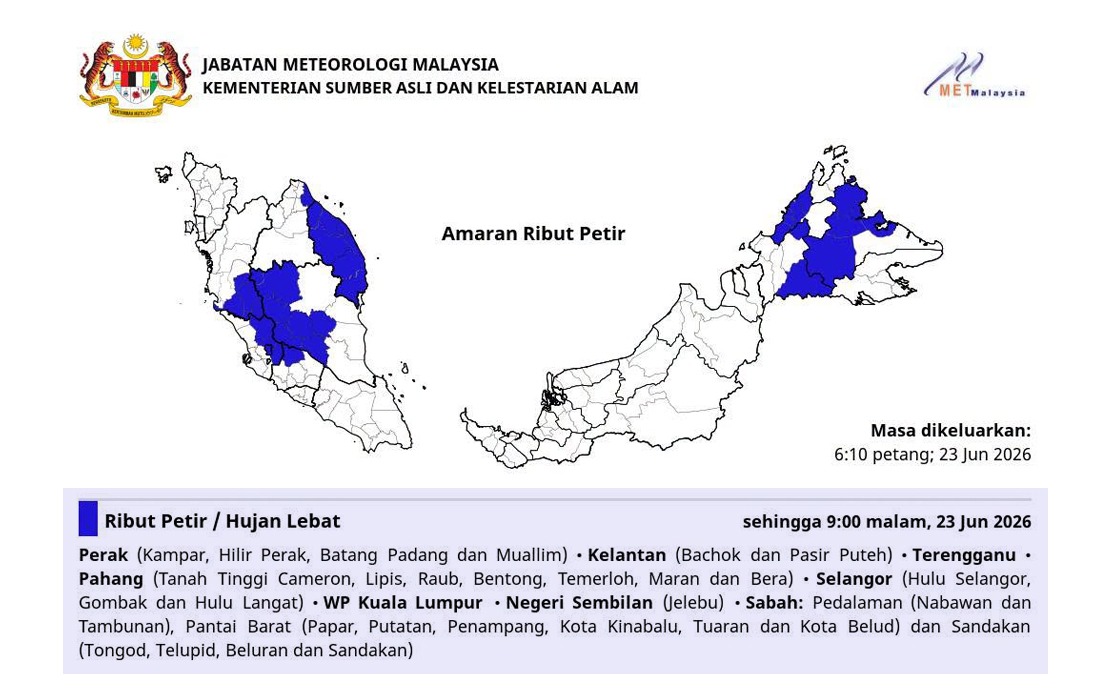
Malaysia's Meteorological Department has issued a formal advisory regarding Typhoon Mekkhala, which currently poses no threat to Malaysian territory despite its proximity to the region. The system, detected approximately 1,616 kilometres to the northeast of Kudat in Sabah, remains concentrated in the vicinity of Luzon in the Philippines, where it presents the more immediate concern for residents and authorities.
According to observations recorded by MetMalaysia's National Weather and Geophysics Operations Centre at 5 pm on June 23, the typhoon was situated roughly 460 kilometres northeast of Luzon. This positioning places the storm system substantially removed from Malaysia's land mass and exclusive economic zone, allowing meteorological officials to rule out significant domestic impacts at this time.
The typhoon exhibited notable forward momentum and intensity characteristics during the monitoring period. The system was advancing in a northwesterly direction at a modest pace of 10 kilometres per hour, while simultaneously developing considerable wind speeds that could reach a maximum of 185 kilometres per hour. This combination of relatively slow movement and moderate-to-strong winds suggests the system may maintain its general trajectory without rapidly approaching Malaysian airspace or coastal regions.
For Malaysian authorities, the lack of direct threat simplifies operational planning across aviation, maritime, and emergency management sectors. However, the existence of such a weather system in the broader Southeast Asian region remains noteworthy for broader economic and social reasons. Regional typhoons and tropical cyclones have historical significance for the interconnected supply chains and transportation networks that bind Malaysia to neighbouring countries, particularly the Philippines and Taiwan.
The Philippines, where Typhoon Mekkhala's impacts would be concentrated, routinely experiences such tropical systems during the annual typhoon season. The nation's geographic location along the Pacific Ring of Fire and in the western Pacific typhoon belt subjects it to frequent encounters with such weather phenomena. Malaysian interests in the Philippines extend across trade partnerships, Filipino migrant workers remitting funds to families, and broader ASEAN regional stability considerations.
MetMalaysia's advisory reflects the standard protocol followed by the department in monitoring tropical systems across Southeast Asia. The issuance of regular updates helps ensure that Malaysian stakeholders—including aviation authorities, maritime operators, and emergency management officials—maintain current situational awareness regarding any systems that might potentially evolve into regional threats. This proactive communication approach has become standard practice among meteorological agencies throughout the region.
The modest northwesterly movement at 10 kilometres per hour indicates the typhoon was not rapidly intensifying or accelerating toward Malaysian territory. Faster-moving systems sometimes pose paradoxical challenges, as rapid forward motion can occasionally outpace weather model predictions and official advisories. Conversely, slower-moving systems allow meteorological forecasters greater confidence in their trajectory projections and provide extended warning periods should conditions change unexpectedly.
From a broader meteorological perspective, June represents an important transition period in Malaysia's weather patterns. The Southwest Monsoon season typically intensifies during this timeframe, bringing increased rainfall to the western coasts of Peninsular Malaysia and the southern regions of the country. The presence of tropical systems elsewhere in the region, while not directly threatening Malaysia, can sometimes influence broader wind patterns and moisture flows that indirectly affect domestic weather conditions.
Malaysian residents and businesses can proceed with normal operations without specific precautions related to Typhoon Mekkhala. However, those with interests in the Philippines—including businesses engaged in trade, Malaysians employed there, or those monitoring family members—would be prudent to monitor local Philippine weather services for updates on the storm's ultimate impact. The Philippines' disaster management authority typically issues more granular regional advisories specific to particular island groups and provinces.
MetMalaysia indicated it would continue monitoring Typhoon Mekkhala as it evolved, with further advisories issued should any significant changes in trajectory or intensity occur that might alter the risk assessment for Malaysia. This ongoing vigilance represents standard meteorological practice and helps ensure that Malaysian authorities maintain comprehensive awareness of regional weather developments that might eventually affect the country, even when current positioning suggests no immediate domestic threat.