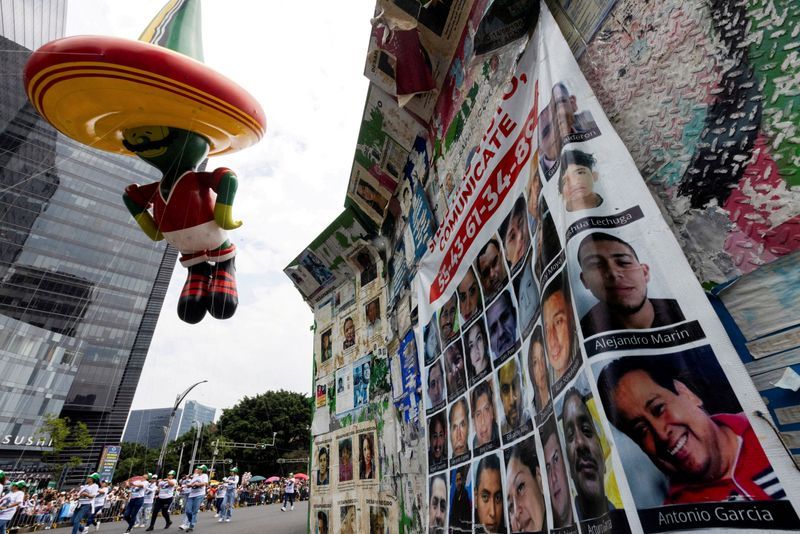
Mexico's passage to the World Cup knockout stages has ignited patriotic fervor across the country, with major avenues in the capital bedecked in celebration for the nation's clash with England. Yet beneath the festive atmosphere of giant screens and nationalist pageantry lies a more sobering portrait of a society wrestling with intractable crises that the tournament, for all its emotional power, cannot resolve. The contrast between sporting glory and civic pain has become unavoidable, forcing many Mexicans to confront an uncomfortable tension between national pride and the weight of unresolved suffering.
The most haunting backdrop to Mexico's unbeaten tournament run involves the estimated 135,000 missing people whose cases remain unsolved, a staggering figure that reflects nearly two decades of violence since former President Felipe Calderon initiated his controversial military campaign against drug cartels in 2006. Along Mexico City's principal thoroughfare, amid the World Cup advertising and celebration, posters bearing the faces of the disappeared serve as stark reminders that for thousands of families, no sporting achievement can fill the void left by absent relatives. This juxtaposition—joyful celebration metres away from desperate pleas for answers about missing loved ones—encapsulates the fractured reality of contemporary Mexico.
The nation's economic woes add another layer to this tension. Despite modest progress in reducing inflation during early June, Mexico's core inflation rate continues to exceed the Bank of Mexico's target of 3%, leaving ordinary households struggling with elevated costs for essential goods and services. The tournament itself has exacerbated these hardships for ordinary supporters, as ticket prices for World Cup matches have become prohibitively expensive, effectively locking out working-class fans who once viewed attending national team matches as an accessible form of civic participation. This democratization of access represents a troubling shift, as the price of patriotic experience now correlates directly with disposable income.
Public unrest has punctuated the tournament from its outset. Teachers affiliated with the CNTE union movement have staged sustained protests in central Mexico City, blocking major roads with encampments and demanding that the government honour campaign commitments to repeal a 2007 pension reform law that diminished social security protections for public employees. Simultaneously, the government faces mounting pressure regarding salary increases for teachers. These demonstrations reflect deeper anxieties about whether the ruling administration will follow through on redistributive promises that animated its electoral campaign.
Carlos Mendoza, a prominent journalist and podcast host, articulated the psychological mechanism by which the World Cup provides temporary relief from these underlying pressures. He observed that sporting success generates a collective neurochemical lift that permits citizens to temporarily suppress awareness of systemic dysfunction—including allegations of collusion between ruling Morena party politicians and criminal organizations. However, Mendoza cautioned that this respite is illusory; when the tournament concludes, the fundamental challenges remain, untouched by sporting outcomes. The World Cup functions as an elaborate distraction, not a solution.
The celebratory mood surrounding Mexico's maiden knockout-stage victory in four decades—a triumph over Ecuador—was itself overshadowed by tragedy. Four deaths occurred during celebrations along Reforma Avenue, a sobering reminder that even moments of national joy can turn volatile in a context of simmering social tensions and inadequate crowd management. Meanwhile, anti-tournament graffiti continues to mark walls across the capital and at the Azteca Stadium, left behind by protesters who view the event as a distraction from governmental failures and a manifestation of priorities disconnected from ordinary citizens' needs.
President Claudia Sheinbaum's administration maintains robust public support, with approval ratings published by El Financiero reaching 69% and recovering from a slight March decline. The government has publicly declared that locating missing persons constitutes a national priority, though implementation remains halting. Sheinbaum's relative popularity suggests that the electorate has not yet pronounced definitive judgment on her capacity to address these entrenched challenges, though patience likely has temporal limits.
Local politician Rodrigo Cordera has articulated a perspective increasingly common among thoughtful Mexicans: that emotional investment in football need not foreclose critical thinking about governance failures. Citizens, he suggested via social media, can simultaneously celebrate their national team's athletic achievements whilst expressing justified anger at FIFA organizational decisions, governmental incompetence, and structural inequalities. This framing rejects the false choice between patriotism and accountability, insisting instead that mature citizenship requires maintaining both perspectives simultaneously.
Resident Alejandra Gonzalez offered perhaps the most penetrating diagnosis of the tournament's function within Mexican society. She suggested that the World Cup does not eliminate civic problems but merely reduces their salience within public consciousness, thereby creating space for government to defer urgent decisions whilst benefiting from the euphoria surrounding sporting competition. Gonzalez advocated for channelling positive national sentiment towards systemic reform rather than allowing it to dissipate into vaporous celebration. Her intervention highlights the stakes: whether this moment of collective identification can catalyze institutional improvement or merely provide another cycle of temporary escape followed by renewed confrontation with unchanged realities. As Mexico advances deeper into the tournament, this fundamental question will likely intensify rather than fade.

