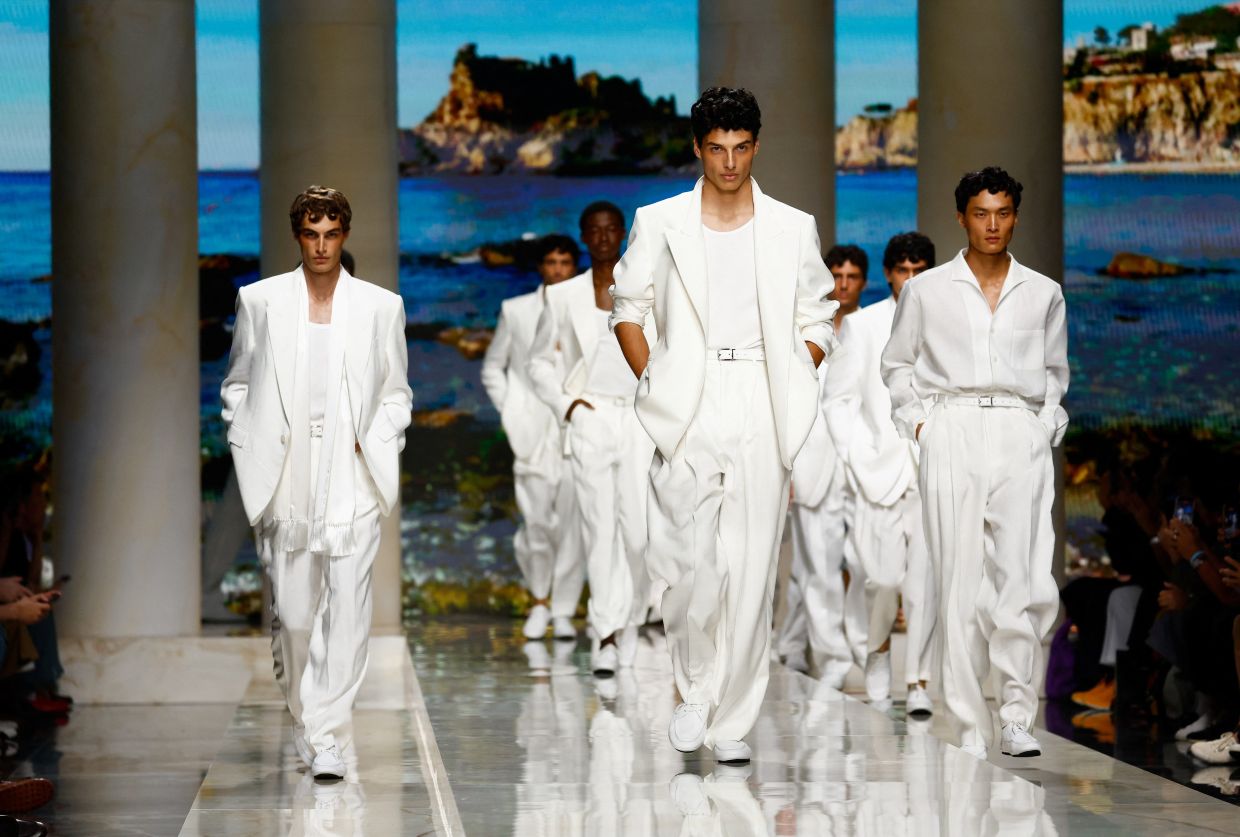
With the world grappling with economic headwinds and rising geopolitical tensions, the menswear collections that paraded across Milan's runways this week offered a distinctly restrained answer: sometimes, less truly is more. As the Italian fashion capital sweltered under summer heat last week, designers responded not by abandoning their craft but by distilling it to its essentials, prioritising clarity of line and proportion over complexity. The message reverberated from the grandest houses to emerging talents: in uncertain times, fashion's elite are seeking refuge in simplicity, whether through silhouette, material choice, or sheer conceptual purity.
Prada's co-creative directors Miuccia Prada and Raf Simons emerged as the philosophical leaders of this minimalist turn, championing an approach that strips away excess while reinvigorating the familiar through fresh proportions and innovative textiles. Rather than abandoning the suit or fundamentally reimagining menswear's grammar, the Prada vision suggested that the greatest luxury in complicated times lies in timeless clothing revisited with restraint and precision. This intellectual clarity set the tone for Milan Fashion Week as it concluded on Monday, June 22, establishing a creative framework that most of the calendar's heaviest hitters appeared willing to embrace, at least in part.
Yet the path to simplicity proved more complex than anticipated, particularly when confronting the practical realities of dressing well in sweltering conditions. The runways bristled with leather and knitted pieces destined for a season many would describe as summer, presenting a paradox that suggested fashion's upper echelons might require arctic-strength air-conditioning, alpine retreats, or relocation to cooler latitudes simply to render their wardrobe choices wearable. This contradiction—between the aspiration of lightness and the material reality of weight—became one of the season's most intriguing tensions, revealing how luxury often demands accommodation rather than compromise.
The persistence of leather emerged as perhaps the season's most surprising narrative thread. Rather than abandoning this traditionally heavy material, designers pioneered new approaches to its application and construction. Prada's leather offerings drew conceptual inspiration from denim's democratic appeal, presenting slim five-pocket trousers paired with cropped, flat-pocketed jackets that functioned almost as alternative shirts. Competitors pursued alternative engineering, employing woven and perforated techniques that transformed leather into something approaching breathability, acknowledging that even the most prestigious designer houses must eventually negotiate with thermodynamics. The result was a season-long conversation about how tradition and innovation might coexist within a single garment.
After nearly a decade of oversized, deliberately shapeless silhouettes that dominated menswear runways, Milan marked a decisive shift back toward silhouettes that acknowledge and embrace the body's contours. This represents a generational correction in taste, suggesting that formality—and the structured tailoring it entails—has recovered cultural currency following its period of deliberate undoing. The emerging consensus held that the well-dressed man remains, fundamentally, a suited man, but the challenge lay in reconciling this sartorial tradition with the brutal heat bearing down on fashion week venues and, by extension, on the summer months that collections address.
The solution arrived primarily through strategic ventilation and selective exposure. Dress shirts appeared unbuttoned as default rather than exception, with some rendered deliberately transparent to acknowledge rather than conceal their presence. Others vanished entirely, leaving jackets to function as outerwear or statement rather than layered necessity. Dolce & Gabbana pursued this logic most aggressively, introducing microshorts designed to showcase the muscularity of the leg, while other houses experimented with torso exposure within structured tailoring contexts. These choices reflected not rebellion against formality but rather a fundamental reimagining of where formality's boundaries might reasonably lie when confronting extreme temperature.
Long trousers maintained their dominance across the collections, confirming that any move toward exposure would remain partial and strategic rather than wholesale. The shift manifested instead as a reorientation toward closer relationship between fabric and body, with tailoring becoming simultaneously more relaxed and more intentional about its relationship to the form it dressed. Designers softened their construction techniques, opened necklines to invite airflow, and experimented with fabrication methods specifically designed to reduce density without abandoning formality. The resulting silhouettes represented tailoring for a warming world, garments that acknowledged rising temperatures as structural rather than merely aesthetic concerns.
Thom Browne's return to Milan for the first time since 2008, now operating under Zegna ownership, demonstrated how even established voices might evolve their vocabulary while maintaining core identity. The designer's exploration of seersucker's subtle texture and pleated skirts—long a Browne signature—suggested that summer-appropriate construction need not sacrifice the precision and intentionality that define tailored menswear. This collection exemplified how minimalism and technical innovation might advance simultaneously, with simpler silhouettes paradoxically demanding greater sophistication in fabric selection and construction detail. The message radiating from such work proved unambiguous: the suit persists not through nostalgia but through constant, intelligent adaptation.
Not every designer, however, embraced the season's dominant aesthetic of restraint. Philipp Plein presented a crystal-encrusted denim ensemble requiring days of meticulous handwork, unapologetically celebrating labour-intensive maximalism and decorative abundance. Dolce & Gabbana similarly leaned into embellishment throughout its collection, incorporating beaded accents evoking coral formations and other natural ornament. These contributions posed a deliberate counter-argument to Prada's reductionist vision, suggesting that glamour and extravagance retain their place in luxury menswear and that some clientele still prize decorative richness over austere simplicity. The season's diversity lay not in avoiding this tension but in allowing it to coexist without resolution.
A lighter overall calendar afforded emerging designers unprecedented visibility alongside industry titans, creating space for new voices to establish themselves without immediate competition from every major house simultaneously. Martin Quad made his Milan debut with unconventional tailoring techniques refined in his native Copenhagen, while Domenico Orefice explored leather and densely woven textiles within a deliberately co-ed collection format. Japanese designer Shinya Kozuka's Shinyakozuka label delivered perhaps the season's most arresting image: a bare-chested model swathed in a billowing sheer coat of teal, its volume and transparency creating a poetic conversation with the body beneath, paired with baggy white trousers suggesting ease rather than precision. Such moments confirmed that minimalism, as Milan practised it this season, remained a discipline capable of producing beauty rather than merely reducing it.
The Spring/Summer 2027 menswear calendar ultimately reflected a fashion industry attempting to speak to contemporary anxieties through aesthetic choice. Economic uncertainty and geopolitical instability create psychological hunger for stability and clarity, conditions that menswear's traditional vocabulary of the suit, proportion, and craftsmanship directly addresses. Yet the simultaneous embrace of provocative exposure, experimental construction, and decorative excess suggested that even amid this gravitational pull toward restraint, fashion maintained its essential character as a space for contradiction, for the coexistence of opposed impulses. Milan closed Monday having demonstrated that simplicity, when pursued with intelligence and precision, need not constitute surrender but rather a form of strength.