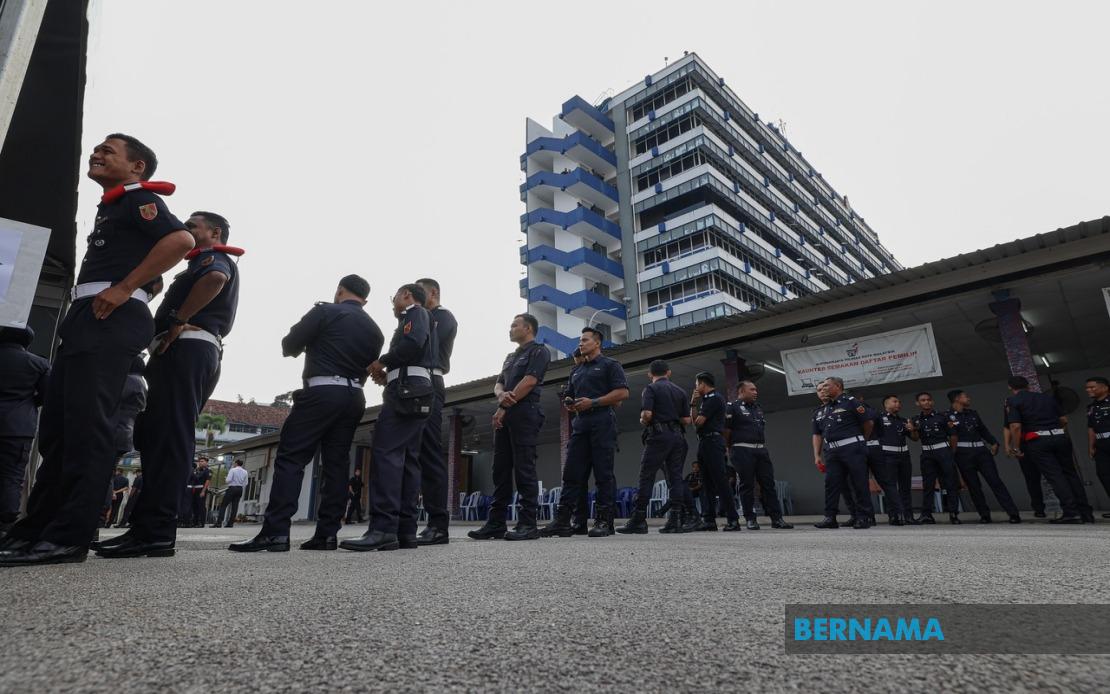
The 16th Negeri Sembilan State Election saw its first phase of voting conclude at two key locations on July 28, with over two thousand military and police officers fulfilling their civic duty in staggered polling sessions. At the Army Basic Training Centre (PUSASDA) in Port Dickson, 1,481 military personnel and their spouses participated in what the Election Commission organised as a parallel voting process, held across 11 separate polling streams between 8 am and 5 pm. The discipline and organisation characteristic of military institutions was evident in the early hours, as eligible voters began queueing from 7 am onwards to participate in this preliminary round, demonstrating strong engagement with the democratic process despite the considerable administrative effort required to coordinate such large-scale voting operations.
The military contingent voting at PUSASDA were all eligible to cast ballots in the Bagan Pinang constituency, a seat currently held by Abdul Fatah Zakaria of Perikatan Nasional. However, his retention of the seat faces a competitive challenge from two other candidates: Sheikh Junaidy Jamaludin representing Parti Pribumi Bersatu Malaysia and Nasir Raman contesting for Pakatan Harapan. The three-way contest reflects the fractious political landscape of contemporary Malaysian electoral politics, where traditional two-candidate races have become increasingly rare at state level. Such configurations create more unpredictable outcomes and typically require candidates to appeal to a broader coalition of voter preferences rather than simply mobilising core supporters.
Army Chief Gen Tan Sri Azhan Md Othman scheduled an observation of proceedings at PUSASDA at 11 am, signalling the institutional importance placed on early voting compliance and proper electoral administration. The presence of senior military leadership underscores how the armed forces view participation in democratic exercises as a professional responsibility integral to their broader constitutional obligations. This high-level oversight also ensures transparent management of the voting process and provides reassurance to military personnel that their ballots will be handled with appropriate security protocols.
Simultaneously, at the Negeri Sembilan Police Contingent Headquarters in Seremban, 979 police personnel and their spouses exercised their voting rights in the Temiang constituency. ASP Harminder Singh Pritam Singh became the first officer to vote in Stream 1, initiating what observers regarded as a relatively smooth and efficiently managed voting operation. The Temiang race similarly presents voters with three distinct options: Ho Weng Wah of Pakatan Harapan, Leaw Kok Chan fielded by Barisan Nasional, and Fazly Hamid standing for Bersatu. This constituency thus embodies the same triangular political contest visible in Bagan Pinang, reflecting how factional realignments within Malaysian politics have fragmented several traditional electoral contests.
Notably, among those who voted at the police headquarters was Datuk Ahmad Dzaffir Mohd Yussof, currently serving as a member of the Home Ministry's Crime Prevention Board in Putrajaya. His background, which includes service as deputy director of Bukit Aman's Management Department and a previous posting as Negeri Sembilan police chief, illustrates how senior security establishment figures maintain active participation in electoral processes. His presence as an early voter likely carries symbolic weight, demonstrating leadership commitment to the democratic exercise even among those with extensive experience in law enforcement and national security apparatus.
Negeri Sembilan Police Chief Datuk Alzafny Ahmad personally visited the headquarters to oversee voting arrangements and was scheduled to conduct a press briefing later at Nilai District Police Headquarters, indicating that police leadership took the early voting phase seriously as both an administrative exercise and a matter of institutional communication. Such visible supervision helps ensure procedural compliance and provides public assurance regarding the integrity of voting operations conducted within security force compounds.
The statewide early voting programme extended across 38 polling centres distributed throughout Negeri Sembilan, employing a phased closing schedule designed to accommodate local logistics and administrative capacity. Eighteen centres concluded voting at noon, two closed at 2 pm, while the remaining eighteen centres operated until 5 pm, creating a graduated rather than simultaneous conclusion to early polling. This tiered approach reflects practical recognition that different polling locations operate under varying constraints regarding physical space, staffing, and voter volume.
Beyond the military and police contingents, the overall eligible cohort demonstrated substantial size. A total of 16,884 military personnel and their spouses possessed voting rights in this state election, while 5,455 police force members and their spouses were similarly eligible, indicating that early voting provisions encompassed a significant segment of the total electorate. For Malaysian readers familiar with electoral cycles, such institutional voting blocs can meaningfully influence outcomes in closely contested seats, particularly where security personnel concentrate geographically in specific constituencies.
The early voting process represented a preliminary phase in what would culminate in the main polling day scheduled for Saturday, when the broader civilian electorate would cast ballots across all Negeri Sembilan constituencies. This sequencing allows security and armed forces personnel to discharge their democratic responsibilities while maintaining operational readiness, a pragmatic accommodation that recognises both citizenship rights and institutional obligations.
For regional observers and Malaysian political analysts, the Negeri Sembilan contest offers insight into shifting electoral dynamics beyond peninsula politics. The prevalence of three-way races, the fragmentation visible across multiple constituencies, and the substantial participation of institutional voters underscore how Malaysian electoral politics continues evolving in unexpected directions. Saturday's polling will reveal whether these early voting patterns translate into concrete outcomes, or whether the broader civilian electorate responds differently to available candidates and parties.

