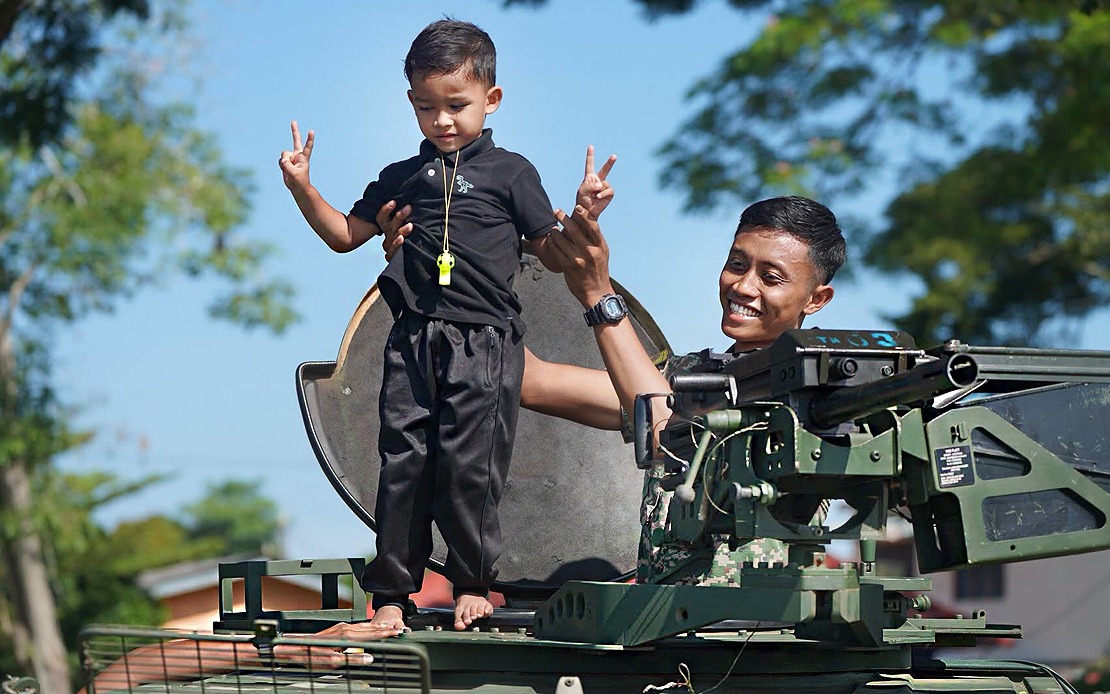
The Ministry of Defence is intensifying its community engagement efforts in the Alor Gajah district through a multifaceted welfare initiative that underscores the government's commitment to bridging the gap between military institutions and civilian populations. Launched on August 15 at Padang Awam Kampung Gadek, the 'Program Jiwa Murni MADANI' represents a strategic shift towards embedding the armed forces within community structures through tangible social investments and collaborative service delivery.
At its core, the initiative reflects a deliberate policy approach where the Malaysian Armed Forces function not merely as a defence apparatus but as a development partner capable of addressing localized infrastructure deficits and social welfare gaps. This repositioning aligns with the government's broader MADANI framework, which emphasises inclusive governance and equitable resource distribution across diverse Malaysian communities. The programme exemplifies how security institutions can leverage their organisational capacity and manpower to deliver measurable improvements in living standards, thereby building institutional legitimacy and public trust.
The infrastructure dimension of this initiative carries particular significance for rural communities like Alor Gajah. The 9th Squadron of the Royal Engineers Regiment executed five distinct projects valued at RM179,200, targeting essential facilities across multiple kampung. These encompassed playground rehabilitation at Kampung Baru, structural repairs to Tamil-language primary school facilities in Durian Tunggal, renovation of a futsal court in Taman Seri Kelemak, and critical roof restoration work at both Madrasah Seri Kemuning and Surau Madrasah Khairiah. Such targeted interventions address maintenance backlogs that frequently plague smaller settlements, where municipal budgets often prove insufficient for sustained upkeep of communal assets.
Complementing the engineering works, Deputy Defence Minister Adly Zahari distributed RM133,000 in grants through the Service Centre Initiative, directing funds to eight community organisations spanning religious institutions, cultural associations, and educational bodies. This funding mechanism benefited surau boards across multiple neighbourhoods, Chinese temples and associations, and notably SJKT Batang Melaka's GreenLab development project. The deliberate inclusion of multi-faith recipients—from Islamic foundations to Hindu temples—signals a strategic commitment to inclusive civil-military relations that transcends religious demarcation and emphasises shared community development irrespective of denominational affiliation.
The welfare component of the programme extended to direct material assistance, with 500 RAHMAH baskets distributed to armed forces veterans and local residents. This humanitarian aid carries symbolic weight beyond mere subsistence support; it acknowledges the armed forces' social responsibility towards their retired personnel while simultaneously positioning the military as a contributor to broader poverty alleviation efforts. For Malaysia's large veteran population, such programmes represent recognition of sacrifices rendered during active service and reinforce institutional bonds with communities that produce military recruitment cohorts.
Parallel to these material interventions, the Religious Corps of the Malaysian Armed Forces organised the 'Program Ilmu dan Muafakat MADANI' at Masjid Kelemak, integrating spiritual engagement with community dialogue. This two-pronged approach—combining infrastructure and welfare delivery with religious education and congregational activities—reflects contemporary understanding that civil-military relations function optimally when addressing multiple dimensions of community life simultaneously. The inclusion of structured religious programming particularly resonates in contexts where faith-based institutions serve as primary social infrastructure and community gathering points.
The strategic framework underpinning these initiatives directly references the National Defence Strategic Plan 2026-2030, specifically Core 4 which emphasises civil-military integration. This explicit alignment demonstrates that ad hoc community outreach has evolved into systematic policy implementation, where defence ministry resource allocation explicitly incorporates civilian welfare objectives. Such institutionalisation ensures programme continuity beyond individual ministerial tenures and establishes measurable accountability frameworks.
For Malaysian readers, these developments carry implications extending beyond Alor Gajah. The replicability of this model across other districts suggests an emerging paradigm where defence budgets increasingly fund civilian infrastructure and social services, effectively broadening the military's role as a development actor. This represents a departure from traditional security-centric defence ministry functions and positions armed forces institutions as multi-purpose government agencies capable of addressing civilian infrastructure deficits. However, this expansion of military roles into civilian domains warrants scrutiny regarding resource efficiency, comparative advantages, and potential opportunity costs relative to conventional development channels.
From a regional perspective, Malaysia's emphasis on civil-military cooperation resonates with Southeast Asian security trends where several nations have utilised armed forces for civilian infrastructure and disaster relief to improve institutional legitimacy and public perception. This approach proves particularly valuable in diverse societies where military institutions sometimes face credibility challenges rooted in historical grievances or perceived ethnic bias. By demonstrating tangible benefits through non-security service provision, such programmes can help reposition the armed forces as national assets serving collective welfare rather than instruments of coercion.
The inclusive community engagement model also addresses contemporary concerns regarding military-civilian disconnection in increasingly urbanised, bureaucratised societies. By rotating active personnel through community service assignments, these programmes foster mutual understanding and humanise military institutions in public consciousness. Armed forces personnel gain exposure to civilian priorities and constraints, while communities witness military professionalism applied to genuinely beneficial purposes, potentially enhancing recruitment appeal and institutional support across demographic segments.
The programme's emphasis on religious and cultural pluralism—evident through support for mosques, temples, and educational institutions serving diverse populations—reflects Malaysia's constitutional commitment to religious freedom whilst demonstrating institutional sensitivity to interfaith concerns. This carefully calibrated approach avoids the perception that military resources disproportionately favour particular religious communities, thereby maintaining the armed forces' standing as a national institution above sectarian division.
Moving forward, the success of such initiatives depends on sustained implementation and genuine responsiveness to identified community needs rather than top-down imposition of predetermined welfare approaches. Regular community feedback mechanisms and transparent project evaluation would strengthen programme credibility and ensure resources address authentic local priorities. Additionally, coordination between defence ministry initiatives and existing civilian development agencies could maximise resource efficiency and prevent duplicative effort.
The broader significance of Alor Gajah's experience lies in demonstrating how strategic policy reorientation can reposition government institutions to function as multi-dimensional development actors whilst maintaining core security responsibilities. As Malaysia navigates the dual imperatives of defence modernisation and social cohesion, initiatives like 'Program Jiwa Murni MADANI' suggest that these objectives need not operate in tension but can instead be integrated through deliberate institutional redesign and resource reallocation that prioritises community welfare as integral to national security.

