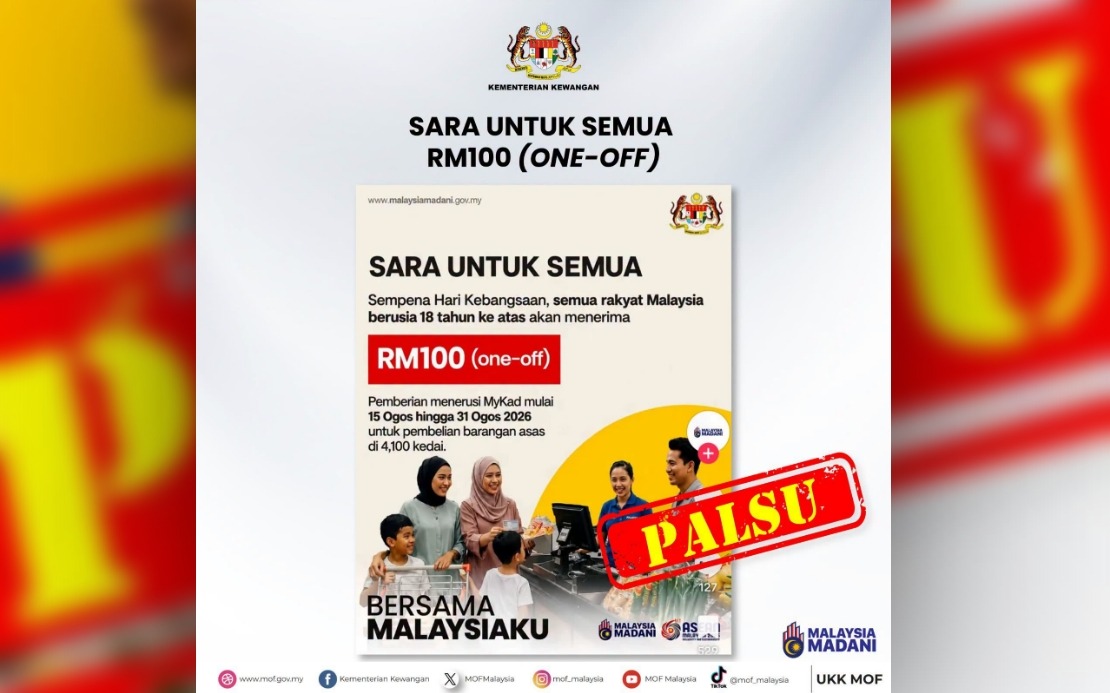
The Ministry of Finance moved swiftly on Tuesday to scotch a viral rumour spreading across social media platforms, categorically denying that Malaysia's government plans to distribute a one-time RM100 payment to all citizens aged 18 and above as part of National Day commemorations. The false claim had gained traction online in recent days, prompting the ministry to issue a public statement emphasising that no such announcement had been authorised or made through official government channels.
The fabricated assertion centred on the Sumbangan Asas Rahmah (SARA) assistance scheme, one of the government's social safety net programmes aimed at supporting lower-income households. The misleading poster circulating on social media suggested that all eligible adults would receive the additional payment to mark the national celebration, creating widespread expectation and confusion among the public. The ministry's decisive response underscores the persistent challenge faced by Malaysian authorities in combating deliberate misinformation and unfounded claims that exploit government welfare programmes.
In its official statement posted across social media channels, the Ministry of Finance explicitly warned residents not to believe or propagate the false poster, emphasising that the claim lacked any legitimate foundation. The ministry stressed that citizens should rely exclusively on verified information disseminated through its own authorised communication platforms rather than unconfirmed posts circulating on unregulated social networks. This guidance reflects growing concern among government agencies about the speed at which unsubstantiated claims can gain credibility online, particularly when they involve financial benefits.
The timing of this misinformation is particularly sensitive given Malaysia's history of government assistance programmes and the public's keen interest in financial support schemes. The SARA initiative, which has been rolled out in phases to distribute cash assistance to qualifying households, enjoys significant public awareness. Scammers and mischief-makers frequently exploit this familiarity by fabricating claims about expanded or enhanced payments, knowing that many citizens will share such posts in hopes that friends and family members might benefit. The RM100 claim followed this established pattern, suggesting calculations or coverage far broader than the actual programme's scope.
Malaysian authorities have become increasingly vigilant about combating electoral-period and celebration-linked misinformation, particularly false claims about government handouts that could influence public sentiment or undermine confidence in official communications. The rapid proliferation of such rumours across messaging applications and social platforms has made countering false narratives a significant part of government communications strategy. Each false claim requires resources to debunk and creates public confusion that potentially damages trust in legitimate policy announcements.
The ministry's statement serves as a reminder to Malaysians of all backgrounds to exercise critical thinking when encountering sensational claims online, particularly those promising unexpected financial benefits. Official government payments and assistance schemes are always announced through formal channels including ministerial press conferences, parliament, gazette publications, and the ministry's verified social media accounts bearing official insignia. Genuine information about SARA eligibility, application procedures, and payment schedules are consistently available through the ministry's website and dedicated helplines.
This incident highlights the broader challenge of information governance in Southeast Asia's digital ecosystem, where Malaysia ranks among the highest in social media adoption rates. The rapid spread of unverified claims creates substantial workload for fact-checking units and government communicators who must constantly counter falsehoods while simultaneously conveying legitimate policy information. Citizens sharing misleading posts, even with good intentions, inadvertently amplify false narratives and contribute to a cluttered information environment that makes genuine government announcements harder to distinguish from fabrications.
The Ministry of Finance has encouraged all Malaysians to establish the habit of verifying unusual or unexpected claims before sharing them, particularly those involving financial benefits or government programmes. Official verification can typically be completed within minutes by visiting government websites, contacting helplines, or checking for announcements from verified government social media accounts displaying official seals and credentials. This simple precaution helps protect both individual credibility and the broader information ecosystem from deliberate manipulation.
Looking forward, the emergence of this rumour underscores the importance of proactive government communication about welfare programmes and payment schedules. When citizens possess clear, regularly updated information about what assistance they qualify for and when payments will arrive, they become less susceptible to false claims that promise unexpected bonuses or accelerated distributions. The ministry's swift response in this instance demonstrates institutional responsiveness, though prevention through consistent transparent communication remains a more efficient approach to managing public expectations around government assistance.

