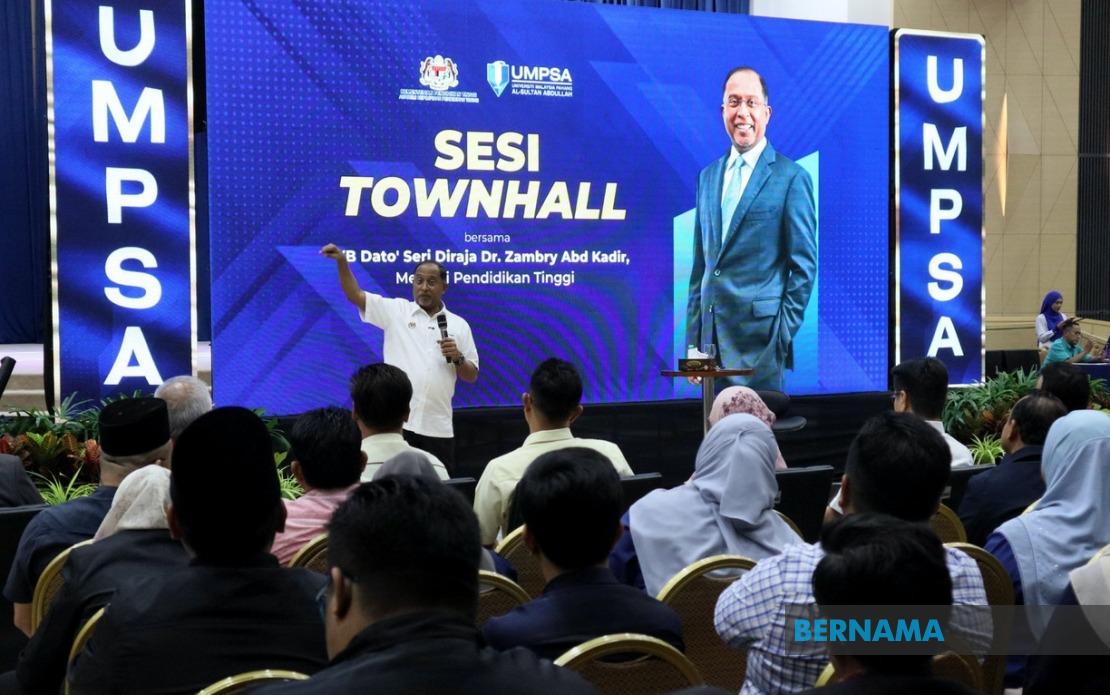
The Ministry of Higher Education (KPT) is moving swiftly to operationalise Prime Minister Datuk Seri Anwar Ibrahim's recent directive on how Malaysian universities should handle student disciplinary matters, signalling a significant shift in institutional governance following years of debate over academic freedoms on campus. Minister Datuk Seri Dr. Zambry Abd Kadir confirmed during a visit to Universiti Malaysia Pahang Al-Sultan Abdullah (UMPSA) that the ministry has initiated the necessary procedural steps to ensure universities comply with the Prime Minister's instructions, a development that reflects the government's commitment to reforming the regulatory framework governing student conduct.
The directive addresses a contentious issue that has long shaped campus politics in Malaysia: the ability of students to engage in political discourse and criticism without facing institutional penalty. Dr. Zambry emphasised that the implementation encompasses multiple dimensions, ranging from departmental-level student affairs processes through to high-level policy coordination, suggesting that the changes will permeate university administration rather than remain confined to symbolic policy pronouncements. The minister's emphasis on legislative consistency indicates the government recognises that any reforms must align with existing parliamentary decisions regarding student rights, a careful balancing act between institutional autonomy and regulatory coherence.
The scope of these revisions extends beyond administrative convenience. Dr. Zambry disclosed that all vice-chancellors from public universities have convened with the director-general of the Higher Education sector to discuss coordinated implementation, with a formal statement anticipated to follow these consultations. This coordinated approach suggests the government views the disciplinary reforms as a systemic issue rather than isolated institutional practice, requiring aligned action across Malaysia's network of public higher education institutions. The involvement of senior leadership at both ministerial and institutional levels underscores the political importance the government attaches to recalibrating the relationship between universities and student activism.
Perhaps most significantly, the Prime Minister directed that students who previously faced disciplinary sanctions for criticising his administration and the government should be released from associated charges. This represents a notable reversal of enforcement patterns that have characterised Malaysian campuses for decades, particularly under the Universities and University Colleges Act (AUKU) 1971, legislation that has long restricted student political expression. Anwar stressed that such remedial action must proceed immediately even as the formal repeal of AUKU remains in progress, recognising that legislative amendments typically require extended parliamentary procedures and cannot serve as an excuse for continued institutional rigidity.
The immediate release of students from disciplinary matters constitutes a form of retrospective justice that acknowledges the restrictive nature of previous policies. By untethering this amnesty from the extended timeline of AUKU repeal, the government signals its unwillingness to prolong the suffering of students who faced institutional sanctions for exercising what many democratic societies consider fundamental rights. This distinction between expedited administrative relief and slower legislative reform reflects pragmatic governance, enabling faster implementation of policy intent without awaiting the full legislative machinery.
Crucially, however, the Prime Minister drew a careful boundary around the scope of this amnesty. Cases involving criminal charges filed by the Royal Malaysia Police (PDRM) under the Criminal Procedure Code fall outside the scope of the disciplinary release. This delineation separates institutional regulation from criminal justice, preserving the police's investigative prerogatives while nonetheless reforming the university system's own conduct standards. The distinction matters considerably for students involved in incidents that crossed from institutional misconduct into allegedly criminal behaviour, a line that has historically been contested and sometimes manipulated to suppress activism.
A complicating factor in implementing these reforms involves private higher education institutions, which operate under different legislative frameworks, particularly the Private Higher Educational Institutions Act 1996 (Act 555). Dr. Zambry acknowledged that private universities and colleges face distinct regulatory environments, creating potential inconsistencies in disciplinary approaches across Malaysia's segmented higher education landscape. Rather than imposing uniform requirements across legally distinct sectors, the minister expressed hope that private institutions, particularly those with state ownership or involvement, would voluntarily align their practices with the reformed public university standards. This cooperative approach respects institutional autonomy while leveraging moral suasion and sector leadership from public universities.
The broader context for these reforms involves Malaysia's evolving political landscape and the government's stated commitment to the Malaysia Madani framework, which emphasises values of harmony and sustainability. The Prime Minister articulated his vision for student conduct standards during the Malaysia Madani Intellectual Forum Series, positioning disciplinary reform as integral to the government's larger developmental agenda rather than as a narrow concession to student activists. This framing allows the government to present the changes as principled governance decisions rooted in contemporary democratic values rather than as reactive capitulations to pressure campaigns.
For Malaysian students, these developments represent a potential watershed in campus politics. The combination of AUKU repeal preparation and immediate amnesty for previous disciplinary cases could substantially expand the parameters within which campus activism can operate without risking institutional sanctions. Observers of Southeast Asian higher education will watch closely whether this Malaysian approach, which separates institutional discipline from criminal prosecution while expediting policy change, establishes a template for other regional governments grappling with similar tensions between institutional order and democratic expression.
The implementation timeline and enforcement mechanisms remain somewhat unclear, as the vice-chancellors' meeting and anticipated joint statement will clarify how universities should operationalise these directives. Key questions persist regarding retroactive application to all historical cases, the criteria for determining which prior disciplinary actions warrant reversal, and whether the amnesty extends to all forms of political speech or remains limited to criticism of government. These details will shape whether the reforms constitute comprehensive liberalisation or more modest adjustment of existing practice.
For Malaysian employers and professional bodies in Malaysia and across Southeast Asia, the reformed approach to student conduct carries implications for graduate recruitment and professional standing. If universities substantially curtail disciplinary action for political expression, employers and regulatory bodies may need to adjust their own considerations regarding graduate conduct records. This cascading effect across institutional sectors demonstrates how higher education governance changes propagate through broader social systems.
The geographic scope of these changes, with vice-chancellors from higher education institutions in Pahang, Terengganu, and Kelantan gathering alongside participants from other regions, reflects the national dimension of these reforms. All Malaysia's major public universities will operate under reformed disciplinary frameworks, creating consistency across the country's educational geography. This nationwide application strengthens the reforms' significance compared to isolated institutional innovations.
Ultimately, the Ministry of Higher Education's follow-up action on the Prime Minister's directive signals that Malaysian governance is recalibrating institutional responses to student activism after years of restrictive approaches. Whether these reforms fully deliver on their liberalising promise or retain sufficient institutional authority to maintain order will shape Malaysian campus politics for years ahead.

