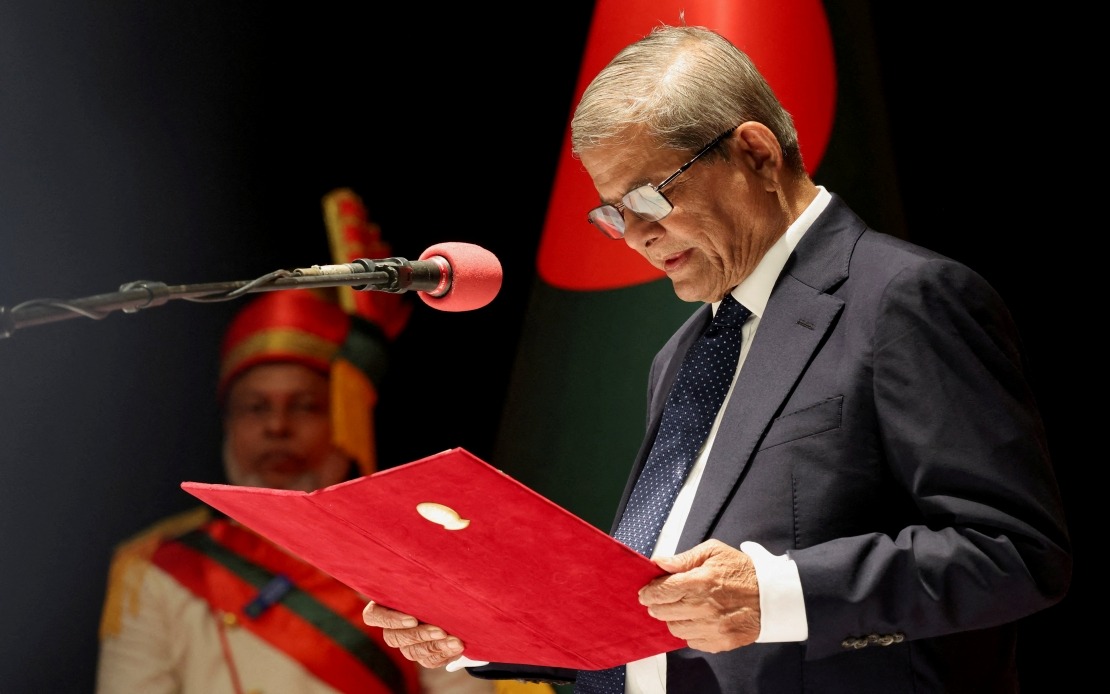
Mirza Fakhrul Islam Alamgir has assumed office as the 23rd President of Bangladesh following his swearing-in ceremony at Bangabhaban's Darbar Hall on Friday evening. The constitutional ceremony, conducted at 7.30 pm local time, marked a significant moment in Bangladesh's political trajectory as the nation's newest head of state entered his role amid a period of governmental transition in the South Asian nation.
Barrister Kayser Kamal, serving as Acting Speaker, administered the presidential oath in accordance with Bangladesh's constitutional procedures. The formal transfer of power saw the incoming president and outgoing Acting President Hafiz Uddin Ahmad Bir Bikram exchange seats—a symbolic gesture embedded in Bangladesh's constitutional traditions that visibly represents the transition of executive authority from one individual to another.
The inauguration ceremony drew a comprehensive representation of Bangladesh's political and administrative establishment. Prime Minister Tarique Rahman attended alongside the chief justice, cabinet ministers, members of parliament, senior civil servants, and military commanders. The presence of foreign diplomats underscored the international dimension of the transition, reflecting the diplomatic importance attached to changes in Bangladesh's highest constitutional office. Upon arrival at the presidential residence, Fakhrul received formal welcomes from senior officials, with Acting President Hafiz Uddin Ahmad Bir Bikram personally greeting the president-elect before the ceremony commenced.
Fakhrul's elevation to the presidency represents a recognition of his decades-long involvement in Bangladesh's political affairs. As a former secretary-general of the Bangladesh Nationalist Party, one of the country's two dominant political organisations, he brings substantial experience in political leadership and party management. His election by parliament in accordance with Bangladesh's constitutional framework reflects the indirect presidential system under which legislators select the nation's head of state, a mechanism distinct from direct popular election.
The oath ceremony concluded with Fakhrul affixing his signature to both the oath of office and oath of secrecy—formal legal documents that bind him to constitutional duties and confidentiality obligations inherent to the presidency. The concluding rendition of Bangladesh's national anthem formalised the ceremonial handover of the highest constitutional position.
For Malaysia and the broader Southeast Asian region, this transition in Bangladesh's political leadership carries implications for bilateral relations and regional governance frameworks. As Bangladesh navigates its domestic political landscape, the continuity represented by Fakhrul's presidency—emerging from Bangladesh's established political structures—may provide stability for regional diplomacy and economic cooperation. The involvement of Prime Minister Tarique Rahman in the ceremony signals ongoing governmental coherence during a period when Bangladesh has undertaken significant political adjustments.
Bangladesh's presidential system assigns the President primarily ceremonial and constitutional functions, with executive authority centred in the Prime Minister's office. This distinction means that while Fakhrul's inauguration marks an important formal transition, the practical direction of government policy remains vested in Prime Minister Tarique Rahman's administration. Understanding this constitutional arrangement is essential for international observers assessing Bangladesh's governance capacity and policy continuity.
The composition of attendees at the inauguration reflects the multi-institutional nature of Bangladesh's state apparatus. The attendance of the chief justice and senior judges signals the judiciary's formal recognition of the new president's constitutional role. Military representation, through senior commanders' presence, underscores the security establishment's acknowledgment of the civilian transfer of power—a symbolically significant aspect in nations where civil-military relations carry historical weight.
Mirza Fakhrul's background as a long-serving political figure positions him to engage effectively in the largely ceremonial yet symbolically important duties of the presidency. In Bangladesh's constitutional framework, the President plays crucial roles in receiving credentials, undertaking state visits, and serving as the formal embodiment of national unity, even as executive powers reside elsewhere. His appointment thus represents both continuity and recognition within the established political order.
The timing and conduct of the swearing-in ceremony adhered strictly to constitutional requirements, reflecting Bangladesh's commitment to formal legal procedures in transferring power. This adherence to constitutional norms contrasts with political volatility that has periodically characterised Bangladesh's recent history and demonstrates the stabilising effect of institutional practices in the nation's governance framework.

