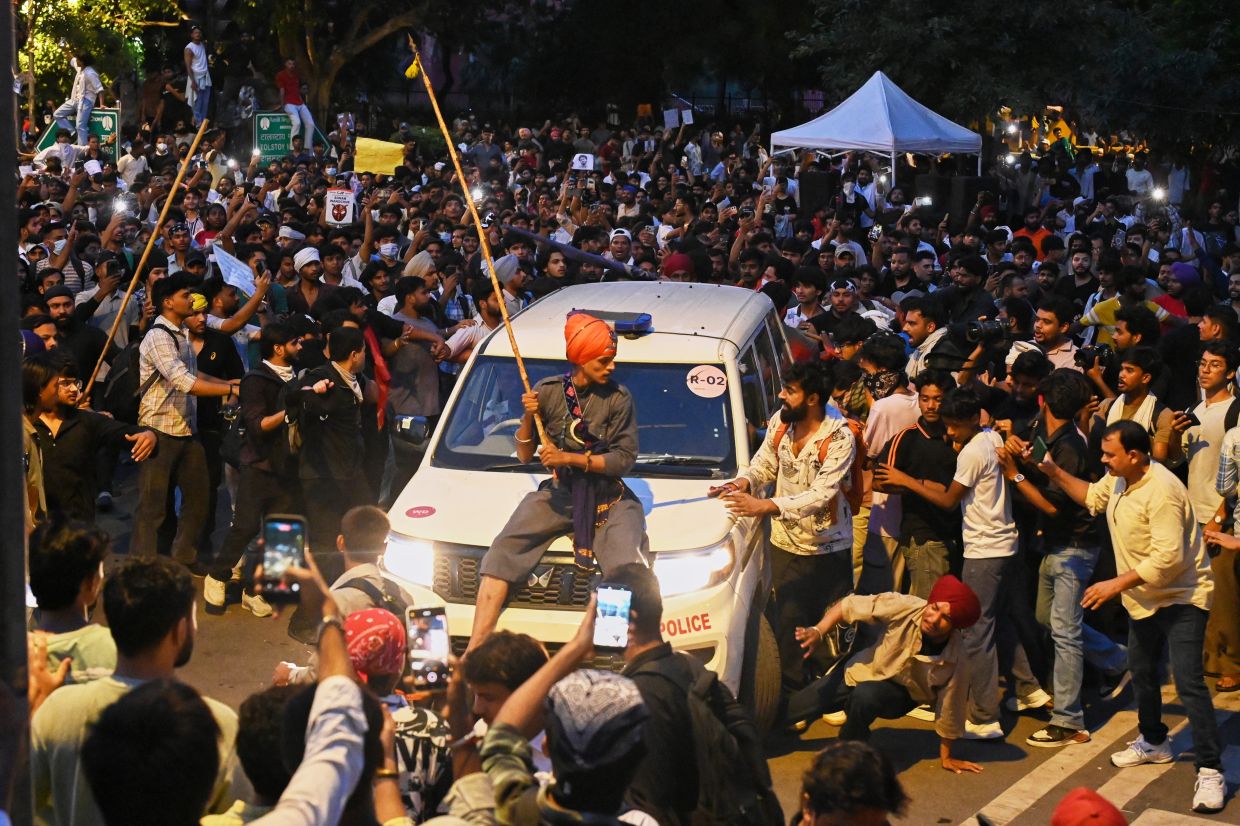
Indian Prime Minister Narendra Modi has pledged "stringent punishment" for those implicated in widespread examination fraud, addressing growing public anger that has triggered some of the most significant anti-government demonstrations since his third-term election victory in 2024. Speaking through social media on Thursday, Modi sought to reassure young Indians that their welfare and educational prospects remain paramount, while proposing the establishment of expedited judicial processes to hold perpetrators accountable. His intervention marks a notable shift in tone from the government, which initially appeared to dismiss mounting student discontent.
The Prime Minister's statement came in the aftermath of sustained street mobilisations in the capital on Wednesday, where demonstrators clashed violently with police outside the Jantar Mantar protest zone. The unrest represents an escalation from earlier confrontations on Monday, when authorities deployed tear gas and lathi charges against tens of thousands attempting to march to parliament as the monsoon legislative session opened. These initial police actions resulted in what participants describe as brutal suppression, with at least 178 people, including security personnel, sustaining injuries. The scale of Monday's violence—involving stone-throwing and resulting in the most substantial street rally the capital has witnessed in approximately five years—appeared to galvanise rather than suppress the movement.
At the heart of the demonstrations lies the Cockroach Janta Party (CJP), a social media-driven grassroots movement that has mobilised millions of followers to challenge what participants view as systemic failures in India's educational infrastructure. The CJP emerged initially in May as a satirical commentary following remarks attributed to Chief Justice Surya Kant, who allegedly characterised young people as "cockroaches" and "parasites" during judicial proceedings. Since that origin point, the movement has substantially broadened its political scope, incorporating grievances related to persistent unemployment, limited economic opportunities for youth, and what adherents characterise as Modi's increasingly authoritarian governance model. This expansion suggests the exam fraud crisis has become a focal point for deeper anxieties among India's younger generations about their futures.
Institutional failures in India's examination system have provided substantial fuel for these grievances. A particularly damaging incident involved the leak of a medical entrance examination question paper, necessitating more than two million test-takers to resit the examination—a logistical catastrophe that exposed serious security lapses. Compounding this crisis, irregularities in the online marking of assessments taken by nearly two million secondary school students generated fresh waves of public frustration. These cascading scandals have fundamentally eroded confidence in a testing apparatus that millions of Indian families depend upon to determine educational and professional pathways. For Malaysian readers, this serves as a cautionary tale about the consequences of inadequate oversight in critical educational infrastructure, particularly as regional economies increasingly compete for skilled talent.
The opposition Indian National Congress has seized upon the government's apparent vulnerability, with senior figures including Rahul Gandhi directly challenging Modi's credibility on educational governance. Gandhi's public accusation that the Prime Minister has overseen the "total capture and destruction" of the education system and shielded responsible officials from accountability reflects the political dimensions of this crisis. Opposition parties have disrupted parliamentary proceedings to demand an apology for Monday's police response, transforming the examination scandal into a broader constitutional and governance dispute. This tactical deployment of institutional platforms suggests opposition actors believe the moment offers genuine political opportunity to damage Modi's standing among youth voters.
Demonstrations have not remained confined to New Delhi's urban core. Parallel protests have materialised in major metropolitan centres including Mumbai, Bengaluru, and Patna, indicating that grievances resonate across India's diverse geographies and demographic groups. Internet shutdowns in the capital and reports of aggressive police tactics against protesters have themselves become lightning rods for international attention and human rights concerns. The CJP's communication apparatus, particularly spokesman Ashutosh Ranka's social media statements, has effectively amplified allegations of state overreach, positioning the movement not merely as a response to examination irregularities but as a broader democratic struggle. This framing appears to be resonating with India's digitally-connected youth.
International dimensions have further amplified the protests' significance. In neighbouring Bangladesh, students have organised solidarity "torch rallies" scheduled for Thursday evening, explicitly referencing the successful 2024 youth-led demonstrations that precipitated Sheikh Hasina's government collapse and her subsequent departure from office. This cross-border gesture carries substantial symbolic weight, suggesting that educational and economic grievances among South Asian youth may possess transnational character. For regional observers, the Bangladesh parallel raises questions about whether examination failures and youth unemployment represent structural vulnerabilities affecting multiple South Asian economies simultaneously. Malaysia and other ASEAN nations with substantial youth populations should regard these developments as pertinent case studies in the political consequences of educational system failures.
The timing of Modi's response reflects clear recognition that the political stakes have escalated significantly. By Thursday, the movement had consolidated sufficient organisational capacity and public support to command the Prime Minister's direct attention, a considerable achievement given typical government tendencies to marginalise protest movements. The promise to establish fast-track courts suggests the administration intends to demonstrate responsiveness through institutional reform, though sceptics will question whether such measures address underlying systemic vulnerabilities or merely provide performative reassurance. The government's apparent willingness to acknowledge wrongdoing, at least rhetorically, contrasts with earlier dismissive postures and may indicate internal recognition that youth alienation poses genuine risks to political sustainability.
For Malaysia and broader Southeast Asia, these developments warrant careful analysis. India's scale—home to approximately 400 million young people—means that educational system failures and youth unemployment there generate ripple effects throughout regional economies and labour markets. As India positions itself as a competitor for talent and investment within the ASEAN orbit, the political instability resulting from educational system failures creates uncertainty. Malaysian policymakers should examine whether examination integrity safeguards in domestic institutions meet contemporary security standards, particularly given increasing digitalisation of testing. The CJP's emergence as a potent political force demonstrates that social media-enabled youth mobilisation can crystallise rapidly around specific grievances and acquire substantial organisational sophistication.
The broader trajectory remains uncertain. Modi's promises may satisfy public concern if implementation occurs swiftly and visibly, or they may be perceived as insufficient if the underlying examination system dysfunction persists. The opposition's parliamentary tactics suggest they intend to maintain political pressure beyond the immediate crisis period. For India's youth, the critical question is whether this moment of heightened attention translates into substantive systemic reform or merely temporary concessions. The answer will substantially shape political dynamics across India and potentially throughout South Asia during coming months.

