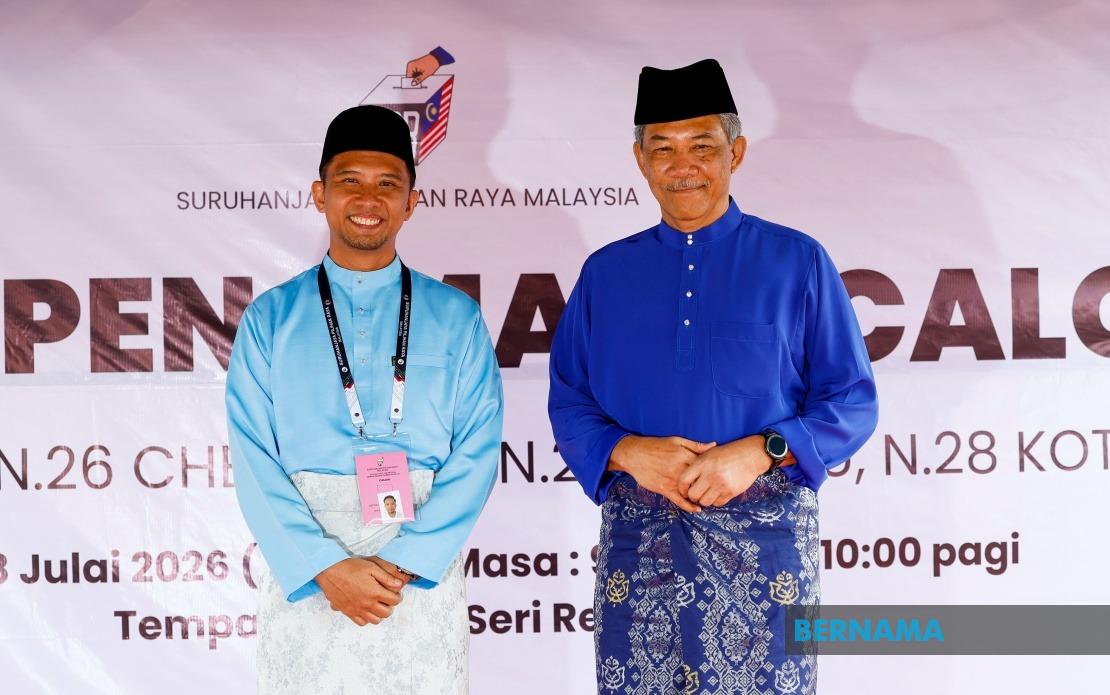
Negeri Sembilan voters are gearing up for a closely contested state election on August 1, with nominations now officially closed and the campaign season formally underway. The Rantau state seat has emerged as a focal point of the contest, pitting Foreign Minister Datuk Seri Mohamad Hasan against Pakatan Harapan's Dr Azizul Hakim Mahdi in a direct two-way battle. The returning officer Mohd Zamri Mohd Esa confirmed the straight fight after the nomination process concluded at Dewan Sri Rembau, signalling the start of what is expected to be an intense campaign period across the state's 36 constituencies.
Modamad Hasan, who doubles as state Barisan Nasional chairman and UMNO deputy president, brings considerable incumbency advantage to the contest, having represented Rantau since 2004. His longevity in the seat underscores his grip on the constituency, though the political landscape has shifted markedly since the 2023 election, when he secured a commanding majority of 10,280 votes over Pakatan Harapan candidate Rozmal Malakan. The Foreign Minister's presence in federal government adds a national dimension to what might otherwise be a routine state contest, making Rantau a barometer of Barisan Nasional's strength in Negeri Sembilan.
Yet Mohamad's grip is not uncontested. Dr Azizul Hakim Mahdi, a 35-year-old medical practitioner, brings a different profile to challenge the incumbent. As owner of three private clinics across Senawang, Puncak Alam, and Melaka, the young professional offers voters an alternative grounded in healthcare expertise and community engagement. His campaign strategy hinges on positioning himself as a candidate attuned to grassroots medical and public health concerns—a deliberate contrast with Mohamad's high-profile ministerial role. For Pakatan Harapan, Dr Azizul represents an attempt to break Barisan Nasional's stranglehold on Rantau by offering substantive policy differentiation rather than merely contesting the seat.
Modamad's immediate priority is to mobilize Barisan Nasional's organizational machinery behind a carefully articulated campaign message. Speaking after the nomination close, he emphasized the importance of systematic groundwork and coherent messaging around the coalition's manifesto. His focus on organizational discipline reflects an understanding that incumbent advantage can evaporate if supporters become complacent or if the machinery fails to execute effectively. The Foreign Minister's confidence, however, rests substantially on his two-decade tenure representing the constituency and the political infrastructure Barisan Nasional has built across Negeri Sembilan.
The Rantau contest unfolds within a broader contest across Negeri Sembilan where other constituencies present varied political configurations. The Paroi seat presents a three-cornered contest involving Ahmad Shahir Mohd Shah representing Pakatan Harapan, Perikatan Nasional's Kamarol Ridzuan Mohd Zin, and Bersatu's Mohd Nazree Mohd Yunus—a configuration that fragments the opposition vote and could benefit Barisan Nasional despite not directly contesting the seat. The Chembong constituency features a straight fight between incumbent Barisan Nasional member Datuk Zaifulbahri Idris and Pakatan Harapan's Danish Nazran Murad, potentially indicating areas where the ruling coalition feels sufficiently confident to face one-on-one contests.
The Kota seat, meanwhile, shapes up as another three-cornered affair involving Barisan Nasional's Suhaimi Aini, Pakatan Harapan's Muhammad Allif Ibrahim, and Bersatu's Akmal Noradzmi Abdul Rahim. The proliferation of three-cornered contests across multiple constituencies suggests that Perikatan Nasional and Bersatu have made strategic decisions to contest alongside or against the traditional big players, potentially fragmenting the anti-Barisan Nasional vote but also complicating simple binary narratives about government versus opposition. This electoral arithmetic adds layers of complexity that could determine final outcomes, particularly in marginal constituencies where the anti-incumbent vote might be split across multiple candidates.
The Election Commission has set July 28 as the early voting day and August 1 as polling day for the 16th Negeri Sembilan state election. A total of 889,490 registered voters are eligible to participate, comprising 867,151 ordinary voters alongside 16,884 military personnel and their spouses and 5,455 police personnel who will vote early. This substantial electorate—notably larger than some previous state contests—suggests active political engagement and the potential for significant voter mobilization efforts from all contending parties. Early voting provisions for security personnel indicate the commission's anticipation of logistical challenges in enabling full participation across the state.
For Barisan Nasional, this state election represents an opportunity to consolidate authority in Negeri Sembilan and demonstrate resilience in peninsular strongholds as it prepares for potential federal elections. The performance in constituencies like Rantau will signal whether the coalition can maintain its traditional support bases or whether Pakatan Harapan is making inroads into previously secure territories. A strong showing by Barisan Nasional could reinforce the perception of its electoral viability at the national level, whereas unexpected reverses might embolden opposition efforts to construct alternative coalitions before any federal contest looms.
For opposition coalition Pakatan Harapan, the Negeri Sembilan contest offers a chance to demonstrate that it remains a credible alternative government capable of winning seats from the incumbent. The decision to field candidates like Dr Azizul Hakim—younger professionals with community credentials—signals a strategic pivot toward presenting candidates with substantive portfolios rather than relying on political seniority alone. Should Pakatan Harapan successfully capture contested seats, it would provide momentum heading into potential federal elections and validate its strategy of targeted candidate selection focused on local relevance and expertise.
Meanwhile, the participation of Perikatan Nasional and Bersatu across multiple constituencies adds unpredictability to traditional two-coalition contests. These parties' decision-making about where to contest heavily reflects broader negotiations within Malaysia's fractious political landscape and their assessment of where they can build constituencies support. In some seats, their presence may function to split anti-government votes, benefiting Barisan Nasional by default, while in others they might position themselves as genuine challengers to both traditional power blocs, potentially appealing to voters fatigued by conventional coalition politics.
The campaign period beginning with nomination closure will see intense activity across all constituencies as parties mobilize supporters, articulate policy platforms, and attempt to frame the choice before voters in ways favorable to their electoral prospects. Ground-level organizing, candidate visibility, and message consistency will prove crucial as campaigns develop. For readers across Southeast Asia observing Malaysian electoral dynamics, the Negeri Sembilan contest offers insights into how coalition politics operate at the state level and how traditional power structures navigate challenges from both established opposition and emerging political forces seeking to disrupt existing arrangements.

