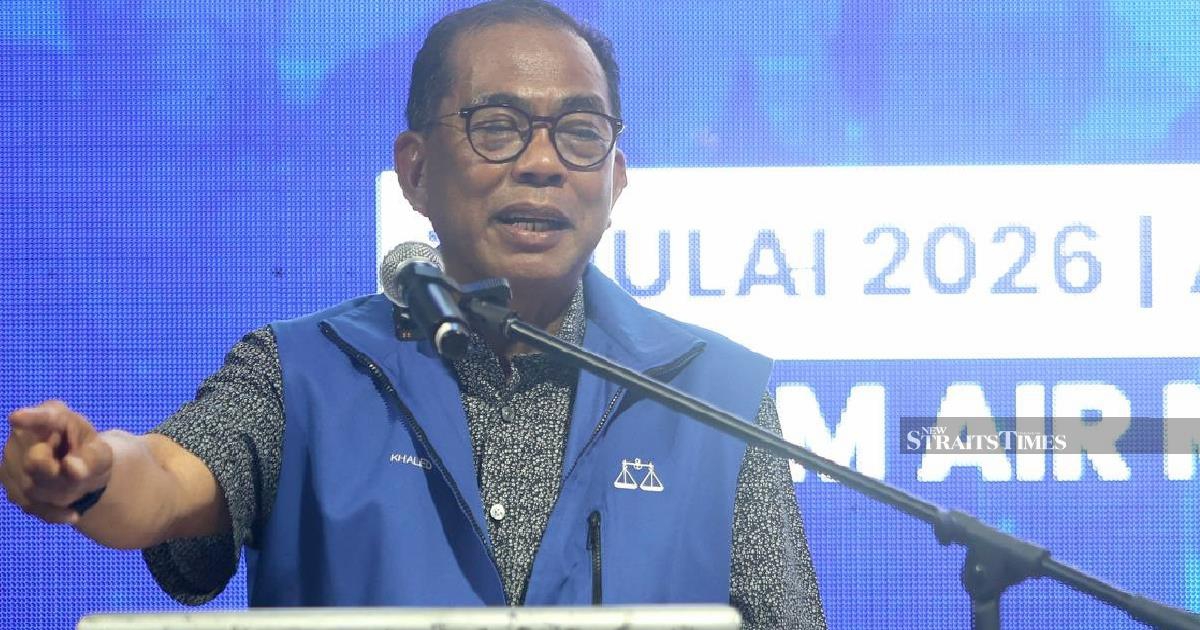
In a direct appeal to Negri Sembilan voters at an election rally in Kuala Pilah, Umno vice-president Datuk Seri Mohamed Khaled Nordin has made an unusually pointed call for the wholesale rejection of Bersatu, arguing that doing so would establish clearer electoral contests in the forthcoming general election. His remarks underscore escalating tensions within Malaysia's fractured political landscape, where coalition mathematics have become increasingly complex and unpredictable.
Khaled's statement reflects growing frustration among Umno's upper ranks with Bersatu's presence as a potential kingmaker in future electoral contests. The party, which defected from Pakatan Harapan to join the Perikatan Nasional coalition alongside Umno and PAS, has become a source of strategic uncertainty for traditional Barisan Nasional components. By calling for voters to deliver a decisive defeat to Bersatu in Negri Sembilan, Khaled is attempting to establish a clear verdict on the party's viability as a major political force.
The Negri Sembilan state election represents a significant testing ground for coalition politics ahead of the next general election. Unlike national polls, state elections allow political parties to test messaging and gauge voter sentiment in a lower-stakes environment. A strong Bersatu performance in the state could reinforce the party's relevance to kingmaker calculations, while a decisive rejection would substantially weaken its negotiating position in future coalition talks at the national level.
Khaled's appeal also carries implications for Umno's broader political strategy. The party has spent considerable effort rebuilding its organizational structure and voter base following the 2018 electoral defeat that ended its six-decade dominance. A clear Negri Sembilan victory without reliance on Bersatu would demonstrate Umno's recovering electoral strength and reduce its dependence on smaller coalition partners whose loyalty remains uncertain.
Bersatu's political trajectory has been volatile since its formation in 2016. The party initially positioned itself as a reform vehicle but has become increasingly absorbed into Malaysia's traditional power structures. Its presence complicates political alignments because it maintains the capacity to influence outcomes without commanding substantial voter support in most constituencies, a dynamic that Khaled's comments suggest Umno finds electorally inefficient and strategically disadvantageous.
The call to eliminate Bersatu from contention also addresses voter fragmentation concerns within coalition politics. When multiple parties compete in the same constituency, vote-splitting can inadvertently benefit opposition candidates, a phenomenon that has plagued Barisan Nasional's recovery efforts in several recent elections. By encouraging voters to concentrate their support against Bersatu, Khaled is attempting to streamline voting patterns in a way that could benefit larger coalition components in other constituencies.
Negri Sembilan holds particular symbolic weight in Malaysian politics as a state that has historically balanced communal interests while maintaining relatively stable governance. The state's voters are known for pragmatic electoral choices, making it a useful barometer for measuring broader political sentiment. A decisive rejection of Bersatu here would send powerful signals to other component parties about their strategic relevance to ruling coalitions.
The timing of Khaled's remarks also matters. With the next general election potentially only months away, coalition partners are beginning to calculate their positions and relative bargaining power. Umno's leadership appears to be signalling that it views Bersatu's presence as a liability rather than an asset, suggesting potential fractures within the Perikatan Nasional coalition that could reshape Malaysia's political landscape considerably.
For Malaysian voters, particularly those in Negri Sembilan, Khaled's intervention demonstrates how state-level contests serve as proxies for resolving larger national political questions. The election outcome will provide clarity on whether Bersatu can retain a meaningful political foothold or whether it faces a period of sustained marginalization. This clarity could reshape coalition negotiations at the national level and influence which parties emerge as serious contenders in general election contests.
The broader context reveals deepening tensions between Umno and Bersatu despite their formal coalition membership. These internal contradictions suggest that Malaysia's political stability remains dependent on volatile personal relationships and shifting factional interests rather than stable institutional frameworks. Voters responding to Khaled's appeal would be not merely endorsing Umno's preferred coalition structure but signalling their preference for more straightforward two-party competition rather than the multi-sided contests that have characterized recent Malaysian elections.

