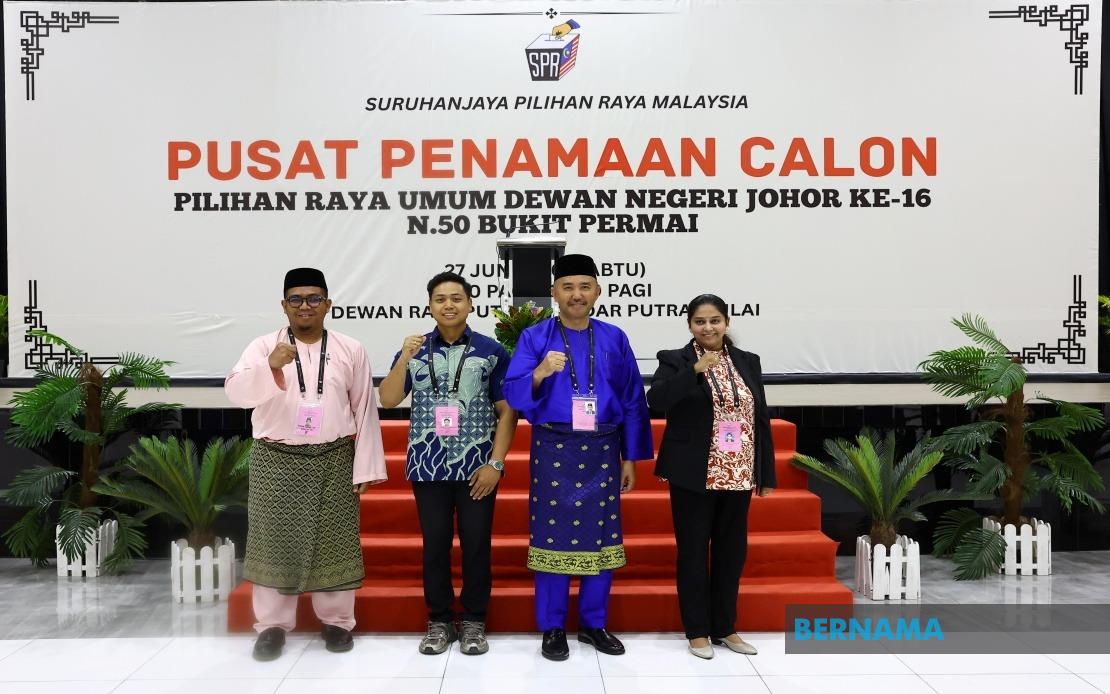
Bukit Permai's political landscape has become significantly more competitive for the incumbent assemblyman as the 16th Johor state election approaches this month. Datuk Mohd Jafni Md Shukor, representing Barisan Nasional, faces a formidable challenge from three opposition contenders vying for the Batu Pahat-area seat in what is shaping up as one of the more fragmented contests in this electoral cycle.
The nominations closed this week at the Dewan Raya Putra nomination centre in Bandar Putra, solidifying the four-cornered fight that will determine who represents approximately 50,000 voters in this state constituency. Mohd Jafni's challengers represent a diverse political spectrum: Mohamad Shafwan Ani carries the Pakatan Harapan banner, M. Lina Manoh contests for Perikatan Nasional, and Muhammad Aidil Riduan Mohd Yusof is fielded by the newer Parti Bersama Malaysia. The diversity of opposition candidates reflects the fractionalised nature of Malaysian politics, where a split opposition vote could theoretically benefit the incumbent despite lower overall support levels.
Mohd Jafni's track record in Bukit Permai provides him with considerable incumbent advantage. In the previous 2022 state election, he secured victory with a commanding majority of 4,755 votes, also in a four-cornered contest. That performance suggests strong grassroots organisational capacity and voter loyalty within the constituency, though electoral dynamics can shift significantly between election cycles. The presence of established opposition coalitions like Pakatan Harapan indicates that the 2022 result may not be taken as a reliable predictor of current sentiment.
The involvement of Johor DAP chairman Teo Nie Ching in supporting Mohamad Shafwan's nomination underscores Pakatan Harapan's commitment to contesting the seat actively rather than ceding it to other opposition forces. The Democratic Action Party's direct engagement suggests strategic importance attached to Bukit Permai within the broader Johor electoral battleground. Pakatan Harapan's performance in Johor has been inconsistent, and Bukit Permai represents an opportunity to strengthen its presence in a state where federal opposition parties have struggled in recent years.
Perikatan Nasional's participation through M. Lina Manoh reflects the broader political realignment that has characterised Malaysian politics since 2020. Perikatan's electoral strategy involves targeting seats where it believes it can exploit dissatisfaction with established coalitions, whether from the government or the traditional opposition. The PN candidacy potentially complicates voting patterns, particularly among Malay voters who might traditionally lean toward either BN or PH depending on local circumstances and campaign messaging.
The entry of Parti Bersama Malaysia through Muhammad Aidil Riduan Mohd Yusof marks an interesting footnote in the contest. As a relatively newer political vehicle, Bersama's presence in Bukit Permai suggests either genuine grassroots support or a strategic effort to establish footholds in key constituencies. The party's performance will be watched as an indicator of whether newer political formations can gain meaningful traction at the state level in Malaysia's electoral system.
Electoral mathematics in such fragmented contests become crucial for all camps. With the votes likely split four ways, the winning threshold could be substantially lower than in previous two or three-cornered fights. This means that campaigns must focus not just on winning votes, but on turning out their core supporters. Ground operations, digital mobilisation, and traditional political machinery will be decisive factors in determining which candidate reaches the finish line first.
The timing of the election, set for July 11, gives candidates approximately two weeks from the close of nominations to conduct their campaigns. Early voting is scheduled for July 7, allowing registered voters who face mobility constraints or work commitments to cast ballots earlier. This compressed campaign period requires well-organised parties to maximise their outreach, particularly in reaching less engaged or persuadable voters who might still be undecided.
For Johor as a whole, the state election represents a significant political moment. The state has traditionally been a BN stronghold, but recent federal election results and demographic shifts have created opportunities for opposition parties. Bukit Permai, as a semi-urban constituency with mixed Malay and Indian populations, reflects the types of seats that will likely determine the overall outcome. An opposition breakthrough would require winning multiple constituencies currently held by BN, making each individual contest meaningful within the larger state narrative.
Mohd Jafni's position as the sitting representative provides administrative visibility and the ability to showcase development achievements over the past five years. Barisan Nasional's campaign will likely emphasise stability, continuity, and the party's role in federal development allocations to the state. However, the three-pronged opposition assault suggests that voters may be actively considering alternatives, whether through established coalitions like Pakatan Harapan or newer political entrants.
The electoral commission's management of the campaign period and polling procedures will be subject to scrutiny from all four camps and from civil society observers. Transparent nomination processes and professional election administration remain essential to maintaining public confidence in the electoral system, particularly in contests where the outcome could be decided by relatively narrow margins.
As campaigns intensify over the coming fortnight, Bukit Permai will serve as a microcosm of broader Johor electoral trends. The four-cornered nature of the contest means that winning strategies, messaging effectiveness, and on-ground mobilisation will determine not just the fate of the individual candidates, but also provide important signals about voter sentiment across the state ahead of the July 11 polling day.

