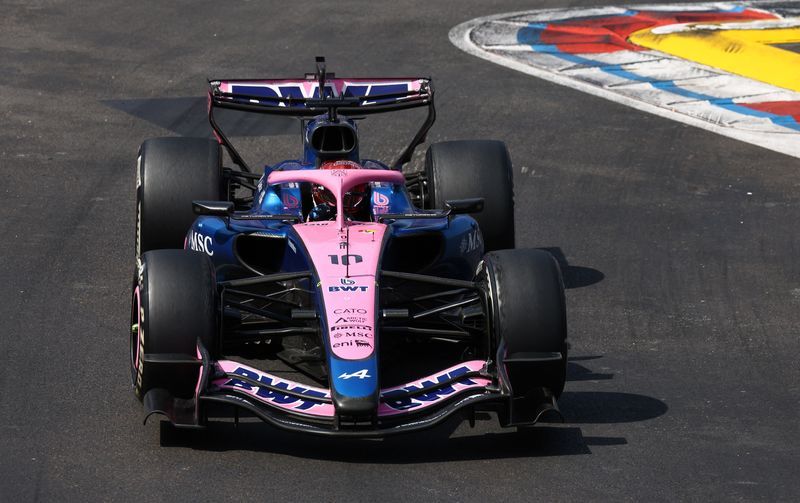
The highest sporting authority in Formula One prepared to settle one of the season's most contentious rulings when its international court of appeal convened in Paris to decide definitively whether Pierre Gasly deserved to keep his podium finish at the Monaco Grand Prix. The hearing represented the culmination of a dispute that had dragged on for more than two months following the June 7 race in the Mediterranean principality, exposing fundamental questions about the consistency and fairness of motorsport governance.
Gasly, competing for Alpine, had crossed the line in third position at Monaco but found his result immediately overshadowed by controversy. Race stewards handed down two five-second penalties for pit-lane speeding violations, a ruling that demoted the French driver to seventh place in the final classification. The penalties were serious enough to trigger a promotion: Red Bull's Isack Hadjar moved up to claim the third-place trophy, and the customary champagne celebration that accompanies a podium finish duly followed.
Within days, however, the entire decision unraveled. On June 12, Alpine's technical team presented evidence to race stewards indicating that a timekeeping error lay at the heart of the original penalty decision. Stewards accepted this argument and voted to overturn their own judgment, removing both penalties and restoring Gasly to third place. Hadjar was required to return the trophy and forfeit his position—an unusual and awkward reversal that raised immediate concerns within Formula One's paddock community about the implications of permitting penalties to be rescinded after the fact.
The swift reversal did not end the matter. Instead, it triggered alarm bells for McLaren and Red Bull, both of which filed appeals on June 16 to the international court, seeking to challenge the stewards' decision to rescind the penalties. Their objections centered on questions of sporting equity and the integrity of the regulatory framework that governs Formula One competition. These concerns reflected deeper frustrations about how penalties were being applied and withdrawn at different stages of the proceedings.
McLaren's grievance carried particular weight because it involved Oscar Piastri, who had dropped from fourth to fifth place when Gasly was reinstated to third. During the race itself, Piastri had incurred penalties for the same pit-lane speeding violation that affected Gasly, accepting the steward's judgment that he had committed an infraction. Unlike Gasly, who had the luxury of serving his penalties after the race concluded with time added to his final result, Piastri lost actual racing time in the pits—a disadvantage that could not be undone retroactively. The Australian driver operated under the assumption that any speeding breach was unavoidable, yet no mechanism existed to appeal or review his penalty once served.
The asymmetry troubled McLaren deeply. Team principal Andrea Stella articulated the sporting concern at the following week's Dutch Grand Prix, where McLaren's Lando Norris secured the race victory. Stella emphasized that McLaren's appeal pursued two distinct but complementary objectives. First, the team questioned whether the post-race procedural approach in Monaco had established an unsettling precedent for Formula One. "We think that the process that happened after the race in Monaco needs to be reviewed because from a standpoint of fairness for all competitors, the fact that the penalty was removed introduces some significant elements of concern," he explained to gathered media representatives.
Beyond the broader sporting principle, McLaren faced material consequences that cut to the championship standings. Stella did not shy away from articulating this second dimension of the appeal. "The second aspect is the interest of McLaren. We got also materially penalised for having served a penalty that is not appealable and this even cost us points in the championship," he added, highlighting how Piastri's lost time cascaded through the remainder of the race, potentially affecting strategic decisions and competitive positioning in ways that ultimately influenced his final points tally.
Stella framed the matter as one touching both the philosophical foundations of motorsport competition and McLaren's specific economic interests in the championship battle. "So there's a general interest for Formula One and the sport and the integrity of the sport, and there's a material interest for McLaren in terms of our championship impact," he said. This dual framing suggested that the controversy extended beyond one race's results; it raised systemic questions about how stewarding consistency and appellate processes should function across a season's calendar.
The FIA announced that the international court hearing would convene with strict confidentiality protocols in place. No members of the public or media would be permitted inside the FIA headquarters during proceedings, a standard practice for such sensitive determinations. The governing body committed to publishing its decision as expeditiously as possible following the hearing's conclusion, though it provided no timeline for when that pronouncement might arrive. This veil of secrecy, while operationally standard, added to the intrigue surrounding a ruling that had already consumed substantial attention within professional motorsport circles.
For Malaysian and Southeast Asian readers closely tracking the championship battle, the Gasly ruling carried implications beyond a single podium position. Formula One's regulatory framework and how consistently it applies penalties affects the entire competitive landscape. A court decision confirming that penalties could be reversed after-the-fact introduced interpretive uncertainty that might resurface at future races. Conversely, a ruling upholding Gasly's reinstatement would signal that stewards possessed discretionary authority to correct demonstrable errors even when doing so required overturning earlier judgments—a principle with broader applications across motorsport governance.
The case also illustrated the degree to which technological precision and human interpretation intersect in modern Formula One. Timekeeping errors—the fundamental basis for reconsidering Gasly's penalties—occurred within systems designed to eliminate ambiguity, yet they occurred nonetheless. This technical dimension resonated with Southeast Asian audiences increasingly invested in understanding the mechanics underlying international sports competitions. The Gasly controversy ultimately suggested that Formula One's regulatory system, despite its sophistication, remained vulnerable to the kinds of procedural complexities that could only be resolved through appellate intervention.

