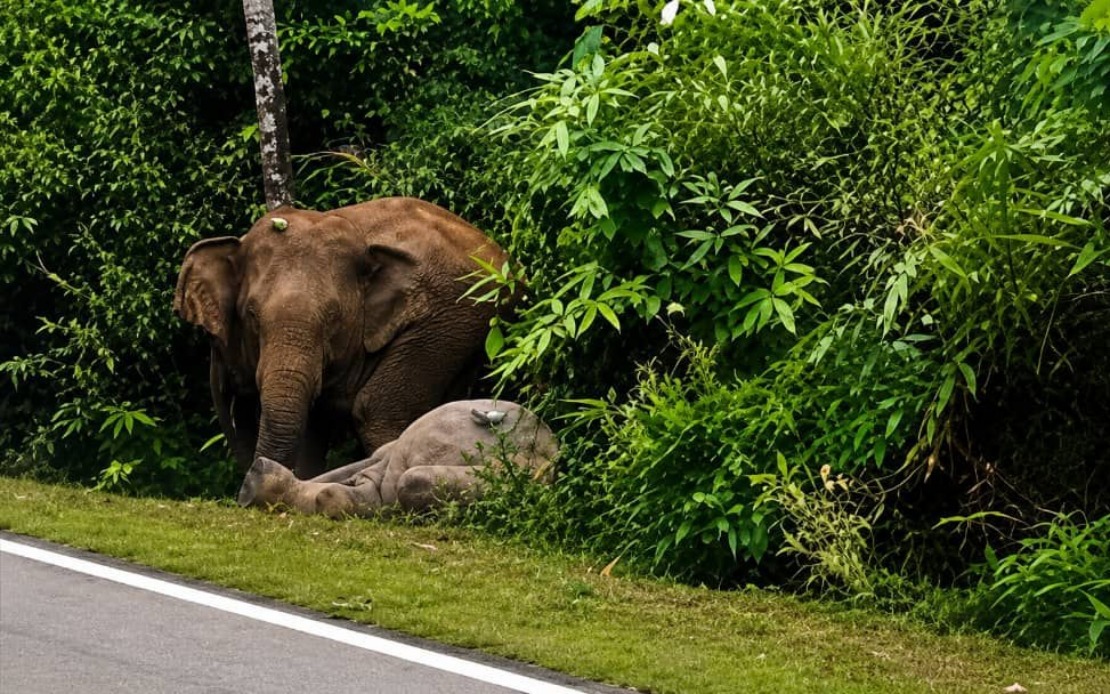
The death of a juvenile elephant along Jalan Felda Nitar in Mersing, Johor, on the morning of July 1 has revived memories of one of Malaysia's most poignant wildlife incidents. A five-year-old female calf was struck by a Perodua Bezza at 2.28 am, and its mother remained beside the carcass for the next seven hours, unwilling or unable to abandon her offspring. The scene, captured in social media footage that quickly spread across digital platforms, underscores the deepening tensions between expanding human infrastructure and wildlife corridors in peninsular Malaysia.
The Johor Department of Wildlife and National Parks (Perhilitan) received word of the incident at around 8.30 am and dispatched four personnel to investigate. Upon arrival, they confirmed that a female elephant calf, roughly 150 centimetres in body length and lacking tusks, had perished in the collision. The adult elephant present at the scene was believed to be the calf's mother, and she had not moved from the spot despite hours having passed. Perhilitan's preliminary assessment identified the elephant herd as belonging to the Jamaluang-Mersing identification group, suggesting these animals are part of an established population tracked and monitored by wildlife authorities.
The incident carries particular weight in Malaysia's ongoing struggle with human-elephant coexistence because it mirrors a tragedy that unfolded on Mother's Day the previous year in Gerik, Perak. In that incident, a young elephant was crushed beneath a container lorry after being struck, and video footage showed an adult elephant—almost certainly its mother—seemingly attempting to push the heavy vehicle away, desperate to save her calf. That moment of maternal anguish captivated national attention and ignited broader conversations about the roads, railways, and development projects that bisect elephant migration routes and feeding grounds. The Mersing incident suggests that lesson has not yet been fully absorbed into planning and management practices.
Beyond the elephant fatality, the collision had serious consequences for the human occupants. A 31-year-old driver was trapped in his vehicle after the impact and sustained leg injuries. The car plunged into a five-metre ravine following the collision with the calf, requiring intervention from the Fire and Rescue Department. While the driver survived, the incident illustrates how human-elephant conflict often produces casualties on both sides—a reality that demands more than reactive crisis management.
Perhilitan's response included deploying the Elephant Capture Unit from the Johor Elephant Sanctuary to encourage the grieving mother elephant back into the forest. The calf's carcass was subsequently buried near the accident site. Officers committed to conducting patrols throughout that night and the following day, concerned that the mother might return to the road, potentially exposing herself to further danger. This post-incident monitoring reflects growing awareness among wildlife authorities that trauma and disorientation can drive elephants to repeat dangerous behaviours.
Warning signage indicating elephant crossing zones had been previously installed along the Mersing route, yet the accident still occurred. This raises uncomfortable questions about the adequacy of passive safety measures when elephant habitat continues to shrink and human traffic intensifies. Road signs alert drivers to potential hazards, but they cannot prevent the fundamental clash between elephant movement patterns and vehicle corridors. Malaysia's national highways, rural plantation roads, and development projects increasingly fragment the landscape that elephants depend upon, forcing them to navigate increasingly hazardous terrain.
The elephants involved in the Mersing incident belong to a population estimated at between 1,500 and 3,000 individuals across Peninsular Malaysia, distributed among fragmented reserves and forests. The Jamaluang-Mersing group represents one of several populations struggling to survive in a landscape dominated by human activity. These herds require vast territories for feeding, breeding, and migration, yet they are confined to shrinking pockets of forest interspersed with roads, agricultural land, and development zones. Each collision between elephant and vehicle is not merely a tragic accident but a symptom of systemic incompatibility between conservation needs and economic development priorities.
For Malaysian and Southeast Asian policymakers, the Mersing incident should serve as a catalyst for more comprehensive strategies. Simply burying casualties and installing warning signs does not address root causes. Effective solutions require investment in wildlife corridors, elevated or underground passages beneath major roads, temporal restrictions on vehicular movement in high-risk areas, and genuine coordination between wildlife agencies, transport authorities, and land developers. Some countries have implemented such measures with documented success in reducing collisions while maintaining human mobility.
The decision by the mother elephant to remain at her calf's side for seven hours reflects behaviour documented in wild elephant populations worldwide. Elephants demonstrate profound bonds within their family groups and exhibit what researchers have interpreted as mourning behaviour when group members die. This maternal attachment, while demonstrating the emotional complexity of these creatures, also places bereaved elephants at risk of further accidents. The psychological impact on the surviving mother remains unknown, but wildlife officers will likely monitor her movements in coming weeks.
The broader context includes Malaysia's commitment to forest conservation and biodiversity targets, enshrined in international agreements and domestic legislation. Yet on the ground, enforcement of wildlife protection laws and integration of elephant conservation into land-use planning remain inconsistent across states. Johor, despite hosting significant elephant populations, continues to authorize agricultural expansion and infrastructure projects in critical habitat areas. This contradiction between stated conservation goals and actual development practices generates repeated tragedies like the Mersing incident.
Public response to the viral video has been emotionally charged, with many Malaysians expressing outrage at the loss of animal life and sympathy for the bereaved mother. This public sentiment represents an opportunity for advocates to push for structural changes in how Malaysia manages development in wildlife areas. The incident demonstrates that wildlife issues resonate deeply with ordinary citizens, providing potential political leverage for comprehensive human-elephant coexistence strategies.
Moving forward, the Mersing collision should prompt Johor authorities to commission a thorough assessment of all roads traversing elephant habitat, with urgent upgrades to the most dangerous intersections. Coordination with neighbouring Pahang and other states sharing elephant populations is equally critical, since these animals do not respect state boundaries. Regional cooperation, supported by federal funding and legislative frameworks that genuinely prioritize wildlife survival alongside human development, remains essential. Without such commitment, more mothers will be left grieving beside the roads of Malaysia.

