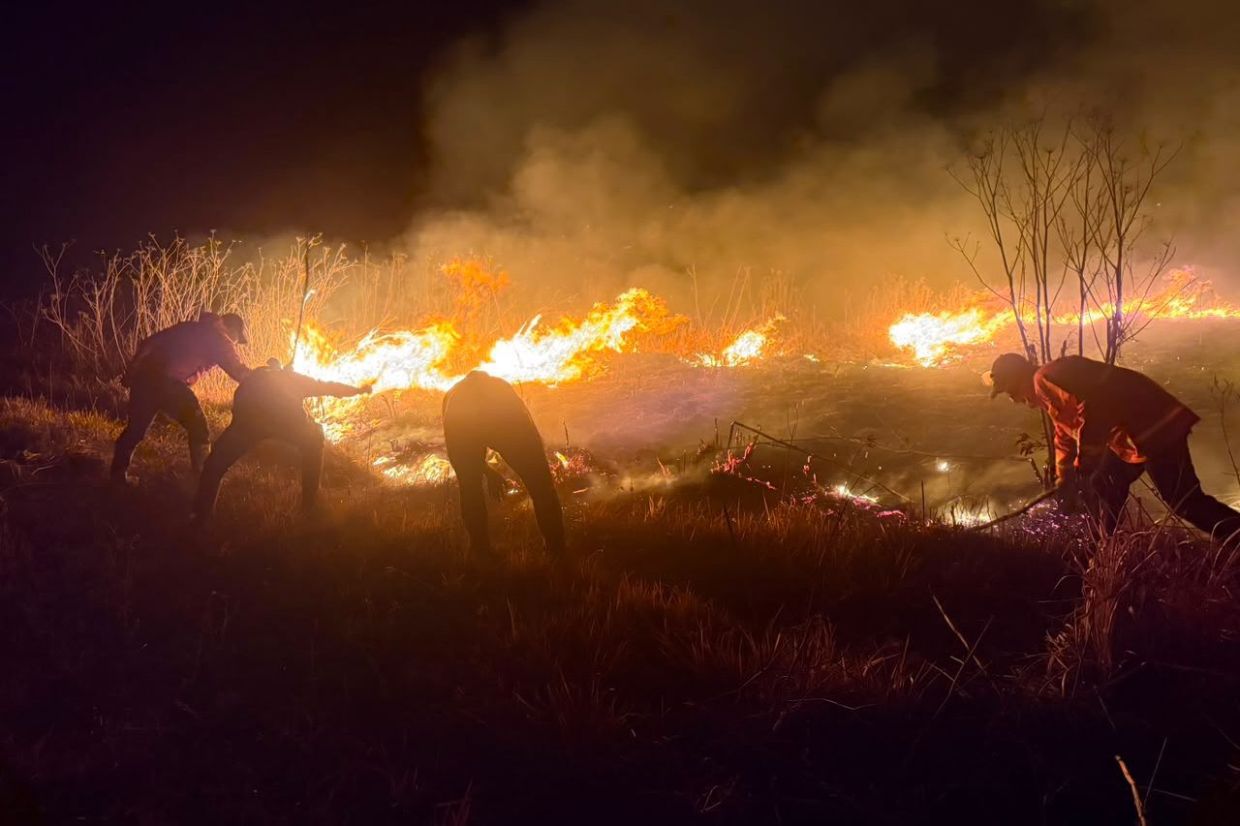
The volcanic landscape of Mount Bromo has become the focal point of an escalating environmental crisis as a major wildfire continues its destructive spread across East Java's most visited natural attraction. The Bromo Tengger Semeru National Park witnessed the fire's extent grow dramatically to approximately 520 hectares following a fresh outbreak late Saturday evening, according to park authorities who disclosed the severity of the situation on Sunday. The expansion came despite intensive containment efforts, with weather conditions proving to be a critical factor in the blaze's rapid progression across the mountain's terrain.
Meteorological conditions have emerged as the primary driver behind the wildfire's acceleration and geographical reach. Rudijanta Tjahja Nugraha, the head of Bromo Tengger Semeru National Park Authority, attributed the alarming spread to notably strong winds that have persisted since Saturday afternoon, creating ideal conditions for the flames to advance from higher elevations downward into lower-lying areas. The wind patterns essentially converted the upper slopes into a launching point for embers and advancing fire fronts, allowing the inferno to traverse significant distances and establish new burn zones. This downslope progression represents a particular challenge for firefighting operations, as gravity naturally works against control efforts when flames are driven downhill by persistent gusts.
Environmental factors unique to Mount Bromo's ecosystem have compounded the disaster. The region's vegetation, already severely desiccated from prolonged dry conditions, provides substantial fuel for rapid combustion and allows flames to spread with minimal resistance. Grass, shrubs, and other botanical matter across the savanna-like expanses have dried to the point where ignition becomes nearly inevitable once exposed to active fire or embers. Nugraha's assessment emphasised this vulnerability, noting that the combination of parched vegetation and strong winds created what fire management specialists recognise as a worst-case scenario for containment. The savanna environment, while visually striking and ecologically significant, burns with particular intensity because of its open layout and dense grass coverage.
The immediate response from park management has prioritised public safety and operational access for emergency services. The Bromo Tengger Semeru National Park Authority implemented a comprehensive closure affecting all entry points beginning at 10pm Saturday, with no predetermined reopening date announced. This decision reflects the unpredictable nature of the ongoing emergency and the need to prevent tourist congestion from impeding firefighting operations. Displaced visitors received compensation options, either receiving refunds for their bookings or rescheduling visits for future dates when conditions normalise. While such measures create economic inconvenience for tourism operators and disappointment for travellers, they represent a necessary prioritisation of lives and operational capacity over commercial considerations.
The investigation into the fire's origin points toward human involvement as the likely cause. Bromo Tengger Semeru National Park Authority officials indicated on Friday that human activity, rather than natural causes such as volcanic activity or lightning strikes, had probably triggered the initial ignition. This assessment carries significant implications for legal accountability and prevention strategies. Forestry Minister Raja Juli Antoni reinforced the government's commitment to prosecuting those responsible, publicly warning that individuals engaged in forest and land burning would face penalties consistent with Indonesian environmental law. The framing of such statements serves both as a deterrent and a signal of governmental seriousness regarding environmental crimes.
The Mount Bromo situation reflects broader patterns of fire management challenges across Southeast Asia, where the transition between wet and dry seasons creates acute vulnerability periods. The region's rapid economic development, combined with agricultural practices that sometimes involve controlled burning, occasionally results in fires that escape containment. Indonesia has historically grappled with devastating wildfire seasons, particularly across Sumatra and Borneo, making institutional capacity for response an ongoing concern. East Java's experience with this particular outbreak demonstrates how even relatively contained geographical areas can become crisis zones when weather conditions align unfavourably and vegetation stress reaches critical thresholds.
For Malaysian observers and regional analysts, the Mount Bromo incident carries relevance beyond Indonesia's borders. Transboundary haze and air quality impacts from major Southeast Asian wildfires have historically affected Malaysia, Singapore, and Brunei, creating public health concerns and diplomatic tensions. While the current Mount Bromo fire may be geographically distant from Malaysia, monitoring its progression and resolution provides insights into regional fire management effectiveness and the potential for cumulative environmental impacts should multiple blazes ignite simultaneously across the region. The emergency response mechanisms being deployed in East Java offer lessons applicable to Malaysia's own national parks and protected areas.
As the situation continues to evolve, the scale and persistence of the Mount Bromo wildfire underscore the interconnection between environmental stewardship, climate conditions, and human behaviour in tropical landscapes. The 520-hectare extent represents a significant ecological impact on a nationally treasured ecosystem, with consequences for biodiversity, soil integrity, and the region's long-term environmental health. The investigation into human causation remains ongoing, with law enforcement authorities tasked with determining specific circumstances and identifying responsible parties. The coming days will prove critical in determining whether the fire can be contained or whether expanding weather patterns might drive further spread.

