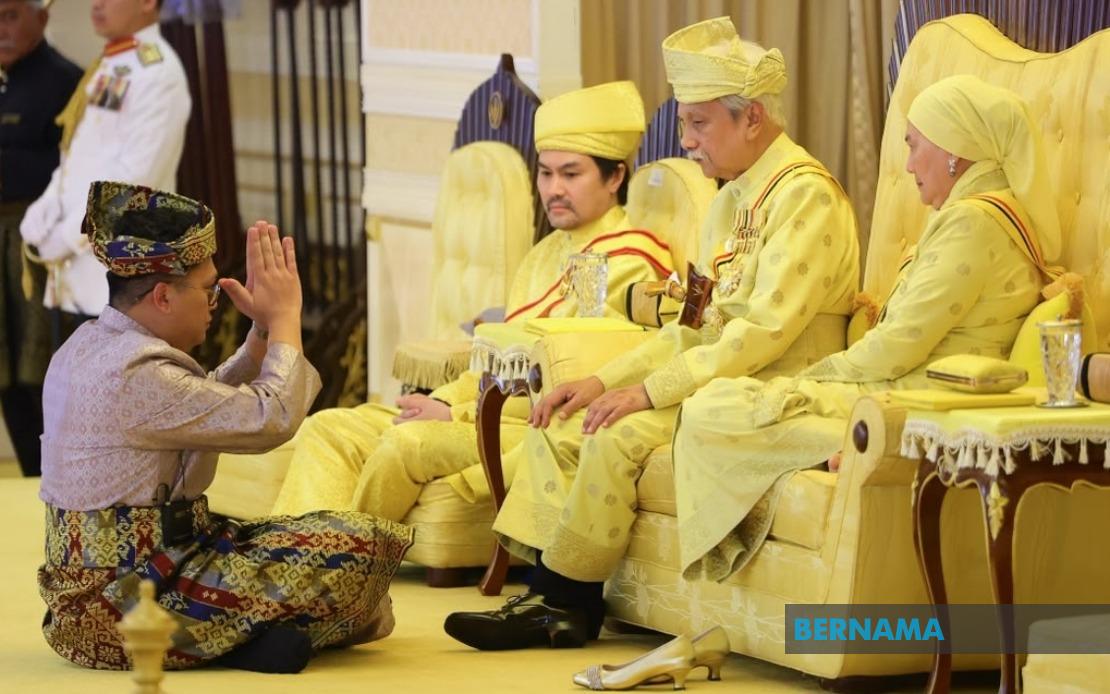
The Yang Dipertuan Besar of Negeri Sembilan, Tuanku Muhriz Tuanku Munawir, has formally installed Muhammad Faris Johari as the 11th Undang of Luak Sungei Ujong during a traditional ceremony held at Istana Besar Seri Menanti on June 27. The 28-year-old professional has been conferred the title Datuk Klana Petra as part of the installation proceedings, marking an important moment in the state's customary leadership structure.
The ceremonial proceedings followed protocols deeply rooted in Negeri Sembilan's administrative traditions. The Orang Empat Istana first sought formal consent from Tuanku Muhriz to begin the installation process, after which the newly appointed Undang publicly pledged his allegiance to the ruler. Following these customary rituals, the Yang Dipertuan Besar formally proclaimed Muhammad Faris in his new position, bringing to conclusion months of anticipation surrounding the leadership transition in Sungei Ujong.
In addressing those gathered for the occasion, Tuanku Muhriz underscored the significance of maintaining institutional continuity and personal integrity within the framework of Negeri Sembilan's constitutional framework. The ruler emphasised that pledges made during such ceremonies must be upheld with unwavering sincerity, ethical conduct, and a profound commitment to public service. Such reminders reflect broader concerns about the sustainability of traditional governance structures in modern Malaysia, where balancing customary authority with contemporary expectations remains an ongoing challenge.
The Yang Dipertuan Besar directed particular attention towards the Orang Kaya, or traditional chieftains, reaffirming their obligation to remain steadfastly loyal to the institution of the Yang Dipertuan Besar and to cultivate relationships with the Palace characterised by respect and close engagement. This guidance reflects the delicate equilibrium required to preserve the constitutional monarchy while maintaining the relevance of customary leadership in an evolving political landscape. For states like Negeri Sembilan, such institutional relationships form the backbone of governance, requiring constant reinforcement to prevent institutional drift or erosion of traditional authority.
The ceremony attracted numerous dignitaries representing both the royal household and state government. Present were Tunku Ampuan Besar Tuanku Aishah Rohani Tengku Besar Mahmud, Tunku Besar Seri Menanti Tunku Ali Redhauddin Tuanku Muhriz, and Tunku Panglima Besar Tunku Zain Al-'Abidin, alongside Menteri Besar Datuk Seri Aminuddin Harun and senior officials from various state government departments. The convergence of royal, customary, and administrative leadership at a single ceremony underscores how Negeri Sembilan integrates multiple layers of governance.
Tuanku Muhriz articulated a broader philosophical vision regarding the foundations necessary for preserving Malaysia's constitutional monarchy system. He stressed that relationships founded on principles of mutual respect, genuine trust, and genuine consensus represent essential ingredients for safeguarding both formal and customary institutions. This perspective proves particularly relevant for Malaysian readers, as it addresses fundamental questions about institutional resilience during periods of political uncertainty or social change across the nation.
The ruler further called upon the general populace to collaborate meaningfully with customary leadership structures in executing their respective roles and responsibilities. Simultaneously, he urged continued commitment to preserving Adat Perpatih, the customary law system practised distinctively in Negeri Sembilan and transmitted through generations. This dual appeal reflects recognition that institutional sustainability depends not merely on formal compliance but on active public engagement with and support for traditional frameworks.
Muhammad Faris Johari, born on October 30, 1997, brings notable professional credentials to his new position. The 28-year-old holds a bachelor's degree in accountancy from Universiti Teknologi MARA and obtained professional qualification through the Association of Chartered Certified Accountants programme in 2022. His appointment therefore represents a generational transition toward leadership with contemporary professional expertise, a trend evident across various Malaysian institutions seeking to blend traditional authority with modern administrative competence. He is married to Sharifah Amirah Syed Ismail Ash-Shahab.
The installation of Muhammad Faris represents only the first of two major customary leadership ceremonies scheduled for the day. Later proceedings would formalise the installation of the 22nd Undang of Luak Rembau, indicating that Negeri Sembilan is currently undergoing significant transitions within its customary leadership framework. These parallel installations suggest a broader rejuvenation of the state's traditional governance structures, potentially influenced by retirements or changes in the existing hierarchy of Orang Kaya positions.
For observers of Malaysian governance, the Sungei Ujong installation carries implications extending beyond state boundaries. Negeri Sembilan's unique system of decentralised leadership among the four Luaks represents a distinct model within Malaysia's constitutional framework, one that continues to warrant attention as the nation navigates questions about institutional modernisation while preserving cultural heritage. The successful conduct of such ceremonies, coupled with the appointment of professionally qualified individuals like Muhammad Faris to traditional positions, suggests one possible path for reconciling customary authority with contemporary governance demands.
The timing of these installations also occurs within a broader context of Malaysian politics where state-level governance and customary institutions have assumed renewed importance. As federal politics has become increasingly complex and contentious, strengthening subnational institutions and customary frameworks has emerged as a priority for many state governments. Negeri Sembilan's deliberate investment in ceremonial rigour and public recognition of its Undang appointments reflects this broader institutional strategy.
Looking forward, the appointment of Muhammad Faris and other new Undangs will test whether the integration of younger, professionally trained individuals into traditional leadership roles can revitalise these institutions while maintaining their cultural authenticity. Success in this transition could provide valuable lessons for other Malaysian states seeking to adapt customary governance structures to contemporary circumstances without sacrificing their essential character and legitimacy within local communities.

