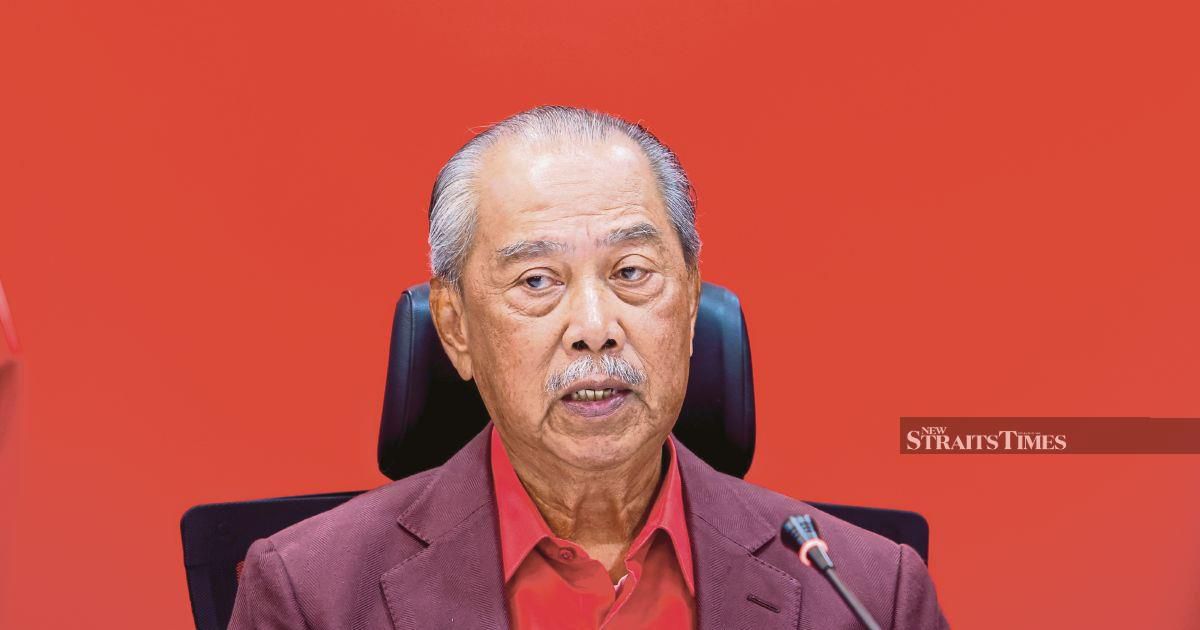
Bersatu president Tan Sri Muhyiddin Yassin has launched a frontal attack on Umno, charging the party with attempting to engineer the downfall of Malaysia's unity government through a coordinated conspiracy similar to tactics that previously toppled a previous administration led by his own coalition. The allegation underscores deepening fractures within the ruling alliance at a time when political stability remains crucial for economic recovery and investor confidence in Southeast Asia's third-largest economy.
Muhyiddin's assertion carries particular weight given his direct experience navigating coalition politics. His previous government, formed between Bersatu and Pakatan Harapan, ultimately collapsed after just 22 months, a period marked by internal tensions and defections that weakened parliamentary support. The Bersatu leader appears to be drawing parallels between that earlier destabilization process and what he now describes as Umno's current strategy, suggesting a pattern of deliberate sabotage rather than genuine policy disagreements.
The unity government represents an unprecedented political experiment in Malaysia, bringing together ideological rivals—the historically dominant Umno, the opposition-turned-coalition partner Pakatan Harapan, and Bersatu—in a bid to restore institutional credibility after years of political turmoil. This tripartite arrangement has delivered relative stability and allowed the administration to pursue policy reforms, including efforts to strengthen institutions and address fiscal challenges. However, maintaining consensus among partners with conflicting interests and voter bases has proven consistently difficult.
Umno's historical dominance in Malaysian politics means that perceptions of its intentions carry substantial implications for coalition longevity. As the party commanding the largest parliamentary bloc within the unity government, Umno possesses significant leverage in negotiations over ministerial positions, budget allocations, and policy direction. If Umno were genuinely to withdraw support or systematically undermine coalition cohesion, the mathematics of parliamentary representation would become precarious, potentially forcing early elections or a complete government reconfiguration.
Muhyiddin's specific allegation suggests Umno is employing indirect methods to weaken the government rather than openly departing the coalition. Such tactics might include exploiting parliamentary procedures to block legislation, orchestrating defections of backbench MPs, or leveraging Umno-aligned state governments to pursue policies contradicting federal government direction. These approaches would create the appearance of governmental dysfunction without requiring an explicit coalition withdrawal, thereby allowing Umno to avoid direct responsibility for instability while simultaneously gaining political advantage.
The timing of Muhyiddin's remarks reflects ongoing tensions over government priorities and resource distribution. Umno, as the largest coalition partner, has consistently advocated for policies favouring its traditional support base in rural constituencies and among Malay-Muslim voters. Conversely, Pakatan Harapan partners prioritize urban constituencies, pluralistic policies, and institutional reform. Bersatu occupies an uncomfortable middle ground, attempting to bridge these competing visions while protecting its own narrow parliamentary representation.
From a Malaysian perspective, these internal coalition disputes matter considerably because they distract from pressing national challenges including inflation management, education system reform, healthcare provision expansion, and infrastructure development. When political energy focuses on internal coalition management rather than policy execution, implementation delays inevitably follow. Small businesses, workers, and households dependent on government services experience real consequences when administration becomes consumed by survival concerns rather than substantive governance.
Regional implications also warrant consideration. Southeast Asia's stability depends partly on Malaysia functioning as a predictable and effective governance partner within frameworks like ASEAN. Political instability, governance uncertainty, and rapid changes in coalition composition undermine Malaysia's diplomatic capacity and economic competitiveness relative to neighbours. Foreign investors and trading partners factor political stability significantly into location decisions, meaning coalition fragility directly affects employment opportunities and prosperity throughout the region.
Historically, Malaysian coalitions have collapsed through death-by-a-thousand-cuts rather than dramatic confrontations. Gradual parliamentary defections, strategic cabinet reshuffles, and accumulated policy frustrations build until coalition mathematics become untenable. Whether Muhyiddin's specific allegations reflect genuine conspiracy or represent rhetorical positioning by a coalition partner anxious about his party's diminishing relevance remains unclear. Bersatu controls only a modest parliamentary contingent and must maintain coalition support to justify ministerial positions and resources.
The fundamental challenge facing all coalition partners involves reconciling incompatible political objectives within a shared government structure. This tension has characterized Malaysian coalition politics since independence and appears unlikely to resolve through Muhyiddin's accusations alone. Instead, resolution requires negotiation, compromise, and mutual commitment to prioritizing governmental stability over short-term factional advantage—a prospect that appears increasingly distant given current accusatory rhetoric.
Moving forward, Malaysian observers should monitor several indicators of coalition health: parliamentary voting patterns on contentious legislation, ministerial portfolio management, resource allocation decisions affecting different states and constituencies, and public statements from senior figures across coalition partners. These signals will reveal whether Muhyiddin's concerns reflect substantive threats or represent standard political positioning during ordinary coalition disagreements. Either way, the unity government's capacity to demonstrate effective governance while managing internal tensions will determine its longevity and Malaysia's economic trajectory.

