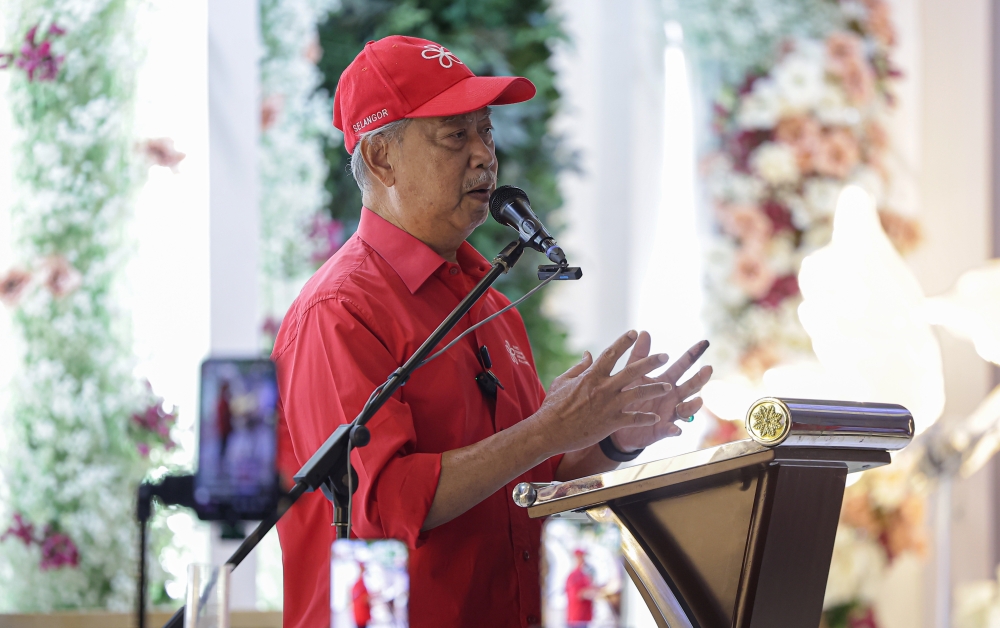
Tan Sri Muhyiddin Yassin has staked a significant claim to political legitimacy by asserting that Parti Pribumi Bersatu Malaysia represents Parliament's solitary authentic Opposition amid Malaysia's increasingly fluid and unpredictable coalition dynamics. The former Prime Minister's declaration arrives at a juncture when the nation's political architecture continues to undergo substantial recalibration, with traditional alliances fragmenting and parliamentary alignments shifting with regularity that has become characteristic of Malaysian politics in recent years.
Muhyiddin's positioning of Bersatu as the country's bona fide Opposition voice rests fundamentally on the party's claimed maintenance of principled autonomy from government structures. This assertion distinguishes Bersatu from rival blocs that Muhyiddin characterizes as having compromised their Opposition credentials through opportunistic manoeuvring and selective collaboration with federal authorities. The distinction Muhyiddin draws is not merely rhetorical; it carries substantial weight in parliamentary proceedings, legislative scrutiny, and the fundamental constitutional function of an effective Opposition holding executive power accountable.
The landscape against which Muhyiddin makes this claim warrants careful examination for Malaysian observers seeking to comprehend contemporary parliamentary dynamics. Malaysia's political system has witnessed unprecedented fragmentation since the 2022 elections, with no single coalition commanding an unquestionable majority and numerous smaller parties occupying pivotal positions. This structural reality has created conditions wherein multiple blocs can reasonably claim Opposition status while simultaneously engaging in tactical partnerships with government entities on specific legislative matters. Such fluidity renders traditional definitions of Opposition cohesion increasingly difficult to apply.
Bersatu's historical trajectory provides essential context for evaluating Muhyiddin's assertions. The party emerged from within Umno, carrying with it considerable institutional knowledge and networks across federal bureaucracies. This background distinguishes Bersatu from newer Opposition formations lacking such governmental experience. Simultaneously, Bersatu's origins within the ruling establishment raise legitimate questions about whether the party can truly position itself as fundamentally adversarial to the system it once inhabited. Muhyiddin's claim of principled Opposition status must be assessed against this complicated genealogy.
The effectiveness of any Opposition depends substantially on its capacity to mobilize parliamentary resources for sustained scrutiny of government actions. This requires legislative cohesion, consistent messaging, and capacity to coordinate amendments, questions, and investigative activities across multiple parliamentary sessions. Bersatu's size relative to other Opposition components becomes relevant here; smaller blocs often face resource constraints that larger coalitions can overcome. Muhyiddin's declaration implicitly contests whether numerical disadvantage necessarily diminishes Opposition authenticity, arguing instead that principled consistency matters more than parliamentary headcount.
Regional implications extend beyond Malaysia's domestic politics. Southeast Asia's democratic systems increasingly feature coalition governments requiring cross-bloc negotiations for legislative passage. Bersatu's assertion of Opposition authenticity reflects broader regional debates about how democracy functions when no single political force commands overwhelming support. Malaysia's experience offers both cautionary lessons and potentially instructive models for neighbouring democracies managing multiparty parliaments where no faction possesses commanding majorities.
The practical mechanics of Opposition function in Malaysia's current configuration merit consideration. An effective Opposition must balance tactical flexibility with principled positions, cooperating with government on matters of national interest while maintaining independent voice on contentious issues. This balance becomes increasingly difficult when political fragmentation means that multiple parties occupy intermediate positions between clear government and Opposition designations. Muhyiddin's argument that Bersatu alone maintains this balance requires examination against documented parliamentary voting patterns and public statements across recent legislative sessions.
The constituencies Bersatu represents geographically and demographically also inform assessments of the party's Opposition role. Bersatu has cultivated particular strength in specific states and among certain voter segments, a reality that shapes which governmental policies the party chooses to contest most vigorously. Opposition parties necessarily prioritize issues affecting their core constituencies, and understanding Bersatu's specific geographic and demographic strongholds reveals which policy domains the party is most likely to challenge effectively. This targeted Opposition function differs from comprehensive challenge across all governmental domains.
Muhyiddin's timing in making this declaration reflects broader political calculations around coalition stability and mid-term realignment possibilities. As the current government continues navigating governance challenges, positioning himself and Bersatu as the principled alternative becomes strategically valuable. The declaration serves multiple audiences simultaneously: Bersatu's existing supporters seeking reassurance the party maintains independent identity, potential coalition partners observing from the sidelines, and voters evaluating which political force can most credibly critique and challenge government performance across the medium term.
The sustainability of Muhyiddin's Opposition positioning depends considerably on whether Bersatu can avoid the opportunistic manoeuvring the former premier attributes to rival blocs. Any apparent alignment with government on critical policy matters, or conversely, any purely tactical obstruction lacking substantive policy foundation, risks undermining claims to principled Opposition status. The party faces consistent pressure to demonstrate that its Opposition role reflects genuine policy disagreements rather than electoral calculation or intra-elite rivalries.
For Malaysian voters attempting to assess available political choices, Muhyiddin's assertion contributes to ongoing navigation of increasingly complex parliamentary landscape. Traditional binary divisions between government and Opposition have dissolved into multidimensional political space where parties occupy numerous positions simultaneously. Voters must now evaluate which political forces best serve their interests across this fragmented terrain, recognizing that Opposition authenticity encompasses multiple forms and that principled challenge to government can originate from various sources rather than single concentrated bloc.
The broader constitutional health of Malaysian democracy may ultimately depend less on any single party's Opposition credentials than on whether multiple competing centres of power can effectively check governmental authority. Muhyiddin's claim reflects one significant voice in Malaysia's ongoing political conversation about how democratic accountability functions when traditional coalitional structures have become substantially more fluid and unpredictable than the relatively stable two-coalition system that previously dominated Malaysian politics for extended periods.

