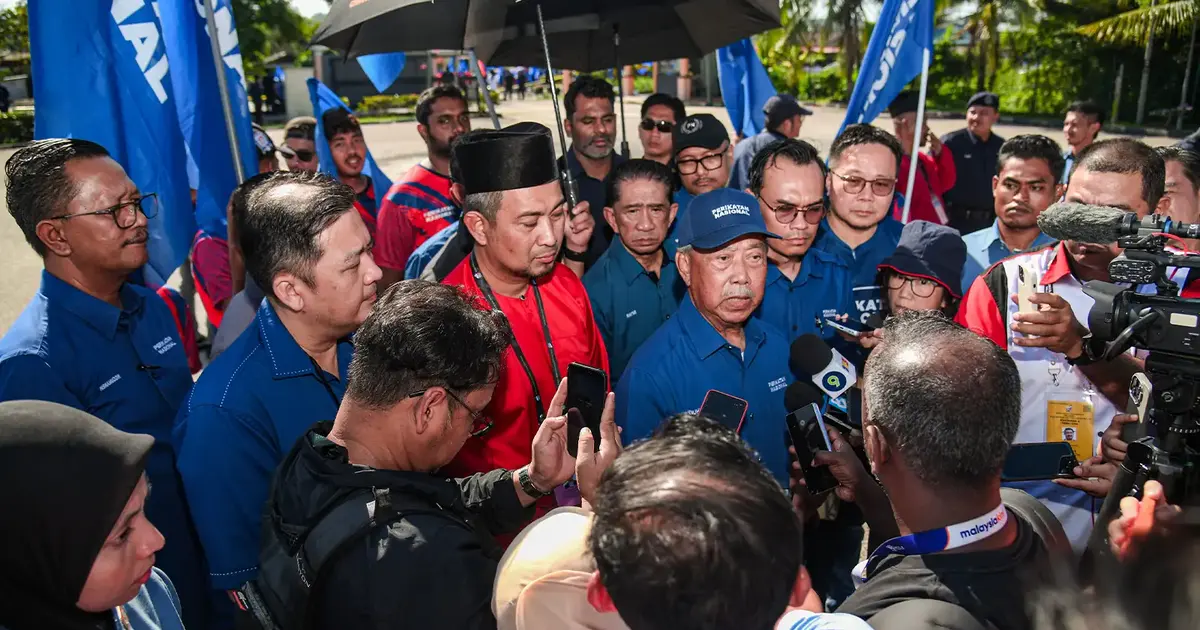
Muhyiddin Yassin, the president of Perikatan Nasional, has voiced confidence that his coalition possesses the necessary strength and political backing to establish governments across multiple states in Malaysia. His remarks signal a strategic pivot towards consolidating the opposition bloc's electoral credentials ahead of anticipated state-level contests, while simultaneously revealing the fragmentation of Malaysia's political landscape into competing coalitions and independent operators.
The Bersatu leader's assertion arrives amid ongoing jockeying for position between the three main political blocs dominating Malaysian politics: Perikatan Nasional, Pakatan Harapan, and the federal administration led by Prime Minister Anwar Ibrahim. Each bloc has been actively cultivating alliances and positioning candidates in preparation for state elections that could reshape the domestic political map. Muhyiddin's public expression of optimism reflects PN's determination to emerge as a credible alternative government at the state level, a crucial stepping stone towards national electoral relevance.
The significance of Muhyiddin's statement extends beyond mere coalition posturing. By explicitly acknowledging that Perikatan Nasional has cultivated relationships with parties positioned outside the formal coalition structure, he is revealing a sophisticated political strategy that extends influence beyond PN's three core components: Bersatu, PAS, and the smaller formations aligned with them. This approach mirrors successful opposition coalitions in other democracies, where electoral arrangements often encompass formal members alongside sympathetic parties willing to support specific candidates or legislative agendas without surrendering their independence.
Muda, the Malaysian United Democratic Alliance founded by former PKR deputy president Muhammad Azmin Ali, emerges as a particularly significant player in PN's calculations. The reformist party has positioned itself as an alternative to established coalitions, capturing younger voters and urban professionals increasingly disillusioned with conventional political structures. Muhyiddin's explicit reference to Muda as a potential ally underscores PN's recognition that 21st-century electoral competition increasingly relies on flexible, issue-based partnerships rather than rigid bloc loyalties. For Malaysian voters, this signals a more fluid political environment where consensus-building may transcend traditional coalition boundaries.
The regional implications of PN's state-level ambitions deserve careful consideration. Several Malaysian states retain competitive electoral dynamics where a disciplined opposition coalition could potentially displace ruling administrations. East Malaysian states, particularly Sarawak and Sabah, have historically demonstrated independent voting patterns and susceptibility to cross-bloc political realignment. Should Perikatan Nasional successfully leverage its alleged alliances with external parties like Muda to challenge ruling coalitions in these regions, it could fundamentally alter the federation's political balance and complicate federal governance arrangements.
Muhyiddin's confidence also reflects the broader strategic calculations within Perikatan Nasional regarding its role in Malaysian politics. Rather than positioning PN solely as an alternative federal government, the coalition appears focused on establishing itself as a dominant force at the subnational level, where state legislatures control crucial portfolios including land administration, agriculture, and local government. Successful state-level governance provides coalitions with administrative experience, revenue sources, and crucially, a platform for projecting competence and legitimacy to national audiences.
The invocation of Muda as an ally warrants deeper examination regarding PN's broader coalition strategy. Unlike the Pakatan Harapan arrangement, which formalised relationships among DAP, PKR, and Amanah through explicit written agreements, PN's approach appears more transactional and issue-specific. This flexibility potentially offers advantages in pursuing state-level victories where local dynamics and personality-driven politics frequently override ideological coherence. However, it also introduces vulnerability to partner defection if electoral calculations shift or leadership conflicts emerge.
For Malaysian observers tracking the evolution of post-2018 electoral politics, Muhyiddin's remarks illuminate the ongoing fragmentation and reconfiguration of political coalitions. The emergence of Muda as a meaningful force, combined with PN's apparent openness to partnership arrangements, suggests that Malaysia's political future may increasingly resemble a multipolar system rather than a simple two-coalition structure. This development carries implications for democratic competition and governance, potentially creating space for minority interests and regional perspectives previously marginalised by larger blocs.
The practical manifestation of PN's state-level ambitions will become evident through candidate announcements, campaign strategies, and electoral outcomes in forthcoming state elections. Muhyiddin's expression of confidence, while politically conventional, does reflect genuine organisational capacity and strategic planning within Perikatan Nasional. Whether these ambitions translate into meaningful electoral gains remains contingent on multiple variables including the timing of state elections, local economic conditions, and whether announced alliances with parties like Muda materialise into effective electoral machinery.
Ultimately, Muhyiddin's statement represents a calculated message directed simultaneously towards three audiences: internal coalition members requiring reassurance regarding PN's viability, potential allied parties contemplating cooperation, and Malaysian voters evaluating whether Perikatan Nasional merits their electoral support. The coming months will reveal whether PN's purported partnerships and state-level strategies constitute serious political positioning or aspirational rhetoric divorced from electoral reality.

