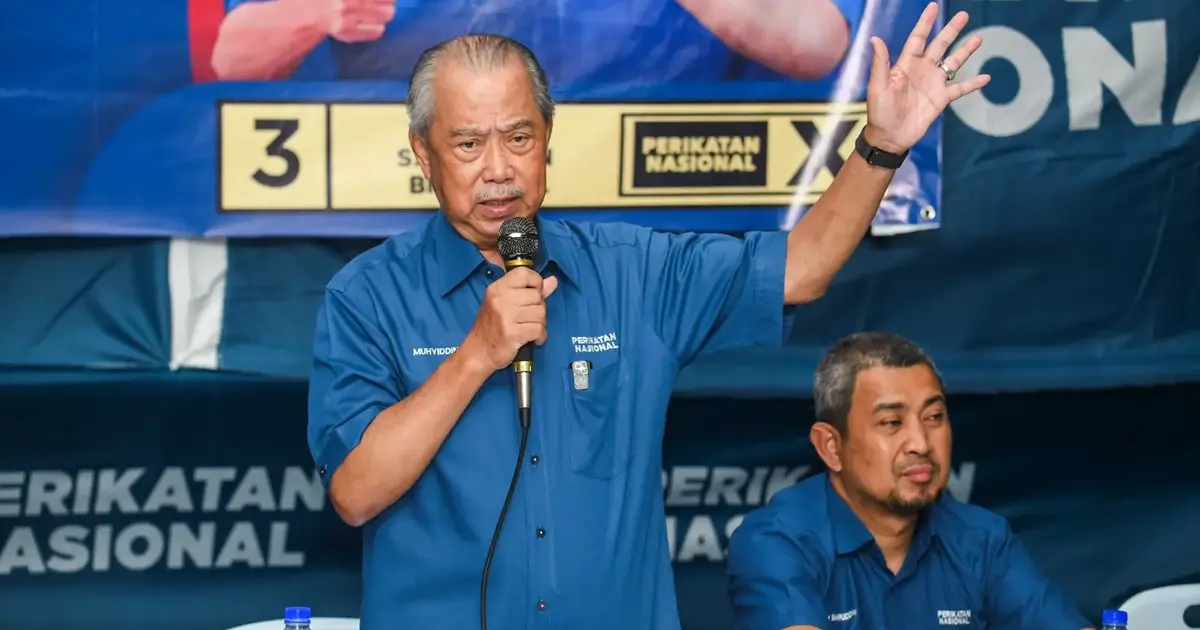
Bersatu president Muhyiddin Yassin has openly suggested that manoeuvres concerning former prime minister Najib Razak's legal future are intertwined with the evolving political landscape in Johor, Malaysia's second-largest state and a traditional stronghold of the United Malays National Organisation. The remarks highlight ongoing tensions within the country's political establishment over how to handle the case of the scandal-plagued ex-leader, whose conviction on corruption charges has remained a defining issue in Malaysian politics for years.
Muhyiddin's statement underscores the contentious nature of any discussions about Najib's potential freedom, a topic that continues to spark debate within government circles and among opposition parties. The Bersatu chief's comments suggest that decisions affecting Najib's legal status may be influenced by calculations related to the timing and outcome of state-level elections, reflecting the intricate web of Malaysia's federal and regional power dynamics. This observation reflects a pattern in which major political decisions often intersect with electoral considerations, a phenomenon not uncommon in Southeast Asian democracies where state and national interests frequently overlap.
Najib's conviction stemmed from his involvement in the 1Malaysia Development Berhad scandal, one of the largest financial crimes in Southeast Asian history. The former prime minister was found guilty on multiple charges related to abuse of power and money laundering in connection with billions of ringgit that disappeared from state coffers. His legal troubles have cast a long shadow over Malaysian politics, dividing the country's political elite and creating fault lines within the Malay-Muslim establishment that has traditionally dominated governance.
The Johor state elections represent a critical political contest, with implications extending far beyond the state itself. Johor has historically served as a power base for the UMNO, the party that governed Malaysia uninterrupted from independence until 2018, and where Najib held significant influence during his decades in politics. Control of the state apparatus carries substantial weight in determining which coalition commands resources and patronage networks, factors that invariably shape discussions about high-profile legal matters involving senior party figures.
Muhyiddin's allusion to the relationship between electoral politics and Najib's situation reflects deeper anxieties within Malaysian political circles about how the country manages accountability for its leaders. The suggestion that state elections might influence decisions affecting a convicted individual's freedom raises questions about judicial independence and whether political expediency could override legal principles. These concerns are particularly acute given Malaysia's recent history of political turmoil, including the 2018 electoral shock that unseated the long-ruling Barisan Nasional coalition.
The timing of such commentary matters considerably in Malaysia's volatile political environment, where alliances shift and power balances fluctuate. Muhyiddin himself has been a central figure in these shifts, having served as prime minister and navigated complex coalition dynamics. His willingness to publicly connect Johor electoral prospects with the Najib matter suggests that senior politicians view these issues as fundamentally linked rather than separate spheres of activity.
For Malaysian voters, particularly those in Johor, these revelations about behind-the-scenes political calculations may reinforce perceptions that the country's legal system and electoral processes are influenced by factional interests rather than principled governance. The state's electorate has shown increasing sophistication in recent years, shifting support between coalitions based on perceived performance and integrity. Any perception that electoral considerations drive decisions about high-profile criminal cases could further erode public confidence in institutions.
The broader Southeast Asian context matters here as well. Malaysia's political developments are watched closely by regional neighbours grappling with their own challenges regarding judicial independence and political accountability. How Malaysia handles the intersection of electoral politics and the legal consequences for former leaders may set precedents or cautionary examples for other democracies in the region facing similar dilemmas involving powerful figures with substantial political networks.
Muhyiddin's emphasis that Najib remains a convicted person serves to anchor the discussion in legal reality, even as he acknowledges the political dimensions surrounding the former leader's situation. This careful framing suggests an attempt to maintain the principle that Najib's conviction is established fact, while simultaneously recognising that discussions about clemency or release necessarily involve political considerations. Such rhetorical positioning reflects the delicate balance Malaysian politicians must maintain between acknowledging rule of law and engaging in realpolitik.
The coming weeks and months will likely see further commentary on these intersecting issues as Johor's political situation develops and speculation about potential executive actions regarding Najib continues. These debates will prove instructive for understanding whether Malaysia can sustain a system in which serious criminal convictions are treated as settled matters independent of electoral cycles and political interests, or whether the country's established power structures will continue to blur these important distinctions.

