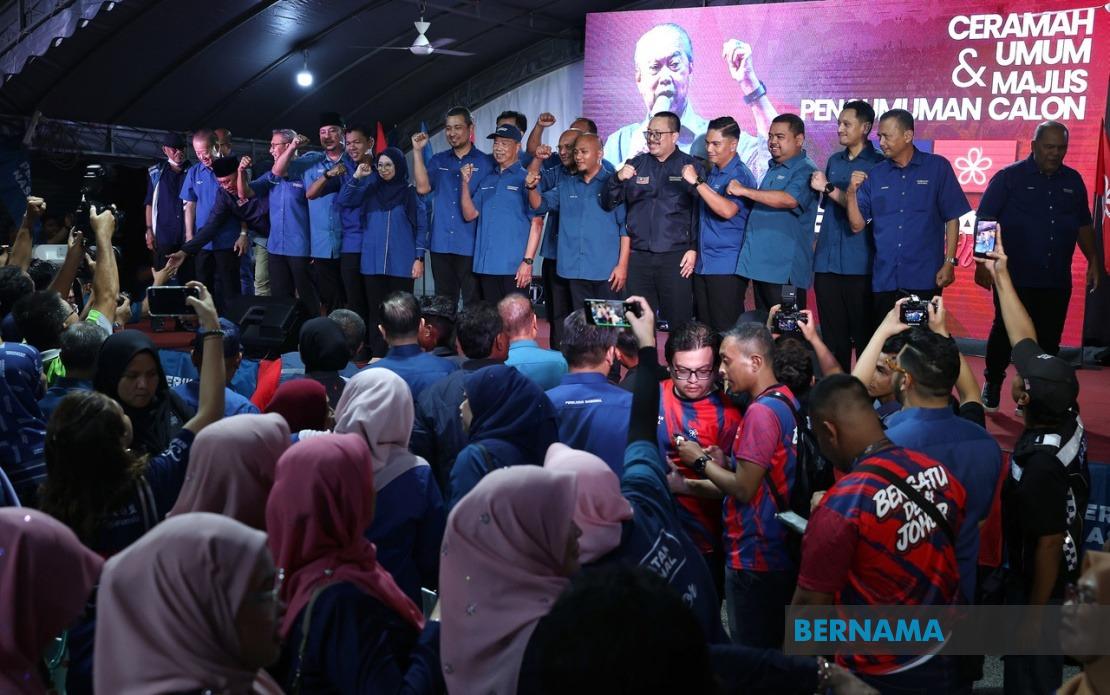
Tan Sri Muhyiddin Yassin formally presented Parti Pribumi Bersatu Malaysia's contingent of 16 candidates for the upcoming Johor State Election during a ceremony and public address at the Pagoh Parliamentary Service Centre in Taman Pagoh Jaya on June 25. The unveiling marked a significant moment for the party as it prepares for what is shaping up to be a closely watched electoral contest in the southern state.
Bersatu's decision to field a full complement of candidates reflects the party's determination to secure a meaningful presence in the Johor assembly following the state's political realignment. The timing of the announcement came as campaigns were entering their final stretch, with candidates having roughly two weeks from nomination day to canvass voters across the state. Among those announced was Mohd Idzharruddin Mohd Nasirruddin, who will represent the N8 Bukit Pasir constituency.
The Election Commission has structured the electoral calendar with considerable precision. Nomination day falls on June 27, affording candidates and their respective parties a three-week window to conduct ground operations before voters head to polling stations on July 11. This timeline emerged after the Johor State Assembly was formally dissolved on June 1, triggering the constitutional process that led to the calling of snap elections.
For Malaysian political observers, Bersatu's participation in the Johor contest carries broader implications beyond the state's boundaries. As a component of the Perikatan Nasional coalition, the party's electoral performance will serve as a barometer for the bloc's standing among Johor voters, many of whom have historically swung between competing political coalitions. The party's ability to retain or expand its footprint will influence calculations within the broader opposition framework as Malaysia heads towards federal elections expected within the coming years.
Johor holds particular strategic significance within Malaysian politics. As the nation's most populous state outside Selangor and a traditional stronghold of established political movements, it serves as a testing ground for emerging political narratives and demographic shifts. The state's diverse electorate, spanning urban centres, industrial zones, and rural constituencies, makes it representative of broader national voting patterns. Any substantial movement in voter sentiment in Johor typically reverberates across other states.
Bersatu's slate of 16 candidates represents the party's assessment of winnable seats within the state assembly's 56-member chamber. This focused approach suggests the party is targeting specific constituencies where it believes it has competitive advantages, whether through incumbency, local organisation, or demographic alignment. The decision to concentrate resources likely reflects a pragmatic calculation about the party's organisational capacity and financial constraints relative to larger rivals.
The political context surrounding these elections has grown increasingly complex following recent shifts in coalition dynamics. Johor's electoral landscape has been reshaped by changing alliances and the repositioning of various political actors. Bersatu's participation must be understood within this fluid environment, where traditional party loyalties have eroded and voters increasingly evaluate candidates on local and personal merits rather than blanket party affiliation.
For the Johor electorate, the enlarged pool of candidates from Bersatu and other parties will expand the menu of choices available to voters. This proliferation of options at the state level reflects broader trends towards political fragmentation and the erosion of two-coalition competition that characterised Malaysian politics for decades. Voters in constituencies contested by multiple slates will face genuine choices between distinct political visions and candidate profiles.
The campaign period ahead will prove decisive in determining whether Bersatu can convert its candidate announcements into electoral gains. The party faces the challenge of establishing clear messaging that distinguishes it from competitors while also defending its record in constituencies where it holds seats. Ground-level organisation, media presence, and the resonance of campaign messaging will ultimately determine whether Bersatu's 16-candidate strategy translates into legislative representation.
Beyond the immediate electoral mathematics, the Johor contest will offer insights into the durability of Perikatan Nasional as a political bloc. Coalition cohesion under electoral pressure reveals much about the underlying strength of partnerships forged among member parties. Strong performance by Bersatu could reinforce the coalition's claim to be a viable governing alternative at both state and federal levels, while disappointing results might prompt questions about the bloc's political viability and long-term trajectory.
For Malaysian political analysts and Southeast Asian observers, the Johor elections represent more than a routine state-level contest. They constitute a significant data point in understanding how Malaysian voters are recalibrating their political preferences following years of instability at the federal level. The results will provide early signals about voter sentiment heading towards the next general election, making the July 11 polling day an event of consequence far beyond Johor's borders.

