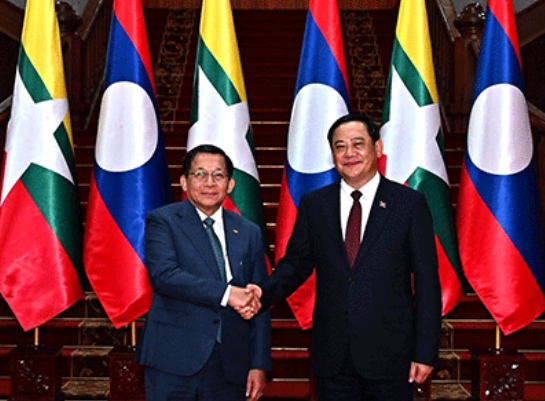
Myanmar's President Min Aung Hlaing has embarked on a significant diplomatic mission to Laos, arriving in Vientiane on July 3 for a three-day state visit that signals renewed momentum in the two countries' long-standing bilateral partnership. The high-profile engagement, which included Laotian President Thongloun Sisoulith extending a warm state reception at the Presidential Palace, represents both a symbolic affirmation of seven decades of diplomatic ties and a practical platform for advancing shared regional interests. As Myanmar's first official foreign visit by its new leadership, the choice of Laos as the destination carries particular weight within Southeast Asian diplomatic circles, underscoring the strategic importance both nations place on their relationship.
The visit coincides with commemoration of the 70th anniversary of formal diplomatic relations between Laos and Myanmar, a milestone that officials from both countries have seized as an opportunity to reframe their partnership for contemporary challenges. During bilateral talks, Presidents Thongloun and Min Aung Hlaing reviewed the trajectory of cooperation and outlined an ambitious agenda spanning multiple economic and security domains. The framing of the visit as a "new milestone" rather than merely ceremonial reflects a deliberate effort by both governments to signal that their relationship extends beyond historical nostalgia into substantive contemporary collaboration.
Defence and security cooperation emerged as a central pillar of the discussions, with both leaders agreeing to strengthen border management protocols and intelligence sharing mechanisms. For Laos, situated between Thailand and Vietnam, effective border coordination with Myanmar holds particular strategic significance in managing transnational challenges including drug trafficking and irregular migration. The emphasis on these security dimensions reveals how regional stability concerns, increasingly acute across mainland Southeast Asia, are shaping bilateral agendas. Myanmar's commitment to enhanced cooperation in these areas also reflects its own interest in securing support from neighbouring states as it navigates complex internal challenges and rebuilds international standing.
Economic and infrastructural partnerships formed another substantial component of the talks, with officials highlighting potential for expanded trade, investment and transport linkages. The two countries explored opportunities in energy cooperation, labour mobility and cross-border infrastructure development, areas that could significantly impact regional connectivity initiatives. For Myanmar, deepening economic ties with Laos serves as a counterweight to potential isolation and strengthens its position within the broader Mekong subregion. For Laos, accessing Myanmar's markets and resources while facilitating investment flows presents avenues for accelerating domestic development, particularly in sectors like energy generation where cross-border collaboration could unlock significant benefits.
The signing of two cooperation memoranda—one addressing tourism collaboration and another establishing "friendship city" relations between Vientiane and Naypyidaw—reflects the ceremonial dimension of the visit while introducing practical institutional frameworks. Tourism cooperation carries economic implications for both nations while also facilitating people-to-people exchanges that can sustain diplomatic goodwill. The designation of Vientiane and Naypyidaw as friendship cities creates an administrative mechanism for ongoing municipal-level cooperation on urban development, cultural initiatives and civil society engagement. Such city-level twinning, increasingly popular across Southeast Asia, provides a secondary channel for bilateral cooperation that can persist regardless of fluctuations in higher-level political relations.
Parliamentary engagement underscored the visit's comprehensive approach to deepening institutional ties. President Min Aung Hlaing's meeting with Xaysomphone Phomvihane, President of Laos' National Assembly, centred on strengthening legislative cooperation and ensuring parliamentary oversight of bilateral agreements. This dimension carries particular significance in demonstrating commitment to transparent, accountable implementation of cooperation frameworks rather than merely symbolic gestures. The agreement to enhance coordination between Laos' National Assembly and Myanmar's Union Parliament creates accountability mechanisms that can help translate diplomatic pledges into tangible policy outcomes benefiting ordinary citizens in both nations.
Laos' warm reception of Myanmar's leadership, signified through full state honours and high-level representation across government bodies, carries nuanced implications within Southeast Asian geopolitics. As the first Asean member state to host President Min Aung Hlaing for official foreign engagement since his assumption of office, Laos has positioned itself as Myanmar's diplomatic gateway to the broader regional community. This positioning reflects both historical ties and pragmatic calculations about Myanmar's importance to Laotian interests within Asean and subregional frameworks. The move also subtly signals Laos' independent foreign policy orientation, willing to engage substantively with Myanmar regardless of scrutiny from other regional players.
Cultural and ceremonial dimensions of the visit reinforced the emotional foundations underlying strategic partnership. Min Aung Hlaing's attendance at a traditional Baci ceremony and participation in a state banquet, combined with his laying of wreaths at the Unknown Soldier Monument honouring Lao revolutionary fighters, demonstrated respect for Laotian national narratives and historical experience. These gestures, while seemingly ritualistic, serve important functions in sustaining mutual respect and understanding between neighbouring societies. Similarly, the scheduled visit to Luang Prabang, including tours of temples and Unesco World Heritage sites, provides opportunities for cultural immersion that can humanise diplomatic relations and create broader constituencies invested in bilateral cooperation.
The visit's emphasis on implementing previous agreements and establishing new institutional mechanisms for coordination reveals both nations' determination to move beyond rhetorical commitments toward concrete collaborative outcomes. The handover of snake antivenom serum from Myanmar to Laos' Ministry of Health, whilst apparently modest, exemplifies the kind of practical humanitarian cooperation that directly benefits populations. Such gestures complement the high-level diplomatic choreography and demonstrate that bilateral relations encompass diverse dimensions serving different constituencies and interests.
Regionally, this visit unfolds within the context of intensifying engagement among Mekong countries and broader Southeast Asian diplomatic dynamics. Both Myanmar and Laos have emphasised their participation in Asean, the United Nations, and the Mekong-Lancang Cooperation framework as spheres for deepened collaboration. For Malaysia and other Southeast Asian nations, the strengthening of Myanmar-Laos ties carries implications for regional cohesion and the management of shared challenges spanning trade, environmental protection and security. The focus on cross-border air pollution cooperation, mentioned in official discussions, reflects growing recognition among mainland Southeast Asian states that environmental challenges demand coordinated responses transcending national boundaries.
For Myanmar specifically, cultivating robust relations with Laos addresses strategic imperatives beyond bilateral interest. As Myanmar seeks to restore international standing following internal transitions, demonstrating commitment to neighbourhood cooperation through substantive engagement becomes crucial. For Laos, deepening ties with Myanmar strengthens its subregional positioning and diversifies its diplomatic portfolio. Both nations share interests in maintaining stability along their shared border region and in securing cooperative frameworks that support development priorities.
The comprehensive nature of this state visit—encompassing political, security, economic, cultural and parliamentary dimensions—demonstrates both countries' understanding that sustainable bilateral relations require multifaceted approaches. Rather than concentrating engagement at a single institutional level, both governments have ensured that cooperation mechanisms exist across government structures, from executive leadership to legislative bodies to municipal administrations. This institutional depth provides resilience, ensuring that personal relationships between individual leaders do not entirely determine the trajectory of bilateral ties.
Looking forward, the cooperation agreements signed during this visit will require effective implementation through designated bilateral committees and regular coordination mechanisms. The success of this state visit will ultimately be measured not by the warmth of ceremonial receptions but by tangible outcomes in trade flows, successful security cooperation, and visible development benefits accruing to populations in both countries. For regional observers in Malaysia and elsewhere across Southeast Asia, the Myanmar-Laos engagement serves as a reminder that mainland Southeast Asia continues to develop its own diplomatic dynamics and cooperative frameworks, shaping regional developments in ways that merit sustained attention.

