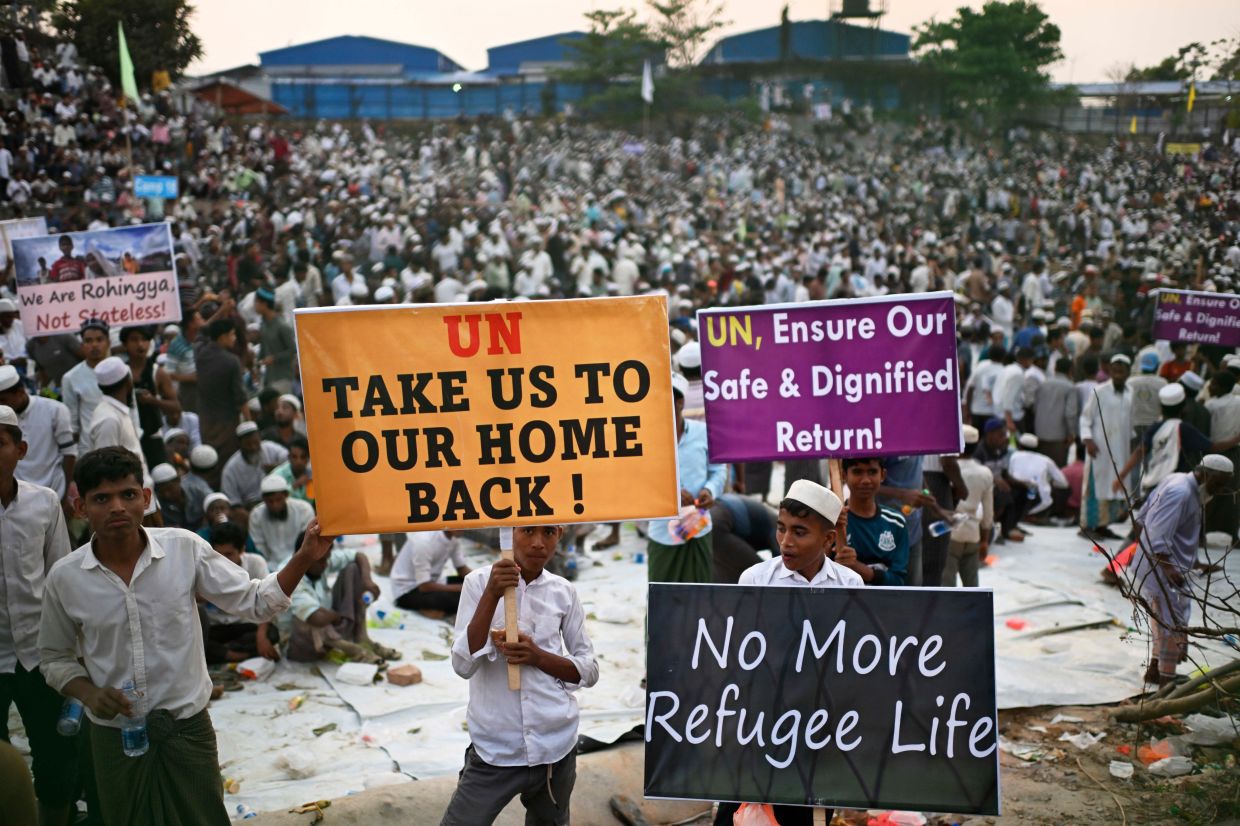
Myanmar's military-backed administration announced on Saturday that it has verified the status of more than 300,000 Rohingya refugees currently sheltering in camps across Bangladesh, declaring them eligible for return to their former homes in western Rakhine state. The Foreign Ministry's statement marks the latest government position on a humanitarian crisis that has now stretched into its ninth year, with no meaningful progress toward resolving the plight of hundreds of thousands displaced persons who have languished in camps since August 2017.
The backdrop to this announcement is one of the most tragic episodes in recent Southeast Asian history. When Myanmar's military launched a broad security operation in 2017 following attacks by a Rohingya insurgent group on guard posts in Rakhine, the response was devastating in scale. Over 700,000 Rohingya fled across the border into Bangladesh during that initial wave, joining an existing population of hundreds of thousands who had sought refuge there over previous decades following earlier cycles of communal violence orchestrated by Myanmar's armed forces. The sheer magnitude and systematic nature of the 2017 operation triggered international condemnation, with the United Nations and numerous governments accusing Myanmar of ethnic cleansing and genocide—charges the junta has consistently denied.
Understanding Myanmar's position on the Rohingya requires grasping a fundamental point of contention: the country does not recognize the Rohingya as one of its 135 officially recognized ethnic minorities. Instead, the government refers to them as Bengalis, a deliberate linguistic choice designed to imply they are migrants from Bangladesh rather than indigenous inhabitants of Myanmar deserving citizenship rights. This nomenclature reflects a decades-long dispute about national identity and belonging that underpins the entire refugee crisis. Myanmar's refusal to acknowledge Rohingya claims to citizenship has made any resolution extraordinarily difficult, since repatriation requires at minimum accepting some degree of responsibility and connection to the group.
The verification figures announced this week reveal the complexity of the humanitarian situation. Myanmar said it had processed 426,545 of the 828,824 refugees on a list provided by Bangladesh—barely more than half the total population. Of those examined, the military government determined that 308,797 qualified as former residents of Rakhine state eligible for return. However, the ministry also reported that 113,507 people could not be verified either way, and controversially claimed that 4,241 individuals had been involved in what Myanmar describes as terrorist activities. These figures suggest a painstaking but incomplete process of documentation, complicated by the absence of reliable records and the politicization of verification decisions.
The pathway toward repatriation has been blocked repeatedly by deteriorating security conditions in Myanmar. In 2018, Myanmar and Bangladesh agreed to a two-year process for receiving refugees back into Rakhine, but that timetable collapsed almost immediately. A military coup in 2021 that ousted the elected government of Aung San Suu Kyi transformed Myanmar's internal politics and diverted military resources away from border management. The coup triggered armed resistance movements across the country, creating an environment of sustained conflict incompatible with the logistics of large-scale refugee repatriation. Most critically for the Rohingya, fighting between the Rakhine-based Arakan Army and Myanmar's military escalated sharply in 2023 as the two forces battled for control of the region. The Arakan Army has captured significant territory from the military in recent years, creating a fragmented governance structure that makes coordinated refugee returns virtually impossible.
The violence in Rakhine during 2023 had a counterintuitive effect on refugee numbers: rather than creating conditions for return, it forced additional Rohingya to flee Bangladesh camps toward neighboring countries. Some attempted perilous maritime journeys toward Malaysia and Indonesia in small, unseaworthy boats, reflecting the desperation born from nine years of confinement and dwindling hope. The humanitarian conditions in the Bangladeshi camps have deteriorated substantially, with international aid budgets slashed repeatedly and living conditions becoming increasingly strained under the weight of such a large displaced population. For many Rohingya, the calculus shifted toward taking extreme risks over remaining indefinitely in limbo.
This desperation has shaped regional dynamics in ways directly relevant to Malaysia. In late July, Prime Minister Anwar Ibrahim announced that Myanmar had agreed to accept 5,000 Rohingya refugees currently residing in Malaysia as part of a repatriation initiative. The announcement generated expectations that Myanmar might finally be moving toward accepting some Rohingya back, particularly given Malaysia's longstanding concern about managing refugee populations and the strain on its own resources. However, Myanmar's Foreign Ministry official Han Win Aung immediately contradicted this narrative when speaking to international media, insisting that the repatriation program applied exclusively to verified Myanmar nationals held in Malaysian detention centers and explicitly rejecting any broader commitment to accepting Rohingya populations.
This disconnect between Malaysian and Myanmar government statements highlights the fundamental impasse surrounding the crisis. Myanmar continues to maintain that it will only receive refugees once security in Rakhine stabilizes, yet the military junta simultaneously rejects responsibility for the Rohingya as a group, limiting its own obligations toward them. The government disputed claims that over one million people were displaced from Rakhine, instead contending that approximately 540,000 crossed into Bangladesh while over 200,000 remained in northern Rakhine—figures that do not align with international documentation. These competing narratives suggest that even if security conditions were to improve dramatically, fundamental disagreements about refugee identity, numbers, and Myanmar's obligations would likely continue blocking any large-scale repatriation.
For Malaysia and other Southeast Asian nations, the implications are profound. As Myanmar's internal instability persists and Rakhine remains a zone of active conflict, the refugee population in Bangladesh shows no signs of diminishing. This creates sustained pressure on neighboring countries to accommodate irregular maritime migration from desperate populations. Malaysia's experience managing refugee populations across its territory, combined with the burden on Bangladesh's resources, places the entire region in a precarious position. The ninth anniversary of this crisis passes with Myanmar's military government no closer to accepting fundamental responsibility for the Rohingya, and the international community exhausted in its efforts to pressure behavioral change. Without either a dramatic shift in Myanmar's political direction or extraordinary diplomatic breakthroughs, the outlook for resolution remains bleak.

