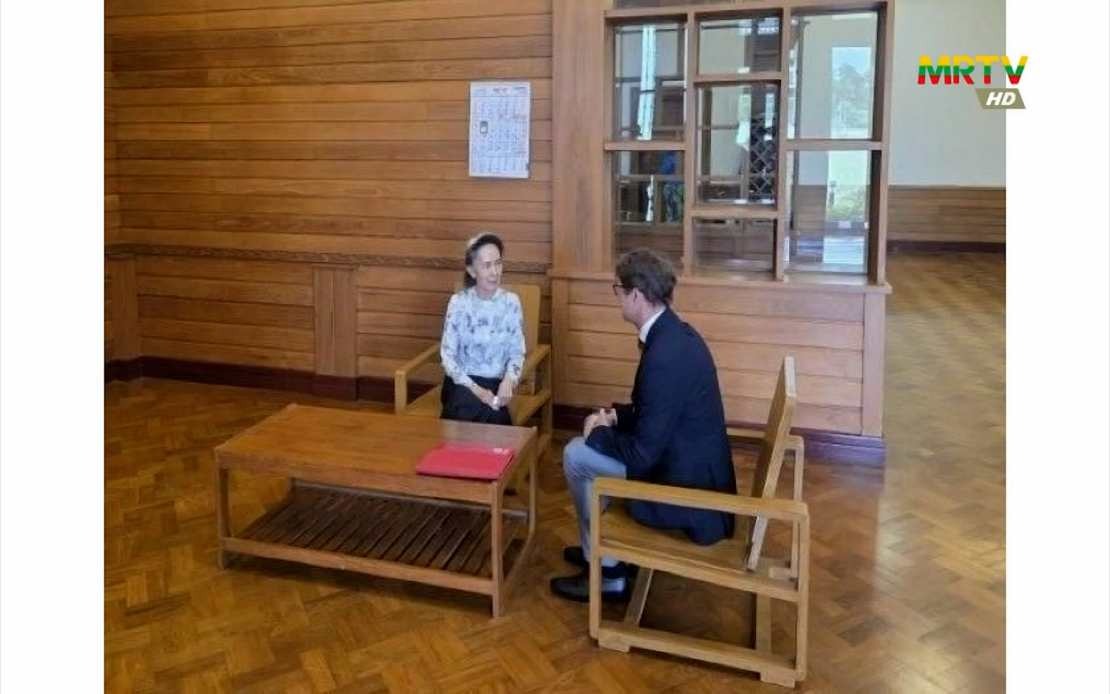
Myanmar's military government announced Monday that Aung San Suu Kyi, the nation's ousted civilian leader, has been permitted to meet with an official from the International Committee of the Red Cross, marking a significant moment in the prolonged detention of one of Asia's most prominent political figures. Government spokeswoman Khine Khine Soe disclosed the encounter between the 81-year-old Nobel Peace Prize winner and Arnaud de Baecque, the ICRC's Resident Representative to Myanmar, occurred in the capital Naypyitaw. The announcement arrives as neighbouring countries and international observers intensify diplomatic pressure on Myanmar's military-dominated administration to provide transparent confirmation regarding Suu Kyi's health and conditions of confinement.
Suu Kyi has remained under state custody continuously since February 2021, when the Myanmar military dismantled an elected civilian government led by her National League for Democracy party in a dawn coup that fundamentally destabilized the impoverished Southeast Asian nation. The intervention halted a decade of tentative democratic progress and triggered widespread civil unrest, armed resistance movements, and humanitarian deterioration across Myanmar's regions. Throughout the past three-and-a-half years, her precise location and physical condition have remained opaque to the outside world, with no foreign dignitaries or international envoys publicly documented as having visited her until this Monday's Red Cross meeting.
The Myanmar government released four photographs purporting to document the encounter, presenting what officials characterize as evidence of Suu Kyi's continued presence and reasonable treatment. Two images depict her conversing with de Baecque inside a minimally furnished room featuring wooden panelling, two chairs, and a desk. A third photograph, described as offering a rare interior view of her residential space, shows Suu Kyi cutting a birthday cake bearing her name, with clothing racks and storage containers visible behind her. The fourth image is a detailed shot of the cake itself, inscribed with "Happy Birthday Aunty Suu 19.6.2026". However, Reuters could not independently verify either the authenticity, location, or precise timing of these images, noting that no earlier versions appeared in online circulation before the government's Monday disclosure.
Suu Kyi's legal predicament remains extraordinarily severe. Following a series of closed-door trials conducted after the coup, she was initially convicted and sentenced to 33 years imprisonment on charges encompassing corruption, election fraud incitement, and violations of state secrecy legislation. The sentencing process generated substantial international criticism, with her political allies and international observers characterizing the proceedings as transparently designed to eliminate her as a political force and neutralize her influence within Myanmar's 51 million-person population, where she remains arguably the nation's most beloved political personality. Subsequent reductions have progressively shortened her sentence—first to 27 years, then reduced by one-sixth in April—leaving her with an officially stated 18 years remaining to serve according to information provided by members of her legal defence team.
The absence of verifiable information regarding Suu Kyi's wellbeing has generated acute anxiety among her family members and international advocates. Her son, Kim Aris, disclosed to Reuters in December that he possesses minimal reliable knowledge concerning his mother's health status, receiving only irregular and secondhand reports of her experiencing heart, bone, and dental problems. He emphasized the profound distress of having received no direct communication from his mother over multiple years, coupled with deep fear that she might suffer serious decline or death without his awareness. His testimony underscores the deliberate isolation strategy that Myanmar's authorities have maintained against the detained leader, systematically preventing independent international verification despite repeated assurances from the military government regarding her purported good health.
Myanmar's successive military-led administrations have issued recurring public declarations insisting upon Suu Kyi's continued good health, yet these claims have received increasing scepticism from regional governments and international human rights organizations. In late April, following a military-orchestrated election process that returned former junta chief Min Aung Hlaing to the presidency, Myanmar authorities announced that Suu Kyi had been relocated to house arrest status, suggesting modified detention conditions yet maintaining her confinement outside normal legal processes. Thailand's Foreign Minister Sihasak Phuangketkeow articulated the emerging consensus among Southeast Asian neighbours during post-election ASEAN diplomatic meetings in Bangkok last month, explicitly requesting that Myanmar authorities permit international access to Suu Kyi "so that we can be able to verify the claims" regarding her health status. This diplomatic language reflects deepening frustration within the regional bloc regarding Myanmar's opacity and resistance to transparent international monitoring.
The military government's consistent refusal to facilitate independent international access has frustrated diplomatic initiatives within ASEAN and beyond. In May, the Philippines formally requested that Myanmar permit an ASEAN special envoy to meet directly with Suu Kyi, a request that Myanmar's authorities rebuffed without providing substantive justification. This pattern of resistance contrasts sharply with international humanitarian protocols and regional diplomatic norms, particularly given ASEAN's espoused commitment to addressing Myanmar's political crisis through constructive engagement and dialogue. The May rejection suggested that the military government regards even limited international scrutiny of Suu Kyi's situation as potentially destabilizing to its political legitimacy and control.
Suu Kyi's political trajectory and symbolic importance within Myanmar's contemporary history cannot be disconnected from her family's foundational role in the nation's independence struggle. She is the daughter of General Aung San, revered as Myanmar's independence hero and founding statesman, whose assassination in 1947 marked a tragic turning point in the nation's post-colonial development. This familial connection to national liberation movements has amplified her popular resonance and generated intense loyalty among Myanmar's democratic constituencies. During a preceding era of military dictatorship, she endured fifteen years of cumulative house arrest at her residence on Yangon's Inya Lake, where she delivered celebrated speeches to gathered supporters from behind the property's metal gates—acts of defiance that crystallized her international reputation as a fearless democratic advocate.
The Monday meeting with the Red Cross representative, while potentially significant as a demonstration of some international access, leaves numerous critical questions unresolved regarding the substance and authenticity of Suu Kyi's current circumstances. The tightly controlled nature of the encounter, the government's exclusive distribution of photographic documentation, and the absence of independent verification mechanisms all suggest that Myanmar's authorities have orchestrated a carefully managed publicity exercise rather than genuinely opening substantive international humanitarian access. The timing of the announcement, coinciding with intensified regional diplomatic pressure, indicates that the military government recognizes the diplomatic costs of maintaining complete isolation yet remains unwilling to permit the unfettered international scrutiny that would satisfy regional partners' legitimate concerns regarding Suu Kyi's treatment and wellbeing.
For Malaysia and other ASEAN member states, Suu Kyi's continued detention and the military government's resistance to transparent international verification represent a persistent challenge to regional stability and the bloc's collective credibility regarding human rights and democratic governance. The situation reflects broader anxieties about Myanmar's trajectory following the 2021 coup, including the military's consolidation of authoritarian control, the deterioration of humanitarian conditions, and the emergence of armed resistance movements that have further fractured Myanmar's territorial integrity. The Red Cross meeting, while potentially meaningful as a modest acknowledgment of humanitarian access principles, falls short of the comprehensive international monitoring and transparent verification mechanisms that regional governments and human rights organizations have repeatedly demanded as essential foundations for credible assurances regarding Suu Kyi's wellbeing and treatment.

