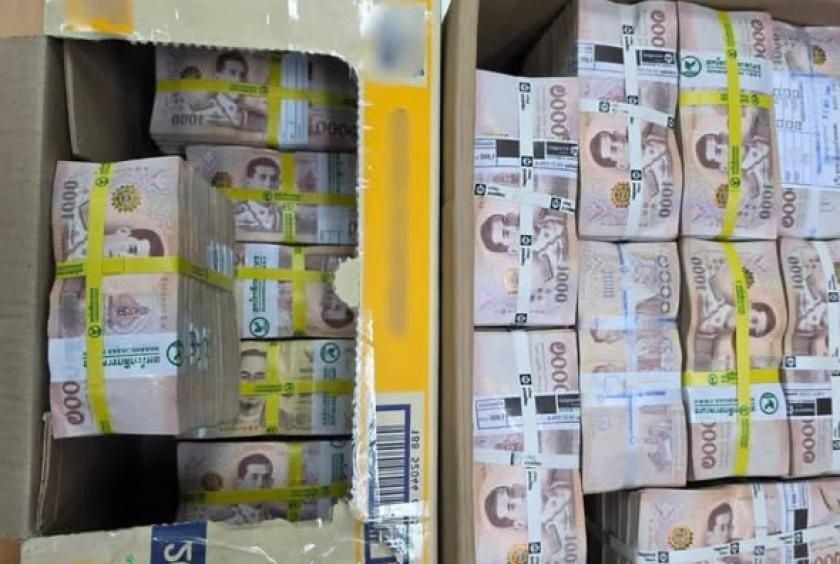
Thai customs officials have detained a 31-year-old Myanmar national suspected of attempting to illegally export over 23 million baht through the Mae Sai border checkpoint on the Thai-Myanmar Friendship Bridge. The arrest marks another significant interception in what remains a persistent challenge for regional authorities monitoring cross-border financial flows in Southeast Asia.
The incident occurred when Thai customs officers stationed at the Mae Sai crossing routinely inspected a private vehicle displaying Myanmar licence plates as it traversed the Friendship Bridge. During this inspection, officials discovered an elaborate concealment scheme involving stacks of Thai currency carefully hidden within ordinary food packaging. The method demonstrates the ingenuity increasingly employed by smugglers attempting to move money across international borders undetected.
Inside two cartons ostensibly containing dried fish and potatoes, authorities uncovered bundles of 1,000-baht banknotes wrapped in plastic bags. The first carton contained approximately 17 million baht, while the second held 6.023 million baht, totalling 23.023 million baht in seized currency. The meticulous packing suggested a level of planning and organisation typical of larger smuggling networks rather than an amateur operation.
The discovery highlights vulnerabilities at one of Southeast Asia's busiest land crossings. The Mae Sai checkpoint, situated on the critical commercial corridor between Thailand and Myanmar, processes thousands of vehicles daily. While Thai customs has demonstrated capability in detecting this particular shipment, the sheer volume of traffic and goods crossing the border daily creates numerous opportunities for determined smugglers to attempt illicit transfers.
According to Thai authorities, the alleged offence violates multiple legal frameworks governing international commerce and financial transfers. The suspect faces charges under Thailand's Customs Act, which comprehensively regulates goods movement across borders, as well as regulations specifically designed to control foreign exchange transactions. Thailand maintains strict protocols regarding the movement of its currency across international boundaries, partly to prevent currency manipulation and maintain monetary policy stability.
The 23 million baht seizure, equivalent to approximately US$689,077, represents a substantial quantity of currency. For context, this amount would enable significant illicit financial transactions, whether funding irregular business operations, facilitating money laundering schemes, or supporting other cross-border illicit activities. The scale of the interception underscores why Thai authorities treat such cases seriously, viewing them not merely as customs violations but as potential indicators of larger criminal networks.
Investigations into the arrested driver continue, with Thai authorities actively seeking to identify accomplices and determine the ultimate destination and purpose of the smuggled funds. Typically, such operations involve multiple parties across the supply chain—individuals arranging the transport, those securing the currency, and recipients awaiting delivery on the Myanmar side. Understanding these networks remains crucial for disrupting organised smuggling operations and addressing underlying demand for illicit currency movement.
For Malaysian readers and broader Southeast Asian observers, this incident illustrates persistent challenges in financial compliance and border security across the region. The sophistication of smuggling methods, combined with substantial sums involved, indicates that illicit financial flows represent an ongoing concern affecting multiple countries. Malaysia itself has confronted similar issues at its borders, particularly concerning cross-border movement of ringgit and enforcement of anti-money laundering regulations.
The case also reflects broader tensions in Myanmar-Thailand relations and commercial activity between the two nations. While legitimate trade remains vibrant, the country's ongoing political instability has created conditions conducive to various forms of smuggling. Some analysts suggest that illicit financial flows from Myanmar have increased as legitimate economic activity has become more restricted, pushing certain transactions underground.
Thai authorities have been methodical in processing this case, detaining the suspect at Mae Sai Police Station while building their investigation. This procedural approach suggests confidence in their evidence and commitment to pursuing charges comprehensively. Regional cooperation will likely prove essential, particularly if Thai investigators determine that networks extend into Myanmar or involve third countries within ASEAN.
As Southeast Asian nations increasingly prioritise financial integrity and money laundering prevention, cases like this reveal both the effectiveness of frontline officers and the ongoing cat-and-mouse dynamic between enforcement agencies and sophisticated criminal networks. The ability to detect 23 million baht hidden in food cartons demonstrates competent inspection protocols, yet authorities acknowledge that this single interception likely represents only a fraction of attempted smuggling across the region's porous borders.
The incident carries implications for Thailand's efforts to strengthen its financial regulatory framework and enhance cross-border cooperation. Enhanced intelligence sharing between ASEAN members, improved detection technology at major crossing points, and coordinated investigation protocols could collectively reduce incentives for would-be smugglers. For now, this Myanmar driver faces serious legal consequences as Thai authorities unravel the connections behind this particular smuggling attempt.

