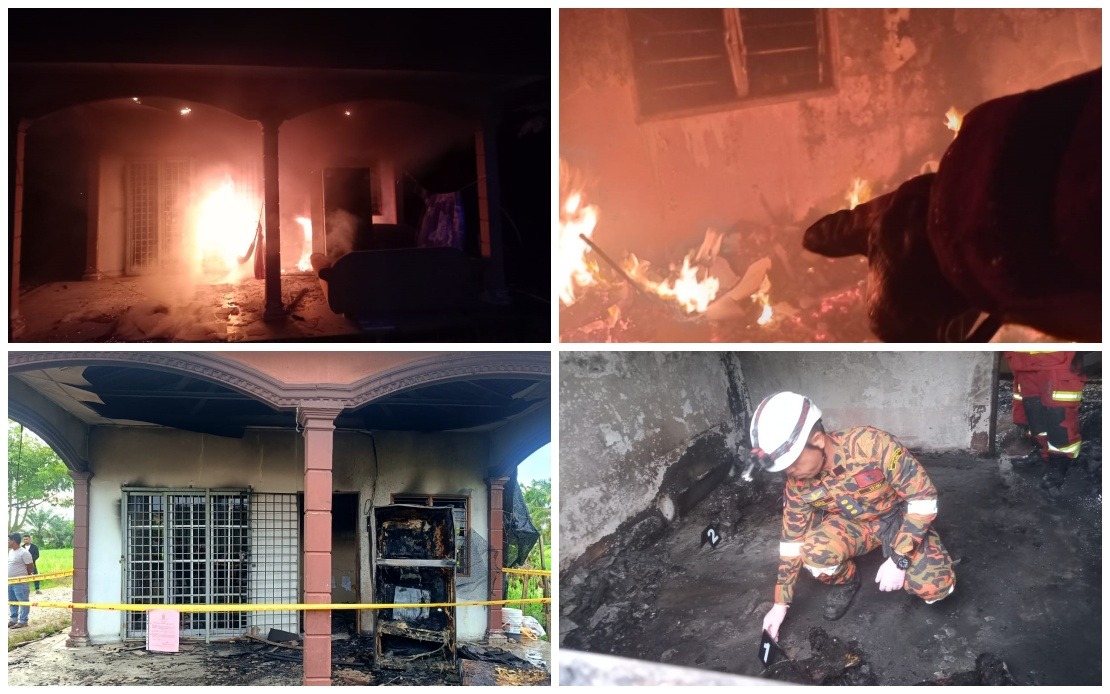
A tragic fire claimed the lives of three members of a Myanmar refugee family in the early hours of Thursday in Perak's Bagan Serai district, leaving the household's surviving members grieving and injured. The incident unfolded at Taman Serai Maju when emergency responders were alerted to the blaze at 5.17 am, arriving at the residential property eight minutes later to discover a Class A dwelling measuring 20 feet by 40 feet already engulfed in flames. The home, which sheltered seven foreign nationals, sustained approximately 70 per cent structural and material damage from the inferno.
The three fatalities have been identified as Mohd Yunus Nor Ali, a 27-year-old man, alongside his two young sons Muhammad Woheed Mohd Yunus aged six and Mohamad Aheed Mohd Yunus aged three. Their wife and mother, Saniya Jahan Juma Abul Kasim, 24, managed to escape the burning structure but not without injury, sustaining burns to her hands and feet that required immediate medical intervention. She was subsequently transported to hospital for ongoing treatment of her injuries sustained during the traumatic evacuation from the property.
According to Datuk Sayani Saidon, director of the Perak Fire and Rescue Department, the family's matriarch was discovered outside the residence when firefighters arrived and informed rescue teams that her husband and two children remained trapped within the premises. This critical information prompted the deployment of search and rescue operations employing established protocols known as the RECEO concept. The rescue team methodically searched the burning structure, ultimately locating the three victims in the first room where the fire had originated, though by that time they had succumbed to the effects of the intense heat and smoke.
Medical personnel from the Ministry of Health who attended the scene officially pronounced all three victims deceased, confirming the worst fears of the surviving family members. The emergency response was comprehensive, with the flames brought under control by 6.20 am and the full operation concluded by 7.35 am, though by then the grim nature of the tragedy had become evident. The bodies of the deceased have been transferred to Royal Malaysia Police custody pending investigation and procedures standard to such incidents, while the injured survivor received emergency medical attention and subsequent hospitalisation.
Investigative work by the Perak Fire and Rescue Department's forensic team has preliminarily established that the fire originated in the first room of the residence, the same location where the three victims were subsequently discovered. However, the precise cause of the ignition remains undetermined as of the incident report, with comprehensive investigations continuing at the scene. Fire officials have cautioned that determining the exact cause and finalising damage assessments will require thorough forensic examination and reconstruction of events preceding the blaze.
The tragedy highlights the precarious living conditions faced by many Myanmar refugee communities across Malaysia, who frequently reside in densely occupied accommodation that may lack adequate fire safety infrastructure and emergency egress routes. The composition of the household—seven individuals sharing a single residential unit—represents a typical arrangement among displaced persons seeking affordable shelter. Such overcrowded conditions dramatically reduce the ability of residents to evacuate safely during emergencies and increase vulnerability to rapid fire spread.
The Rohingya refugee population in Malaysia has grown substantially over recent years, with tens of thousands of individuals fleeing persecution in Myanmar seeking refuge in Southeast Asia. Many settle in urban and suburban areas across Peninsular Malaysia, including Perak, where they establish communities while navigating significant socioeconomic challenges. Housing accessibility remains a critical issue, with refugee families often occupying substandard properties where fire safety measures, proper electrical installations, and emergency preparedness protocols may be inadequate or entirely absent.
This incident adds to a concerning pattern of fire-related disasters affecting vulnerable populations in Malaysia. The combination of crowded living spaces, potentially faulty electrical systems, cooking apparatus proximity, and limited safety awareness creates dangerous environments where preventative measures are often overlooked. Families living in informal or informal-adjacent housing arrangements typically lack the resources to implement comprehensive fire prevention systems or to access fire safety education that might reduce the risk of tragedy.
The loss of three family members—a young father and two children not yet in primary school—represents an immeasurable human cost beyond the property damage quantified by firefighters. The surviving mother will likely face extended recovery, both physical and psychological, as she processes the sudden and violent loss of her nuclear family unit. Such personal tragedies ripple through refugee communities already fragmented by displacement and loss, compounding collective trauma and grief.
Authorities have not yet indicated whether dwelling safety inspections will be expanded across refugee settlements in the region or whether fire safety awareness campaigns targeting displaced populations will be implemented as preventative measures. Such proactive initiatives could significantly reduce vulnerability to similar incidents. The investigation's conclusions, once finalised, may provide crucial insights into whether this tragedy resulted from individual negligence, structural deficiencies, or systemic inadequacies in how housing occupied by foreign nationals is regulated and monitored.
The incident underscores the urgent need for comprehensive approaches addressing the intersection of refugee vulnerability, housing security, and fire safety in Malaysia. Beyond emergency response excellence—which Perak's firefighting personnel clearly demonstrated—prevention through infrastructure improvement, safety education, and regulatory oversight remains critical. Malaysian authorities and humanitarian organisations serving displaced populations would benefit from reviewing current protocols to prevent future losses of life among communities already bearing substantial burdens of displacement and loss.

