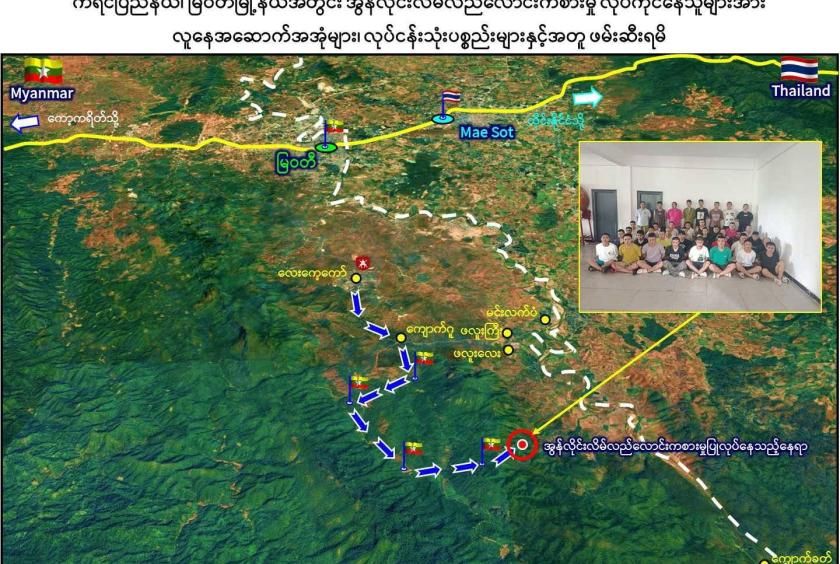
Myanmar's military and security forces have conducted one of the country's largest crackdowns against organised online fraud, detaining 777 individuals allegedly operating elaborate scam compounds in the Kyauk Khat area of Myawaddy Township in Kayin State. The operation underscores the scale of cybercriminal activity flourishing in border regions and the government's determination to address what has become a persistent regional security challenge affecting multiple nations across Southeast Asia.
The arrested individuals comprised a striking international composition that reflects the transnational nature of modern online fraud operations. Among those taken into custody were 631 Chinese nationals, whose presence in Myanmar's borderlands suggests the operation functioned as a hub for scams likely targeting audiences across China, Taiwan, and other East Asian markets. Three Thai nationals and 143 Myanmar citizens rounded out the detained group, indicating local involvement in orchestrating and supporting these criminal networks. The diversity of nationalities hints at an organised ecosystem where foreign expertise, capital, and logistics work in tandem with local knowledge and resources to sustain fraudulent activities.
The technological sophistication revealed through seized equipment demonstrates how organised these operations have become. Security forces confiscated a Starlink satellite terminal, suggesting the scam operators had invested in advanced infrastructure to maintain reliable internet connectivity in a border region where conventional telecommunications infrastructure may be unreliable or monitored. The 85 computers and 183 mobile phones discovered indicate a sprawling call centre-style operation capable of managing thousands of victim interactions simultaneously. Such infrastructure investments point to substantial funding mechanisms behind these criminal enterprises, likely generated through previous successful fraud campaigns or underwritten by larger criminal syndicates.
Authorities attributed the raid's success to intelligence gathering operations that had been monitoring the illegal compounds over time. Rather than a sudden discovery, the operation represents the culmination of surveillance and investigation work by Myanmar's security apparatus, possibly coordinated with intelligence from neighbouring countries concerned about scam networks targeting their own citizens. This methodical approach suggests growing sophistication in law enforcement responses to cybercrime, though sceptics question whether enforcement efforts can keep pace with the rapid evolution and relocation of these networks.
The raid's execution encountered armed resistance that complicated the operation and raised serious questions about the protection infrastructure surrounding these scam hubs. Myanmar authorities alleged that members of the Karen National Liberation Army (KNLA) and the People's Defence Force (PDF) were actively protecting the illegal compounds in exchange for financial compensation. This allegation, if verified, reveals how insurgent groups operating in Myanmar's border zones have diversified their funding sources beyond traditional taxation and poppy cultivation. The involvement of armed organisations transforms what might otherwise be a straightforward law enforcement matter into a complex security problem intersecting organised crime, regional autonomy movements, and state control.
The firefight that erupted during the raid resulted in 13 armed group members killed, indicating the military commitment to executing the operation despite active resistance. The confiscation of nine firearms, ammunition supplies, fortified bunkers, and military equipment from the opposition forces demonstrates that these scam compounds were defended with significant firepower. The loss of life during the raid underscores the stakes involved when law enforcement confronts criminal enterprises protected by militarised groups with their own military capabilities and organisational discipline.
The confiscated equipment will be processed according to Myanmar's legal framework, though questions remain about the country's capacity to systematically investigate and prosecute such large numbers of detainees. The 777 arrested individuals face prosecution under existing Myanmar laws governing fraud and illegal gambling. International observers will monitor whether Myanmar conducts thorough investigations into the operations' scale, targets, and funding sources, or whether logistical constraints and resource limitations result in rushed prosecutions of lower-level operators while masterminds escape accountability.
This raid carries particular significance for Southeast Asia, as several nations in the region have become primary targets and havens for online scam networks. Thailand, Cambodia, and Laos have all experienced similar problems with organised fraud operations targeting their populations and those of neighbouring countries. Myanmar's geographic position as a crossroads between South Asia, Southeast Asia, and East Asia makes it an attractive location for scammers seeking refuge from more intensely policed jurisdictions. The porous borders and competing authorities in border regions create enforcement gaps that transnational criminals exploit effectively.
Myanmar's stated commitment to international cooperation on dismantling these networks signals recognition that cybercrime transcends borders and requires coordinated responses. However, implementing meaningful cross-border law enforcement remains difficult given Myanmar's international isolation and strained relationships with many neighbouring governments. The military government's credibility on human rights issues also complicates international partnerships and intelligence sharing. Neighbouring countries may harbour reservations about collaborating with Myanmar authorities, particularly regarding handling of detainees and transparency of investigations.
The existence and apparent profitability of such large scam operations raises questions about victim response mechanisms and public awareness. Millions of individuals across Asia have likely fallen victim to fraud schemes originating from operations like the one dismantled in Myawaddy. Without coordinated victim assistance programmes and public education campaigns, the financial and psychological damage to fraud victims remains largely unaddressed. Regional governments have invested less energy in victim support than in law enforcement operations, leaving survivors to navigate recovery individually and often unsuccessfully.
Looking forward, this raid represents both a significant enforcement success and an indication of how deeply entrenched organised cybercrime has become in Myanmar's borderlands. Unless authorities address the underlying economic incentives—including poverty, conflict-driven instability, and limited legitimate economic opportunities in border regions—scam operations are likely to reconstitute rather than disappear. Criminologists studying transnational organised crime note that disrupting individual operations without eliminating enabling conditions typically results in network reorganisation rather than permanent dismantling. Myanmar's security forces may have won a tactical victory, but the broader strategic challenge of combating sophisticated transnational fraud networks remains formidable and ongoing.

